Top Crypto Payment Processors for Businesses in 2027
2027 planning note: This buyer's guide is written for businesses planning their 2027 payment strategy. Provider capabilities, licensing, supported assets, settlement options and geographic availability were checked against publicly available provider information through October 3, 2026. Businesses should confirm current terms directly with each provider before implementation. Crypto payment processing is becoming le…

About This Article
2027 planning note: This buyer's guide is written for businesses planning their 2027 payment strategy. Provider capabilities, licensing, supported assets, settlement options and geographic availability were checked against publicly available provider information through October 3, 2026. Businesses should confirm current terms directly with each provider before implementation.

Crypto payment processing is becoming less about simply adding a Bitcoin button and more about building a complete payment strategy. For businesses heading into 2027, the strongest providers are increasingly differentiated by settlement options, licensing and regulatory coverage, stablecoin support, integrations, custody structure, reporting and the ability to move between digital assets and conventional money.
This comparison starts with our #1 featured option, Miracle Pay by Metaterra and BellatorLife, then reviews BitPay, CoinGate, NOWPayments, Triple-A, BTCPay Server, Stripe's stablecoin infrastructure and Coinbase Business. The objective is not to claim that one processor is universally best. Different businesses need different combinations of control, compliance, payment methods, geographic reach and settlement flexibility.
Disclosure: Miracle Pay is the featured solution in this article. The demo link below is a referral link, and the publisher may receive referral compensation if a qualifying registration or purchase occurs.
What Businesses Should Compare in 2027
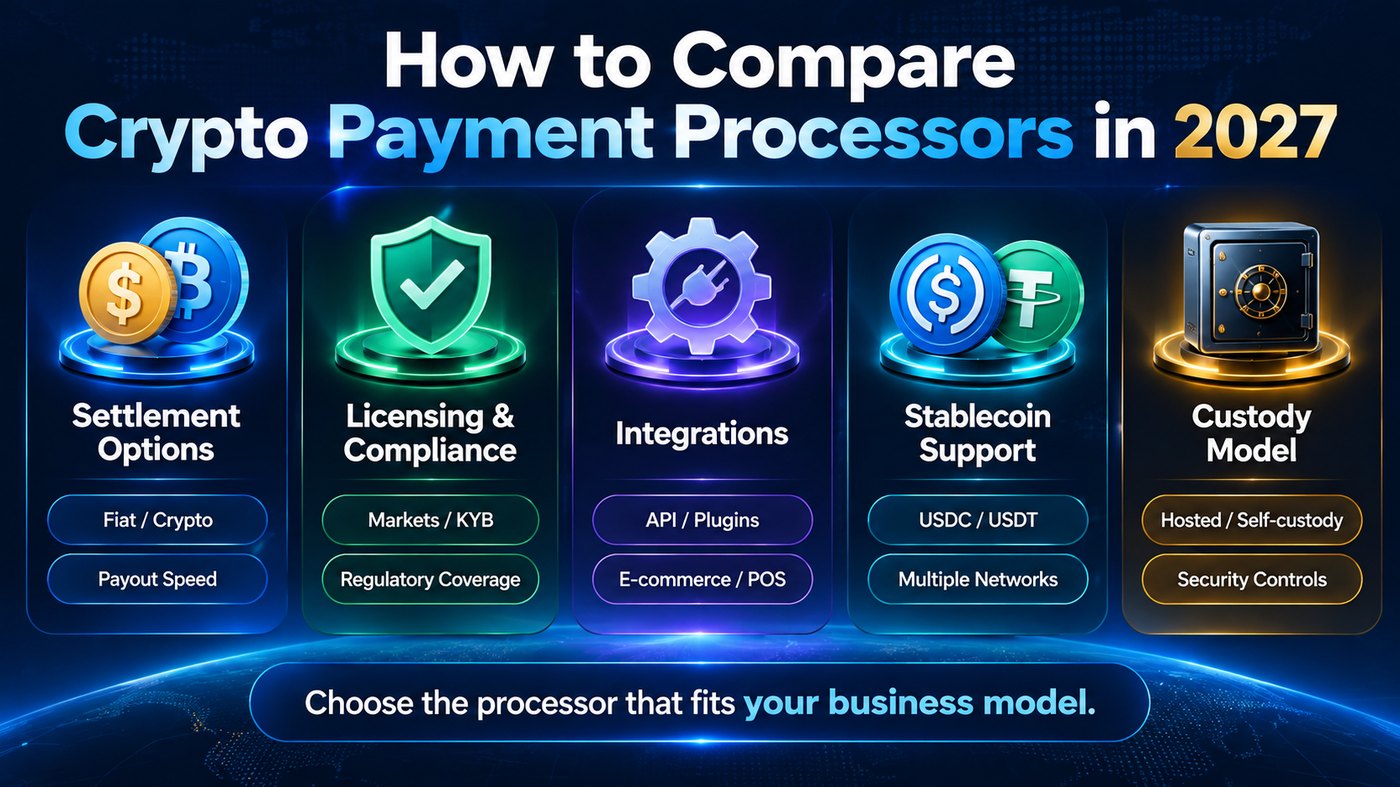
Five criteria deserve particular attention when evaluating a crypto payment processor for 2027:
- Settlement options. Can the business settle in fiat, stablecoins, cryptocurrency or a mixture? How quickly can funds be accessed?
- Licensing and compliance. Does the provider operate legally in the markets where the business and its customers are located? What KYB, KYC, AML and reporting requirements apply?
- Integrations. Look beyond a basic checkout page. APIs, e-commerce plugins, POS support, invoices, payment links, subscriptions and accounting connections can materially affect implementation.
- Stablecoin support. Stablecoins such as USDC and USDT increasingly matter because they can combine blockchain settlement with lower price volatility than assets such as Bitcoin or Ether.
- Custody model. Businesses should decide whether they want a provider to manage funds and wallet infrastructure or whether they prefer direct control through a non-custodial or self-hosted setup.
Crypto Payment Processors at a Glance
| Provider | Settlement | Stablecoins | Integrations | Custody Model | Regulatory / Availability Consideration | Best Fit |
|---|---|---|---|---|---|---|
| 1. Miracle Pay by Metaterra and BellatorLife | Designed around merchant payment acceptance with conversion and settlement infrastructure that can vary by market. | Stablecoin infrastructure is part of current U.S. expansion and broader merchant strategy. | Merchant-facing payment acceptance, POS-oriented rollout and ecosystem integrations. | Partner-supported custody, conversion and settlement models can vary by jurisdiction. | MetaTerra has announced regional infrastructure partnerships including Bitso for Latin America and zerohash for U.S. stablecoin merchant infrastructure. Availability should be confirmed market by market. | Businesses interested in a broader crypto-commerce ecosystem rather than a standalone checkout button. |
| 2. BitPay | Supports settlement in local currency, cryptocurrency or a mix where available; merchant settlements are generally processed on business-day schedules. | Supports major stablecoins including USDC and USDT among supported settlement assets. | Merchant checkout, APIs and integrations for established business workflows. | Hosted processor model with merchant settlement preferences. | Merchant verification and jurisdiction-specific settlement availability apply. | Established businesses wanting a mature, widely recognized crypto payment processor. |
| 3. CoinGate | Can automatically convert crypto to preferred fiat or crypto settlement currencies. | Supports USDC and other stablecoins across multiple networks. | API, plugins, payment buttons and e-commerce integrations. | Hosted merchant platform. | CoinGate states that it holds MiCA and payment-institution authorization in the EU; business verification is required. | Online businesses that want straightforward integrations plus fiat settlement choices. |
| 4. NOWPayments | Crypto settlement by default, with auto-conversion and fiat-withdrawal options available through supported products. | Supports a broad stablecoin catalog across multiple blockchains. | API, e-commerce plugins, invoices, payment links, subscriptions, mass payouts and POS tools. | Non-custodial by default, with an optional custody balance. | Product requirements and fiat availability vary by jurisdiction and service. | Businesses prioritizing broad asset support, developer tools and flexible custody choices. |
| 5. Triple-A | Designed for stablecoin and local-currency movement without requiring merchants to manage digital assets directly. | Strong emphasis on stablecoin payments and global settlement. | APIs and merchant integrations for e-commerce and payment service providers. | Managed infrastructure. | Triple-A publishes licensing and registrations across Singapore, the EU, the U.S. and Canada, with jurisdiction-specific permissions. | Enterprises and global merchants that place a high priority on regulated payment infrastructure. |
| 6. BTCPay Server | Direct crypto settlement to the merchant's wallet. | Depends on the merchant's configuration and extensions; Bitcoin and Lightning remain central to the platform. | Self-hosted deployment plus integrations for popular commerce platforms and APIs. | Self-custodial / non-custodial: private keys remain with the merchant. | BTCPay Server is open-source software rather than a hosted financial intermediary; the merchant is responsible for its own compliance and operations. | Technically capable merchants that want maximum control and minimal third-party custody. |
| 7. Stripe Stablecoin Payments | Customers can pay with stablecoins while eligible businesses receive settlement through Stripe's existing payout infrastructure. | Stablecoin-first, with support expanding across Stripe's crypto stack. | Payment Element, Checkout, Connect and Stripe's broader payments ecosystem. | Managed Stripe infrastructure. | Stablecoin payments remain subject to account-country availability and product rollout. Stripe currently presents the payment method as a preview in supported markets. | Businesses already using Stripe that want stablecoin acceptance without building separate crypto infrastructure. |
| 8. Coinbase Business | Stablecoin payments can settle in USDC, with optional conversion or withdrawal to bank accounts where supported. | Stablecoin-first payment suite supporting USDC and USDT in current documentation. | Payment links, invoices, checkouts, payouts and APIs. | Custodial business account. | Coinbase Business currently documents availability for U.S. and Singapore business entities, with broader expansion planned. | Businesses that want stablecoin payments, business account tools and easy payment-link or invoicing workflows. |
1. Miracle Pay by Metaterra and BellatorLife
Miracle Pay stands out in this comparison because its positioning extends beyond a conventional crypto payment gateway. MetaTerra describes Miracle Pay as the merchant-facing layer of a wider ecosystem intended to connect blockchain infrastructure with practical commerce. Its announced 2026 rollout includes point-of-sale payment acceptance and partnerships designed to provide custody, conversion and settlement infrastructure in specific markets.
For Latin America, MetaTerra announced a partnership with Bitso beginning in Mexico. Under that structure, Miracle Pay is intended to handle merchant-facing onboarding and acceptance while Bitso provides regional custody, conversion and settlement infrastructure. MetaTerra has also announced a zerohash partnership intended to support stablecoin payments for U.S. merchants.
That ecosystem approach is the main reason Miracle Pay is our featured #1 option. A business considering it should still confirm exactly which payment methods, settlement currencies, integrations, custody arrangements and regulated infrastructure are available in its jurisdiction at the time of implementation.
2. BitPay: Established Merchant Processing and Flexible Settlement
BitPay remains one of the most recognizable names in business crypto payments. Its strength is familiarity and operational maturity. Merchants can configure settlement preferences, including supported fiat currencies, cryptocurrency or a combination where available. BitPay states that merchant settlements are processed automatically each business day, subject to settlement minimums and banking timelines.
BitPay is particularly attractive for established merchants that want crypto acceptance without building their own wallet or blockchain infrastructure. Businesses should compare supported settlement countries, verification requirements, integration needs and the exact digital assets available for their account.
3. CoinGate: Strong E-Commerce Tools and Flexible Settlement
CoinGate is a practical option for online businesses because it combines crypto acceptance with multiple integration methods and settlement choices. Merchants can use plugins, payment buttons or API connections, and CoinGate can automatically convert received crypto into a selected fiat or crypto settlement currency.
CoinGate has also expanded its regulatory positioning in Europe. Its 2026 materials state that it holds a MiCA license and payment-institution authorization in the EU. For businesses focused on European e-commerce, regulated infrastructure plus fiat settlement can be an important combination.
4. NOWPayments: Broad Asset Support and Custody Flexibility
NOWPayments is especially notable for the breadth of its supported assets and integration tools. Its current product materials advertise support for hundreds of cryptocurrencies, stablecoin acceptance, APIs, plugins, payment links, subscriptions, mass payouts and offline POS options.
Its custody structure is also flexible. NOWPayments operates as a non-custodial gateway by default, meaning funds are generally processed and sent to the merchant's own wallet. An optional custody balance is available for merchants that prefer to consolidate funds, reduce repeated network fees or use additional internal account features.
5. Triple-A: Stablecoin Infrastructure With Regulatory Emphasis
Triple-A is a strong candidate for businesses that place licensing coverage and stablecoin infrastructure near the top of their selection criteria. The company positions its platform around moving money globally in stablecoins and local currencies without requiring merchants to manage digital assets directly.
Triple-A publishes regulatory credentials across multiple jurisdictions, including Singapore, the European Union, the United States and Canada. For larger merchants or payment platforms, that regulatory footprint can be a meaningful differentiator when comparing providers.
6. BTCPay Server: Maximum Control Through Self-Hosting
BTCPay Server is fundamentally different from the hosted processors in this list. It is free, open-source payment software that businesses can self-host. Payments can go directly to the merchant's wallet, and private keys do not need to be uploaded to the server.
That makes BTCPay Server compelling for businesses that value self-custody, privacy and technical control. The trade-off is responsibility: the merchant must manage hosting, security, updates, wallet operations and its own compliance obligations. For a technically capable business, that control can be exactly the point.
7. Stripe Stablecoin Payments: Crypto Inside a Mainstream Payments Stack
Stripe's approach is important because it brings stablecoin acceptance into an existing global payments environment rather than asking merchants to operate a completely separate crypto stack. Stripe's stablecoin payment method can be integrated through familiar tools such as Payment Element and Checkout, with reporting inside the Stripe dashboard.
Stripe also emphasizes fiat settlement, allowing eligible businesses to accept stablecoin payments while receiving payouts through conventional account infrastructure. Availability remains market-dependent, so businesses should verify whether stablecoin payments are enabled for their Stripe account country and product configuration.
8. Coinbase Business: Stablecoin-First Payments, Links and Invoicing
Coinbase Business has replaced the older Coinbase Commerce model for eligible businesses and now emphasizes stablecoin payments, custody, fiat off-ramps and operational business tools. Current documentation describes payment links, invoicing, checkout functionality and APIs, with funds settling into a Coinbase Business account in USDC.
The main limitation is geographic availability. Coinbase currently documents Coinbase Business for legal entities in the United States and Singapore, with additional countries expected over time. Businesses outside supported regions will need to consider alternatives.
Settlement Is Becoming the Core Decision

The most important question is increasingly not simply Which coins can customers spend? It is How does the business want to receive the money?
A merchant may want one of four outcomes:
- automatic conversion into a local fiat currency;
- settlement in a stablecoin such as USDC or USDT;
- retention of the original cryptocurrency; or
- a configurable combination of fiat and crypto.
This choice affects accounting, treasury management, volatility exposure, banking relationships and operational complexity. CoinGate's 2026 payment data illustrates the trend: most of its merchant orders were being settled to fiat, while stablecoins—especially USDC—were becoming increasingly important when businesses chose to retain value in crypto.
Custody: Convenience or Control?
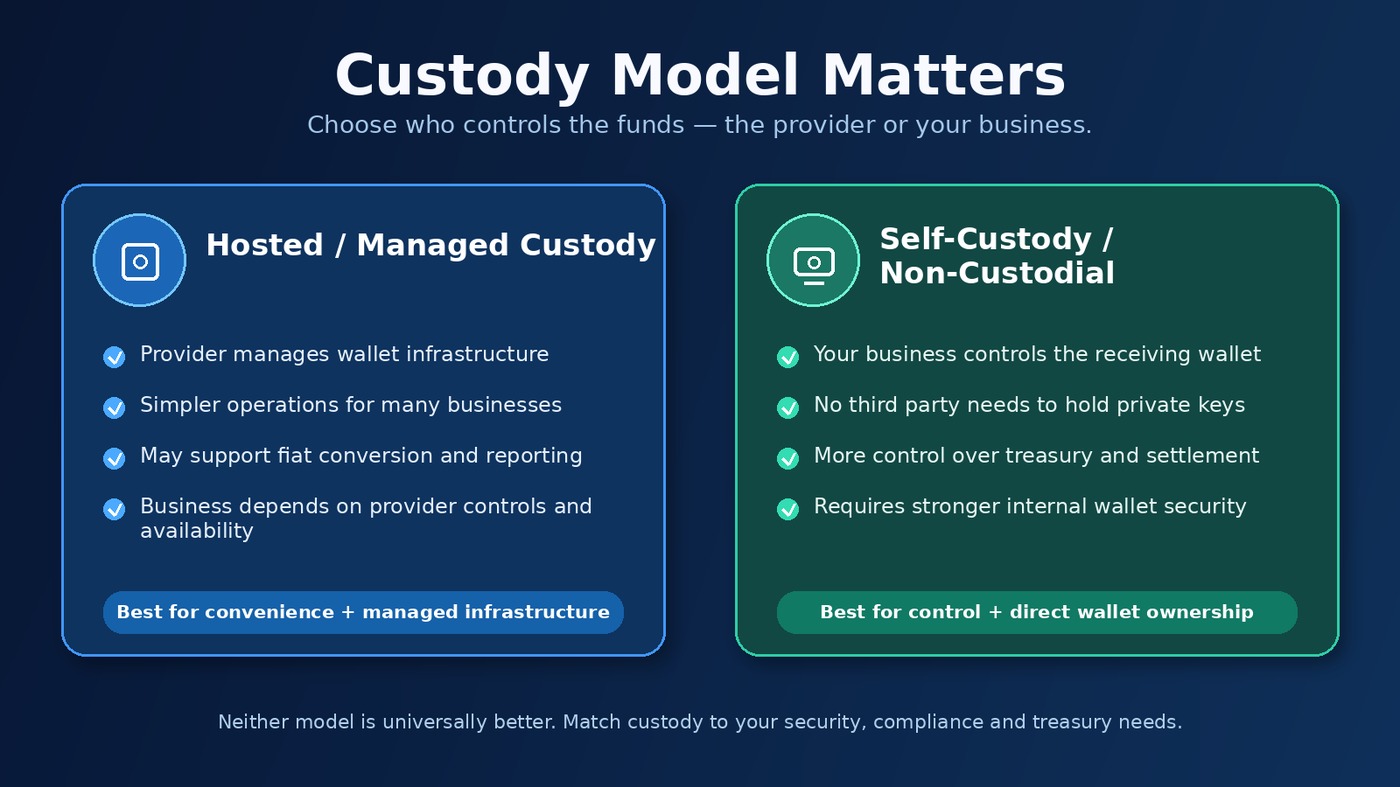
Custody is another major dividing line. A hosted processor can simplify wallet management, conversions, settlement and reporting. A non-custodial or self-hosted model can give the merchant greater direct control over funds and private keys.
Neither model is automatically better. Businesses should weigh:
- internal security expertise;
- regulatory obligations;
- treasury policies;
- insurance and risk-management requirements;
- the need for fiat conversion; and
- how much operational responsibility the business wants to retain.
Why Stablecoins Are Becoming Central to Business Payments
The shift toward stablecoins is one of the clearest changes in business crypto payments. Instead of asking merchants to accept highly volatile assets and hold them on the balance sheet, modern payment infrastructure increasingly lets customers pay with stablecoins or lets the processor convert incoming crypto into stablecoins or fiat automatically.
For businesses, this can reduce the gap between conventional payments and blockchain settlement. The payment can move over blockchain rails while the business receives a more predictable unit of value. Stripe, Triple-A, Coinbase Business, CoinGate, NOWPayments, BitPay and Miracle Pay's announced U.S. infrastructure all reflect the growing importance of stablecoin-based commerce.
Which Processor Should Your Business Choose?
There is no single answer for every merchant. A useful way to narrow the list is to start with the business model:
- Choose Miracle Pay if you want to explore a broader payment ecosystem combining merchant acceptance with a developing network of real-world infrastructure and regional partnerships.
- Choose BitPay if you value an established provider and conventional merchant settlement workflows.
- Choose CoinGate if e-commerce integrations, European regulatory positioning and fiat settlement are priorities.
- Choose NOWPayments if broad asset support, flexible APIs and non-custodial options are important.
- Choose Triple-A if regulatory coverage and stablecoin infrastructure for enterprise payments are central requirements.
- Choose BTCPay Server if self-custody and technical control matter more than turnkey convenience.
- Choose Stripe if your business already runs on Stripe and wants to add stablecoins inside the same payments environment.
- Choose Coinbase Business if you operate in an eligible market and want a stablecoin-first business account with payment links, invoicing and checkout tools.
Final Thoughts
The crypto payment processor market is moving toward a more mature question: not simply whether a business can accept cryptocurrency, but whether the provider can deliver the right combination of settlement, stablecoins, regulatory coverage, integrations and custody.
Miracle Pay is our featured option because its strategy is broader than basic payment acceptance, linking merchant-facing services with regional infrastructure partners and a wider commerce ecosystem. But businesses should compare that model with established hosted processors, regulated stablecoin specialists and self-hosted alternatives before making a final decision.
Businesses interested in exploring Miracle Pay and the BellatorLife ecosystem can Click here to request a demo.