The Workers Training Their Replacements: How micro1 Founder Ali Ansari Is Building a New AI Labor Economy
As AI threatens to automate work from accounting and law to warehouses and repair shops, micro1 founder Ali Ansari is building an economy around something machines still desperately need: human knowledge. Most conversations about artificial intelligence and employment begin with the same question: Which jobs will AI eliminate? Ali Ansari appears to be building micro1 around a different question: What happens economi…
About This Article
As AI threatens to automate work from accounting and law to warehouses and repair shops, micro1 founder Ali Ansari is building an economy around something machines still desperately need: human knowledge.
Most conversations about artificial intelligence and employment begin with the same question:
Which jobs will AI eliminate?
Ali Ansari appears to be building micro1 around a different question:
What happens economically while AI is learning how to perform those jobs?
That distinction may prove important.
The founder and CEO of micro1 is building an infrastructure business that connects frontier AI developers with the people, companies, professional judgment, operational data and physical demonstrations required to make increasingly capable AI systems work.
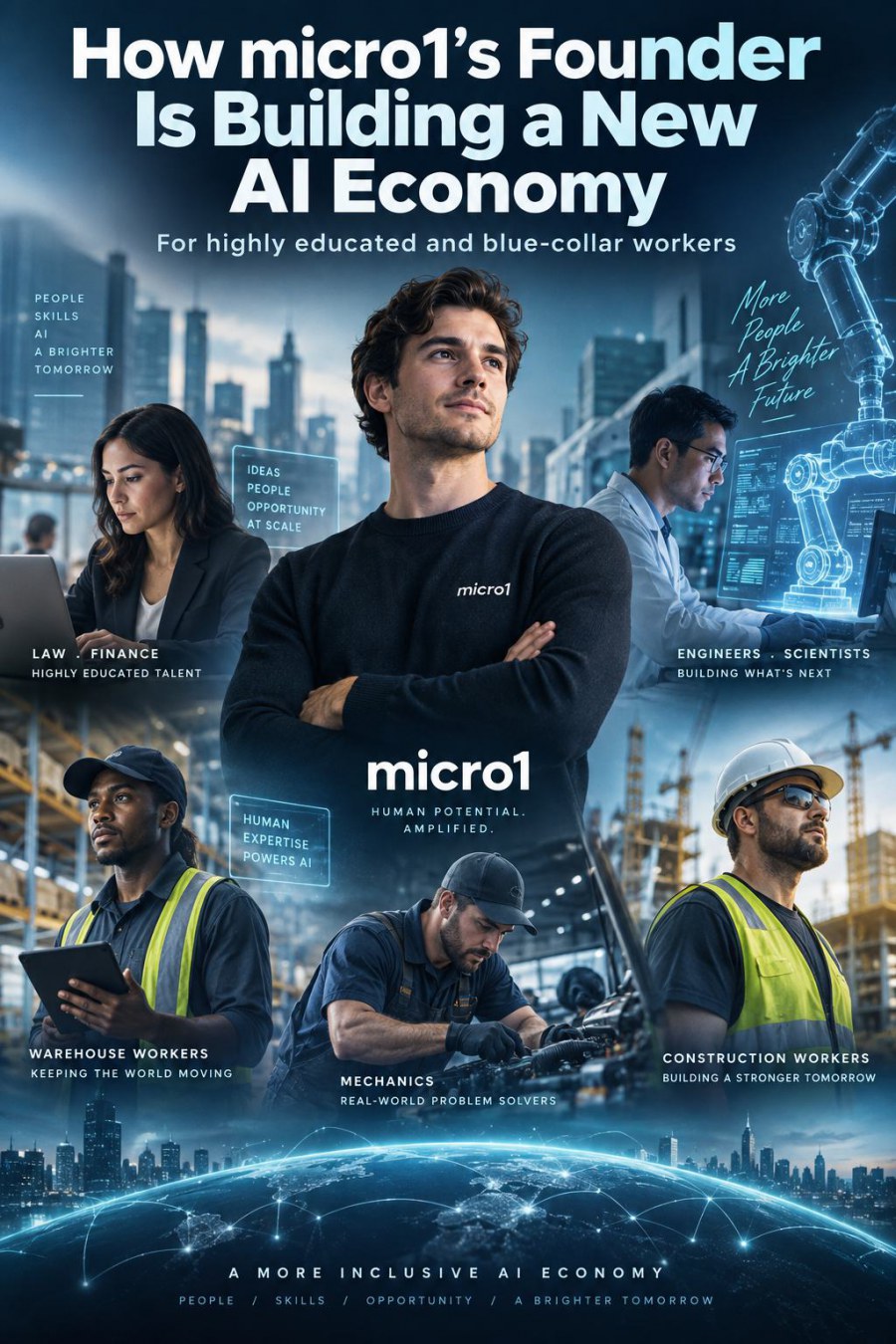
At one end of the emerging marketplace are PhDs, lawyers, engineers, accountants and other highly trained professionals being paid to challenge and evaluate sophisticated AI models. At the other are mechanics, warehouse workers, construction crews and other hands-on professionals whose movements can become training data for robotics.
The paradox is difficult to ignore: some of the people most exposed to future AI automation may also become economically valuable precisely because AI needs to learn from them first.
Ansari summarizes the shift this way:
“AI training is fundamentally affecting the economy; it’s an entirely new job sector.”
What micro1 is building suggests that AI disruption may not simply be a story about machines replacing labor. There may be an enormous intermediate—and perhaps continuing—economy in which human intelligence itself becomes infrastructure.
From AI Recruiter to Human-Intelligence Marketplacemicro1 did not begin as a robotics-data company.
Ansari's entrepreneurial path started much earlier. According to a profile supplied for this article, he moved from Iran to Los Angeles more than a decade ago, experimented with entrepreneurship while still in school, sold textbooks online, built an online math-tutoring business and later operated a software consultancy while studying at Berkeley.
His frustration with finding qualified offshore engineers eventually led him to use GPT-3 to create an AI recruiter capable of interviewing and evaluating candidates. When that recruiting operation exceeded $1 million in annual revenue, he focused on it full time.
Then came the pivotal realization.
A data-labeling company approached micro1 looking for help recruiting hundreds of engineers for an AI project. Ansari saw the demand and recognized that recruiting talent was only one part of a much larger emerging industry: AI companies needed humans capable of teaching increasingly sophisticated models.
micro1 subsequently moved aggressively into AI training data.
The company's September 2025 Series A announcement described a three-part strategy:
- AI-based human-intelligence vetting to identify capable contributors.
- Talent performance management to measure how people perform once assigned.
- A data platform through which expert human knowledge can be converted into training and evaluation data for frontier AI systems.
That architecture is more significant than a conventional staffing company.
It creates something closer to a marketplace between human capability and machine learning.
Two Very Different Groups Are Entering the Same AI EconomyThe most interesting part of Ansari's strategy may be its expansion across the labor market.
AI training used to evoke images of low-paid workers clicking labels onto photographs.
That model is rapidly becoming more sophisticated.
| Emerging AI workforce | What humans contribute | Examples |
|---|---|---|
| Highly educated professionals | Judgment, reasoning, evaluation, corrections and domain expertise | Lawyers, physicians, accountants, scientists, engineers |
| Technical practitioners | Specialized workflows and applied knowledge | CAD professionals, programmers, technicians |
| Blue-collar and skilled workers | Physical demonstrations of how real tasks are performed | Mechanics, construction workers, warehouse employees |
| Businesses | Operational records, SOPs, workflows and institutional knowledge | Logistics firms, manufacturers, service businesses |
| Everyday participants | Images, video, speech and real-world behavioral data | Visual, voice and robotics datasets |
The common resource is not a particular degree or job title.
It is knowledge AI does not yet possess.
At the Top End, Expertise Is Becoming Training DataFor sophisticated AI models, generic internet data is no longer enough.
A model expected to perform high-level accounting work needs accountants capable of recognizing subtle errors.
A legal AI system needs lawyers who know when an argument, contract provision or interpretation is flawed.
A scientific model requires experts capable of distinguishing plausible-sounding nonsense from technically correct reasoning.
micro1's current marketplace demonstrates the economics already developing around that requirement.
For example, current listings include a Financial Systems Expert role paying $90–$170 an hour, a Physics Expert requiring PhD/postdoctoral expertise paying $100–$200 an hour, a STEM opportunity paying $80–$130 an hour, and legal opportunities such as Funds Attorney positions paying $90–$150 an hour.
Earlier reporting on Ansari's business described specialists earning roughly $60–$170 an hour, with some medical and financial experts commanding substantially higher rates.
Why pay humans that much?
Because as models improve, the human correcting them often needs to be better than the model at the task being evaluated.
That changes the economics of data labeling.
A person is no longer merely identifying whether a photograph contains a bicycle.
They may be determining whether:
- an AI-generated financial reconciliation is correct;
- a legal interpretation would survive professional scrutiny;
- an engineering solution violates a physical constraint;
- a scientific argument contains a subtle methodological error;
- an AI agent made the right sequence of business decisions.
The closer AI gets to expert-level performance, the more valuable genuinely expert human judgment can become during training.
Investor Adam Bain described this evolution by noting that data labeling has become increasingly complex because providers now need to find people capable of outperforming the models they are evaluating.
Then Ansari Took the Same Thesis to Blue-Collar WorkThis is where micro1's strategy becomes much more consequential.
Large language models could initially learn from enormous quantities of information already available online.
Robots cannot.
There is no equivalent of Wikipedia containing billions of properly captured first-person demonstrations showing how humans:
- Replace a damaged automobile component.
- Fold hotel linens efficiently.
- Load a warehouse pallet safely.
- Repair a leaking faucet.
- Install construction materials.
- Clean and prepare a commercial workspace.
- Handle tools around unexpected obstacles.
- Perform hundreds of thousands of other physical tasks.
Those demonstrations have to be created.
Ansari therefore sees robotics as potentially creating another enormous market for human-generated training data.
Earlier reporting described micro1 shipping recording equipment—including wearable devices—to people who would capture themselves completing ordinary physical tasks so the footage could become foundational robotics data.
micro1's own robotics research now argues that rapidly diversifying robotics applications are producing demand for specialized post-training data across factories, homes, vehicles and other environments.
That produces an extraordinary economic inversion.
The mechanic may become valuable not only because he can repair a vehicle—but because a robot needs to learn how he repairs it.The warehouse employee's movements become data.
The construction worker's technique becomes data.
The housekeeper's sequence of actions becomes data.
The technician's judgment becomes data.
The physical expertise accumulated over years of employment becomes something that can potentially be captured, structured, licensed and sold.
The People AI May Replace Could Become Its TeachersThis is the central tension in Ansari's vision.
AI developers are explicitly building systems intended to perform larger portions of human work.
Ansari himself has argued that advanced AI will eventually automate large categories of economic activity, including software, logistics, production, coordination, judgment and execution. His argument is that automation also frees humans to develop new functions, creating another cycle of invention and eventual automation.
That means micro1 occupies an unusual place in the transition.
It can pay people for the very knowledge that may ultimately reduce demand for some of their existing labor.
Consider the progression:
| Today | AI-training phase | Possible future |
|---|---|---|
| Accountant performs reconciliation | Accountant evaluates AI reconciliation | AI performs more reconciliation autonomously |
| Mechanic repairs component | Mechanic's repair is captured as robotics data | Robot may perform portions of repair work |
| Lawyer drafts agreement | Lawyer grades AI-generated legal work | AI agent handles more routine drafting |
| Warehouse worker moves inventory | Worker provides first-person task demonstrations | Robotics automates more material handling |
| Engineer solves technical problem | Engineer creates and evaluates AI reasoning tasks | AI performs larger parts of engineering workflow |
This can sound dystopian if viewed only as workers being paid to train their replacements.
But that interpretation misses another possibility.
The training process itself creates a market for knowledge that previously had almost no independent economic value.
A retired accountant may still possess valuable reasoning.
A displaced technician may still understand machinery.
An experienced construction worker may possess decades of practical knowledge that a robotics company cannot simply download from the internet.
AI potentially separates the value of someone's knowledge from the traditional job in which that knowledge was previously monetized.
That is a significant economic development.
Human Knowledge Is Becoming a Sellable AssetHistorically, workers usually monetized expertise by performing a job.
An accountant earned money by doing accounting.
A mechanic earned money by fixing vehicles.
A lawyer earned money by practicing law.
A warehouse employee earned money by moving goods.
The AI-training economy introduces another mechanism:
Teach a machine what you know.
That creates several potential forms of economic participation.
| Human asset | New potential AI-era use |
|---|---|
| Professional knowledge | Evaluate and improve AI reasoning |
| Years of experience | Create difficult training scenarios |
| Physical skill | Demonstrate tasks for robotics |
| Business workflow | Train AI agents on real operations |
| Corrections and judgment | Provide reinforcement and evaluation data |
| Institutional knowledge | License operational datasets |
| Workplace activity | Generate real-world video datasets |
This does not guarantee that AI training will compensate for employment ultimately lost to automation.
That remains one of the major unresolved economic questions of the AI transition.
But micro1 is demonstrating that the knowledge workers accumulated before automation can itself acquire market value during automation.
Ansari Is Extending the Model From Individuals to Entire Companiesmicro1 is not stopping with individual workers.
The company is also developing a market for business knowledge.
Companies routinely accumulate years of:
- standard operating procedures;
- CRM histories;
- internal documentation;
- project records;
- QA processes;
- decision-making patterns;
- logistics workflows; and
- human feedback concerning AI systems.
micro1 now offers businesses compensation for licensing qualifying operational datasets, with its website describing $100,000+ partnerships, $500,000+ opportunities for larger-scale datasets or ongoing participation, and $1 million+ for highly distinctive proprietary operational data.
The company has also publicly discussed partnerships reportedly ranging from $100,000 to $2 million or more for real-world business workflows.
So Ansari's emerging marketplace operates at multiple levels:
- An individual can monetize expertise.
- A skilled worker can monetize demonstrations of physical work.
- A company can monetize the accumulated knowledge of its operations.
- AI developers receive data they cannot easily obtain elsewhere.
- micro1 provides the infrastructure connecting these groups.
That looks increasingly less like a data-labeling company and more like a human-intelligence supply chain.
Why micro1's Recruiting Origins MatterThere is a reason Ansari's first successful product was an AI recruiter.
Finding human expertise is itself difficult.
An AI laboratory may decide that it needs 500 experts capable of evaluating advanced mathematics, accounting, medicine or engineering.
Its problem isn't simply finding 500 résumés.
It needs to determine:
- who genuinely understands the subject;
- who can communicate that knowledge;
- who can consistently evaluate AI;
- whose work is reliable;
- who performs well at scale; and
- who should remain assigned to increasingly difficult projects.
micro1's recruitment infrastructure provides the first layer.
Its AI interview system screens candidates. Contributors can then complete simulations, while human managers help coordinate projects and performance data is collected throughout the process. The company's model has emphasized what Ansari calls a “humans first” philosophy.
Ansari's logic is practical:
“If the experts are happy, they produce better quality work, and the labs get a better model.”
That reveals another important part of the business.
The human isn't incidental to the technology.
The human is part of the production infrastructure.
Investors Are Betting That Human Data Will Remain ValuableThe speed of micro1's growth suggests investors believe this market could become substantial.
micro1 raised a $35 million Series A at a $500 million valuation in September 2025, led by 01 Advisors, with Microsoft's M12 participating.
By August 2026, TechCrunch reported that the company had reached approximately a $500 million gross run rate, illustrating just how rapidly demand for AI-training infrastructure has expanded.
The deeper bet, however, is not simply on micro1.
It is a bet that advanced AI will continue requiring enormous quantities of high-quality human-generated information.
That assumption has been debated. Some investors previously believed increasingly intelligent models would eventually generate much of their own training material, reducing the need for humans.
But sophisticated models create a moving target.
When a model can solve elementary mathematics, elementary mathematics stops being particularly valuable training material.
Researchers then need harder mathematics.
When models handle ordinary accounting tasks, they need expert accountants to expose difficult failure cases.
And when robots master simple movements, they need increasingly complex real-world demonstrations.
The frontier keeps moving.
Robotics Could Make the Human-Data Market Even LargerLanguage-model training benefited enormously from a world that had already been digitized.
Human beings had spent decades creating websites, books, code repositories, videos, academic papers and discussion forums.
Robotics has a different problem.
Much of humanity's physical knowledge has never been converted into machine-learning data.
There is no comprehensive database containing every legitimate way to:
- repair every type of appliance;
- prepare every kind of commercial kitchen;
- maintain every industrial machine;
- clean every hotel environment;
- handle every warehouse exception;
- build every physical structure;
- operate every piece of specialized equipment.
The world itself becomes the dataset.
And humans become the people who generate it.
Ansari's view is that this requirement may make robotics data an even larger opportunity than today's language-model training market. The source profile describes him arguing that the world can never be modeled perfectly, which implies an ongoing requirement for new observations and data.
This New Economy Will Also Create Difficult QuestionsThe opportunity is significant, but so are the unresolved issues.
1. Is AI-training work temporary?
Some data-labeling tasks will almost certainly become automated themselves. The economically durable work may migrate toward increasingly specialized expertise, difficult edge cases and genuinely novel real-world data.
2. Who owns a worker's knowledge?
If a worker records a procedure learned over 20 years, questions can arise over whether the resulting data belongs to the worker, employer, client or platform.
3. What happens to biometric and workplace data?
Video and audio collection introduce privacy, consent, security and intellectual-property considerations that require much stronger safeguards than ordinary freelance work.
4. Will training income compensate for displaced employment?
There is no guarantee. A person earning temporary AI-training income today could still face economic disruption if automation eliminates a stable career tomorrow.
5. Who captures most of the value?
The ultimate distribution of wealth between AI laboratories, data platforms, businesses and individual contributors will determine whether the human-data economy becomes broadly beneficial or highly concentrated.
These are not peripheral questions.
They will help determine whether the transition Ansari is betting on creates a genuine new labor market or merely a temporary bridge toward greater automation.
The Founder Is Really Building a Market for What Humans KnowIt is easy to look at micro1 and see a data-labeling startup.
That description increasingly seems too narrow.
Ansari is assembling several components of a much larger system:
| Infrastructure | Function |
|---|---|
| AI recruiting | Find people with relevant knowledge |
| Skill verification | Determine who actually possesses expertise |
| Human performance management | Measure quality and reliability |
| Expert marketplace | Match specialists to AI-training projects |
| Enterprise data partnerships | Turn company knowledge into training datasets |
| Robotics video collection | Capture physical human expertise |
| AI evaluation | Determine where models still fail |
| Data infrastructure | Deliver usable training material to frontier labs |
micro1's own stated ambition is unusually large: it says it wants to enable one billion people to perform meaningful work by applying their expertise to AI.
Whether it ever approaches that number is unknowable.
But the underlying economic thesis is already becoming visible.
AI May Replace Work Without Making Human Knowledge WorthlessThis may ultimately be the most interesting aspect of what Ali Ansari is building.
AI automation is usually discussed as though knowledge and employment are the same asset.
They aren't.
A person can lose demand for a particular task while still possessing knowledge that has enormous value.
The accountant may no longer need to manually perform every reconciliation, but may be valuable for determining when an AI reconciliation is wrong.
The mechanic may eventually work alongside increasingly capable robotics, but decades of mechanical judgment can help teach those machines.
The lawyer may produce fewer first drafts but become valuable in defining what legally acceptable AI-generated work looks like.
The warehouse employee's existing job may change dramatically, while the physical knowledge accumulated through that job helps produce the robotics systems responsible for the change.
That is the strange new economy emerging around AI.
People are not only using AI.
They are being paid to teach it.
Businesses are not only purchasing AI.
They are beginning to sell knowledge to it.
And workers whose jobs may eventually be transformed or partially automated are discovering that their experience is itself an increasingly valuable raw material.
Ali Ansari has recognized that there may be an enormous business in organizing this exchange.
For decades, technology companies built platforms around information, attention, commerce and communication.
micro1 is attempting something different:
A platform around human intelligence itself.The ultimate irony may be that the more powerful artificial intelligence becomes, the more valuable the remaining frontier of human knowledge becomes to the companies trying to push it further.
And if Ansari's thesis is correct, the transition to an automated economy will produce an entirely new occupation along the way:
teaching machines everything humanity already knows.