Could Your Business Get Paid to Help Train Robotics AI? micro1 Is Recruiting Commercial Video Data Collection Partners Worldwide
The next generation of artificial intelligence is being trained on far more than text, code, photographs and documents. Robotics AI increasingly needs real-world video showing how people actually perform physical work. That creates a new opportunity for businesses in construction, manufacturing, automotive repair, agriculture, warehousing, hospitality, field services, beauty, logistics and other hands-on industries.…
About This Article
The next generation of artificial intelligence is being trained on far more than text, code, photographs and documents. Robotics AI increasingly needs real-world video showing how people actually perform physical work.
That creates a new opportunity for businesses in construction, manufacturing, automotive repair, agriculture, warehousing, hospitality, field services, beauty, logistics and other hands-on industries.
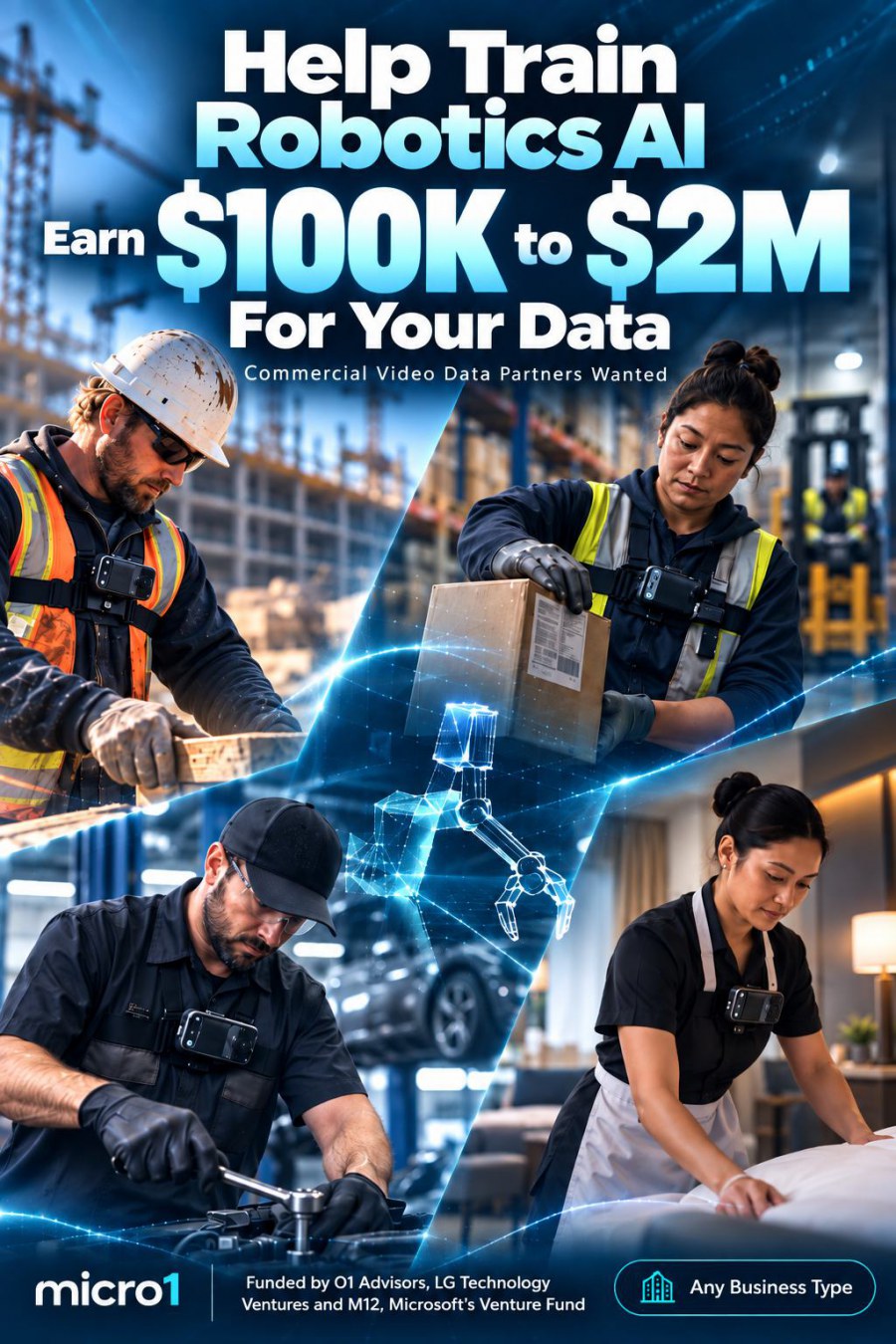
micro1 is currently recruiting companies for its Commercial Video Data Collection Partner – Any Business Type program. Participating businesses help collect anonymized point-of-view video showing real employees carrying out real commercial workflows. The resulting footage can be transformed into structured datasets used to train and evaluate robotics AI systems.
Review the micro1 Commercial Video Data Collection Partner opportunity →
Opportunity at a Glance| Category | Details |
|---|---|
| Opportunity | Commercial Video Data Collection Partner – Any Business Type |
| Organization | micro1 |
| Role Type | Contractor / Business Partnership |
| Location | Remote |
| Minimum Company Size | 20 employees |
| Primary Contribution | POV / egocentric video of real manual work |
| Equipment Required | Eligible smartphones and wearable phone mounts |
| Work Environment | Authentic commercial operations |
| AI Experience Required | Not required |
| Industries | Construction, hospitality, logistics, retail, beauty, manufacturing, healthcare, automotive, agriculture and more |
micro1 states that its broader partnership network includes 100+ partner companies, representation across 100+ countries, and more than $200 million generated for partners. These are company-reported figures associated with the opportunity.
Why Robotics AI Needs Videos of Real People Doing Real WorkWritten instructions can explain a task, but they rarely capture everything that happens while an experienced person performs it.
For example, a warehouse procedure might say:
Pick up the package, verify the label and place it in the correct location.
A human worker understands hundreds of details that are not contained in that sentence. Robotics AI must eventually learn many of those details as well.
| What the written instruction says | What real-world video can demonstrate |
|---|---|
| Pick up the package | Where to grip it, how much force to use and how to adjust for size |
| Verify the label | Where labels are normally located and how workers inspect them |
| Move the package | How workers navigate around people, equipment and obstacles |
| Place it correctly | Orientation, shelf position and handling procedures |
| Follow safety rules | Body positioning, equipment awareness and workplace protocols |
| Handle exceptions | What happens when the package is damaged, missing information or unusually heavy |
For robotics and embodied AI systems, how work is actually performed can be just as important as the formal instructions describing the work.
What Is POV or Egocentric Video?micro1 is specifically seeking POV, or egocentric, video data.
This is footage recorded from approximately the worker's own perspective, typically using a smartphone attached to a wearable mount. Rather than watching an employee from across the room, researchers can see something much closer to what the worker sees while performing a task.
POV footage can capture:
- How hands interact with tools and objects.
- The order in which tasks are completed.
- How workers position themselves relative to equipment.
- How physical environments affect decisions.
- How employees respond to unexpected situations.
- How safety procedures are incorporated into daily work.
- How experienced workers perform tasks efficiently.
This type of data can be particularly useful for AI systems that need to understand physical actions, sequencing, spatial relationships and real-world decision-making.
What Participating Businesses Would Be Asked to DoThe program involves more than uploading random workplace footage. micro1 is looking for organizations capable of functioning as structured data-collection partners.
1. Facilitate Real-World Video CollectionParticipating companies would help capture first-person video showing workers performing authentic manual tasks within the normal course of commercial operations.
The objective is to document real work in real environments, rather than staged demonstrations created solely for filming.
2. Coordinate Video Submissions at Scalemicro1 is interested in businesses capable of managing substantial quantities of footage across multiple employees.
A larger organization may be able to provide:
- multiple workers performing similar tasks;
- several work locations or departments;
- different methods of completing the same job;
- variations caused by equipment, materials or working conditions; and
- examples of routine and non-routine situations.
That diversity can make a dataset substantially more useful for AI training.
3. Explain Workflows and Best PracticesParticipating businesses may also contribute expertise about how their work should be performed.
That can include information about:
- standard operating procedures;
- equipment use;
- workplace safety;
- quality-control standards;
- task sequencing;
- common exceptions; and
- professional best practices.
The organization would be responsible for communicating recording instructions to participating employees and helping ensure that submissions meet agreed project standards.
5. Monitor Progress and Provide FeedbackPartners may be expected to report progress, identify problems and communicate with micro1 about ways to improve the collection process.
6. Maintain Privacy, Safety and Consent StandardsCompanies must ensure that data collection is conducted according to applicable privacy, consent, safety and ethical requirements.
See the complete micro1 partnership requirements →
What Types of Businesses Could Participate?One of the most interesting features of the opportunity is its breadth. micro1 lists Any Business Type, provided the organization has meaningful hands-on operations and can meet the participation requirements.
| Industry | Examples of Potential Workflows |
|---|---|
| Construction | Measuring, cutting, drilling, fastening, installation, inspection |
| Manufacturing | Assembly, machine operation, quality control, packaging |
| Automotive Repair | Diagnostics, tool use, component replacement, inspections |
| Agriculture | Crop handling, equipment use, harvesting, maintenance |
| Warehousing | Picking, packing, shelving, scanning, inventory movement |
| Hotels & Hospitality | Room preparation, housekeeping, maintenance, food service |
| Retail | Stocking, merchandising, checkout preparation, inventory handling |
| Healthcare | Approved non-sensitive operational and equipment workflows |
| Logistics | Loading, unloading, sorting, fulfillment, transport preparation |
| Property Services | Cleaning, repairs, inspections, landscaping, maintenance |
| Beauty | Hair, nail, skincare and other hands-on service procedures |
| Fitness | Equipment setup, movement demonstrations and facility operations |
The common denominator is not the industry. It is the existence of repeatable physical workflows carried out by experienced people.
Why Companies With 20 or More Employees May Be Attractive Partnersmicro1 lists businesses with at least 20 employees among its preferred qualifications.
Larger teams can provide greater dataset diversity. Instead of recording one person completing one task, a participating company could potentially capture multiple variations of the same process.
| Dataset Advantage | Why It Matters |
|---|---|
| More workers | Shows different but valid ways to perform tasks |
| More locations | Exposes AI to different environments |
| More equipment | Increases variation in tools and machinery |
| More shifts | Captures changing lighting, staffing and operating conditions |
| More exceptions | Helps AI understand unusual or difficult situations |
| More repetitions | Provides stronger examples of common workflows |
For machine learning, this variation can be extremely valuable because real environments are rarely identical.
The Equipment Requirements Are Relatively SimpleCompanies do not necessarily need specialized filmmaking equipment.
The opportunity identifies three principal requirements:
- Eligible smartphones capable of producing suitable video.
- Wearable phone mounts that allow hands-free recording from the worker's perspective.
- A real commercial setting where genuine work is being performed.
This lowers the technical barrier for businesses that already have the employees, facilities and workflows but do not operate professional video-production departments.
How Different Industries Could Contribute Valuable Robotics Training Data ConstructionConstruction environments contain a wide range of physical tasks, tools, materials and safety procedures.
| Potential Video Category | Example Activities |
|---|---|
| Measurement | Measuring surfaces, marking materials |
| Tool use | Drilling, fastening, cutting |
| Installation | Positioning and securing materials |
| Inspection | Checking work against specifications |
| Material handling | Carrying, positioning and organizing supplies |
| Safety | Protective equipment, safe positioning and jobsite procedures |
A construction company can generate thousands of examples showing how experienced workers interact with complex physical environments.
Hotels and HospitalityHospitality operations involve a completely different set of physical workflows.
Examples include:
- Room preparation and turnover.
- Linen handling.
- Cleaning and sanitation procedures.
- Food and beverage preparation.
- Facility maintenance.
- Inventory replenishment.
- Guest-service preparation.
- Room and facility inspections.
- Event setup and teardown.
The value lies not simply in seeing the final result, but in observing the sequence of actions required to produce it.
Automotive RepairAn automotive operation can demonstrate processes such as:
- selecting and using tools;
- inspecting components;
- diagnosing physical problems;
- removing and installing parts;
- handling fluids and materials;
- performing safety checks; and
- validating completed repairs.
These workflows involve substantial hand-eye coordination and professional judgment.
Beauty and Personal CareBeauty businesses are particularly interesting because their workflows often require fine motor control.
| Skill Area | Example |
|---|---|
| Tool manipulation | Brushes, clippers, nail tools, styling equipment |
| Visual judgment | Evaluating shape, texture, colour and symmetry |
| Fine motor control | Detailed hand movements |
| Sequencing | Performing procedures in the correct order |
| Sanitation | Cleaning and preparing tools |
| Adaptation | Adjusting techniques for different clients |
This kind of training data could potentially be useful for AI systems studying precise human interaction with tools and objects.
The Business Opportunity: Turning Existing Work Into a New Data AssetThe most important economic aspect of this model is that the business already performs the underlying work.
A warehouse already moves inventory.
A hotel already prepares rooms.
A mechanic already repairs vehicles.
A salon already performs beauty services.
A construction company already installs materials and operates tools.
The potential new asset is the structured documentation of those workflows for AI training purposes.
Traditionally, businesses have monetized assets such as property, equipment, software, intellectual property, customer relationships and brands. AI is creating another possible category:
Operational Behavior and Expertise| Traditional Business Asset | Emerging AI-Era Asset |
|---|---|
| Equipment | Demonstrations of how equipment is used |
| SOPs | Real-world execution of those SOPs |
| Employee expertise | Physical demonstrations of professional skills |
| Facilities | Authentic environments for workflow data |
| Business processes | Structured sequences of human actions |
| Institutional knowledge | Examples showing how experienced workers solve problems |
For qualifying companies, this could create a supplementary revenue stream around activity already occurring inside the business.
Why This Matters for the Rise of Embodied AIMost consumers first encountered modern AI through chatbots and image generators.
The next phase increasingly involves embodied AI: intelligent systems capable of perceiving and interacting with the physical world.
Potential applications include:
- humanoid robots;
- warehouse robotics;
- industrial automation;
- service robots;
- autonomous equipment;
- AI-assisted manufacturing;
- computer-vision systems; and
- robotic assistants.
Training those systems requires enormous quantities of data showing how humans interact with real environments.
Text can teach an AI what a screwdriver is.
Video can demonstrate how someone actually uses it.
That difference is fundamental.
Privacy, Employee Consent and Compliance Must Be Taken SeriouslyWorkplace video can unintentionally capture information beyond the intended task.
Before participating, companies should establish clear procedures covering what can and cannot be recorded.
| Potential Risk | What Companies Should Review |
|---|---|
| Employees | Written consent and participation requirements |
| Customers | Preventing unauthorized recording |
| Computer screens | Avoiding confidential or personal information |
| Documents | Protecting contracts, invoices and internal records |
| Security systems | Excluding sensitive procedures or access controls |
| Healthcare information | Ensuring protected information is never exposed |
| Trade secrets | Identifying proprietary equipment or methods |
| Workplace safety | Preventing recording requirements from interfering with safe work |
micro1 states that participating organizations are expected to comply with applicable privacy, consent and ethical standards.
Companies should therefore review the partnership agreement carefully and involve legal, HR, privacy, cybersecurity and operations personnel where appropriate.
Who Is micro1?micro1 describes itself as an AI Data Lab focused on connecting frontier AI development with real-world human intelligence.
According to the opportunity materials, the company states that it is backed by Microsoft, has reached more than $400 million in annual recurring revenue, and has involved millions of professionals through its broader ecosystem.
Those figures are company-reported claims and businesses considering a commercial partnership should conduct their own due diligence before signing any data agreement.
micro1's underlying proposition is that the next generation of AI will require more than publicly available internet information. Advanced systems increasingly need exposure to:
| AI Training Resource | What It Provides |
|---|---|
| Text | Knowledge and language |
| Images | Visual recognition |
| Voice | Speech and audio understanding |
| Professional expertise | Judgment and specialized reasoning |
| Operational data | Business processes |
| POV video | Physical actions and workflows |
| Human feedback | Evaluation and correction |
| Real workplaces | Environmental context |
This opportunity may be especially relevant to companies that meet most of the following conditions:
- Employ 20 or more people.
- Operate a business involving meaningful hands-on work.
- Have managers capable of coordinating employee participation.
- Can provide authentic commercial environments.
- Can use compatible smartphones and wearable mounts.
- Have repeatable workflows that can be documented.
- Can comply with privacy, consent, safety and ethical requirements.
- Are interested in turning operational expertise into a potential new revenue source.
Businesses do not need to be technology companies.
In fact, companies operating in traditional physical industries may possess precisely the type of real-world knowledge that robotics developers need.
Your Business May Already Be Producing Valuable AI Training Data Every DayA logistics company thinks it is fulfilling orders.
A hotel thinks it is preparing rooms.
A mechanic thinks it is fixing cars.
A salon thinks it is serving clients.
A construction company thinks it is completing projects.
From the perspective of robotics AI, however, each organization is also producing thousands of examples showing how experienced humans interact with the physical world to accomplish specific goals.
That makes operational expertise increasingly valuable.
The important question for business owners may no longer be simply:
What data does our company own?
It may also be:
Interested companies can review the full requirements and submit their information directly through micro1.What does our workforce know how to do that an AI system needs to learn?
Apply: Commercial Video Data Collection Partner – Any Business Type →