The Great Creator Migration: Why Social Media Creators Are Building Communities, Owning Their Audiences, and Redefining the Creator Economy
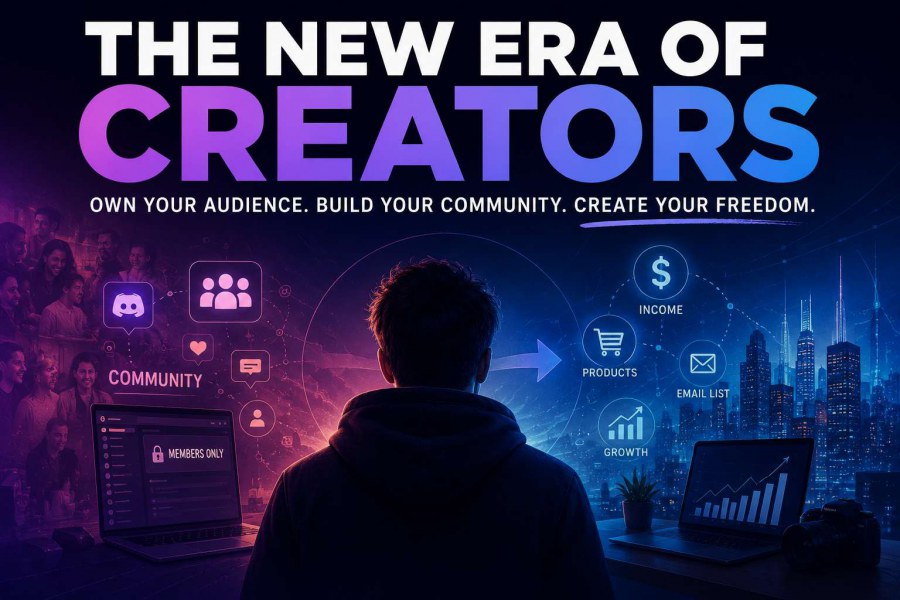
🚀 A New Era Has Begun For more than a decade, social media platforms promised creators an unprecedented opportunity: build an audience, grow your influence, and earn a living doing what you love. Millions of creators embraced platforms like YouTube, TikTok, Instagram, Facebook, and X. They amassed followers, produced millions of pieces of content, and collectively generated billions of views. But a growing number of…
About This Article
For more than a decade, social media platforms promised creators an unprecedented opportunity: build an audience, grow your influence, and earn a living doing what you love.
Millions of creators embraced platforms like YouTube, TikTok, Instagram, Facebook, and X. They amassed followers, produced millions of pieces of content, and collectively generated billions of views.
But a growing number of creators have reached the same conclusion:
Followers are valuable—but ownership is priceless.
Today, the creator economy is undergoing one of its most significant transformations since the rise of social media. Rather than relying entirely on algorithms and advertising revenue, creators are building private communities, launching businesses, collecting email lists, developing AI-powered marketing systems, and creating multiple independent sources of income.
This isn't simply another trend.
It is a structural shift in how creators think about ownership, monetization, and long-term sustainability.
📈 The Rise of Creator CommunitiesThe first major shift is easy to recognize.
Creators are no longer satisfied with simply posting content.
Instead, they are building communities where they have a direct relationship with their audience.
These communities often include:
-
💬 Private discussion groups
-
💎 Premium memberships
-
📧 Email newsletters
-
🎓 Coaching communities
-
🤝 Mastermind groups
-
🌟 VIP memberships
-
🎯 Exclusive educational content
Instead of depending entirely on public social media feeds, creators are inviting their biggest supporters into spaces they control.
🤔 Why Are Creators Moving Off Social Media?The answer is surprisingly simple.
Most creators have discovered they don't actually own their audiences.
Every major social platform controls:
-
The algorithm
-
Content distribution
-
Advertising policies
-
Revenue sharing
-
Audience visibility
An account with one million followers can suddenly experience an 80% decline in reach because of an algorithm update.
That means creators are effectively building businesses on rented land.
Increasingly, they're asking a different question:
📊 The Shift From Rented Audiences to Owned Audiences"How do I build an audience I actually own?"
This change is becoming one of the defining characteristics of today's creator economy.
👑 The MrBeast EffectOne of the best examples of this evolution is MrBeast.
While many people still think of him as simply the world's largest YouTuber, his business has become something much bigger.
Instead of relying solely on YouTube advertising revenue, he has expanded into:
-
🍫 Consumer products
-
👕 Merchandise
-
🏢 Production companies
-
❤️ Philanthropic initiatives
-
🤝 Strategic partnerships
-
📈 Business investments
Rather than monetizing only attention, he has built an ecosystem where content fuels products, products strengthen the brand, and revenue finances even larger content projects.
This business model is often described as creator-led vertical integration.
The creator owns:
Content → Audience → Products → Revenue
The audience becomes the foundation of an entire business ecosystem.
🌍 The Biggest Trends Reshaping the Creator Economy 1️⃣ Audience OwnershipInstead of accumulating followers, creators increasingly prioritize:
-
Email databases
-
Customer relationship management (CRM) systems
-
Membership communities
-
Subscriber lists
Followers can disappear overnight.
An owned audience cannot.
2️⃣ Communities Are Becoming More Valuable Than AdsAdvertising income fluctuates constantly.
Communities create recurring revenue.
Many creators now consider recurring memberships more valuable than advertising revenue alone.
3️⃣ Diversification Is Becoming EssentialCreators no longer rely on one platform.
Instead they build ecosystems across:
-
YouTube
-
TikTok
-
Instagram
-
Newsletters
-
Websites
-
Online stores
-
Membership platforms
-
Affiliate programs
Each channel reduces dependency on the others.
4️⃣ Creator-Led BusinessesModern creators are becoming entrepreneurs.
Many now launch:
-
Digital products
-
Online courses
-
SaaS applications
-
Apparel brands
-
Food products
-
Consulting services
-
Events
-
Licensing businesses
Content is increasingly serving as customer acquisition for larger businesses.
5️⃣ Micro-CommunitiesRather than speaking to everyone equally, creators are segmenting audiences into multiple layers.
Typical Funnel
Public Audience
⬇
Free Community
⬇
Email Subscribers
⬇
Premium Members
⬇
VIP Customers
Each level increases engagement, loyalty, and lifetime customer value.
6️⃣ Artificial Intelligence Is Changing EverythingArtificial intelligence is allowing creators to operate like small media companies.
AI now assists with:
-
Content generation
-
Content repurposing
-
Search optimization
-
Community management
-
Customer support
-
Audience segmentation
-
Marketing automation
-
Lead nurturing
Instead of doing everything manually, creators increasingly manage intelligent systems that perform much of the repetitive work.
🏗️ The Next Evolution: Creator Operating SystemsWhile creator communities represent today's dominant trend, another category is beginning to emerge.
Rather than offering only memberships or discussion spaces, some platforms are evolving into what could be described as Creator Operating Systems.
Instead of simply hosting communities, these systems aim to help creators:
-
Recruit new audiences
-
Build owned customer databases
-
Automate outreach
-
Manage affiliates
-
Distribute earnings
-
Publish content across multiple channels
-
Coordinate AI-powered marketing activities
This represents a shift from community management toward complete creator business infrastructure.
🌟 Where Pamper Me Network FitsThis is where Pamper Me Network (PMN) positions itself differently from many traditional creator platforms.
Rather than focusing solely on community hosting, PMN is designed around the broader challenge creators increasingly face:
How do creators become less dependent on social media platforms while increasing control over their audience, earnings, and long-term growth?
PMN combines several functions that are often spread across multiple services, including:
-
🤖 AI-powered marketing assistants
-
👥 Audience-building systems
-
🎁 Social rewards technology
-
💰 Referral and affiliate monetization
-
📧 Audience ownership strategies
-
📣 Multi-channel promotion
-
🔄 Marketing automation
-
🧠 AI-assisted content distribution
Instead of serving only as another membership platform, PMN is built around helping creators establish an independent marketing and monetization infrastructure that extends beyond any single social network.
As creators increasingly seek greater control over their businesses, platforms that support audience ownership and diversified revenue strategies are becoming more relevant.
🔮 Where the Creator Economy Is HeadingThe next generation of successful creators will likely look less like influencers and more like CEOs.
Expect to see more creators building:
-
🏢 Mini media companies
-
🌍 Global membership communities
-
🛍️ Consumer brands
-
🤖 AI-powered marketing operations
-
📧 Large owned email databases
-
💼 Licensing businesses
-
🤝 Affiliate ecosystems
-
🌐 Independent creator networks
The creator economy is evolving from content creation into business creation.
📊 Creator Economy EvolutionSOCIAL MEDIA POSTS
│
▼
FOLLOWERS
│
▼
PRIVATE COMMUNITIES
│
▼
OWNED AUDIENCES
│
▼
MULTIPLE REVENUE STREAMS
│
▼
CREATOR-OWNED BUSINESSES
│
▼
AI-POWERED CREATOR ECOSYSTEMS
🎯 Summary
The evidence is becoming increasingly clear.
The most successful creators of tomorrow are unlikely to depend on advertising revenue alone.
They will own relationships instead of merely accumulating followers.
They will build communities instead of chasing algorithms.
They will diversify income instead of relying on a single platform.
They will use artificial intelligence to scale operations that once required entire teams.
And increasingly, they will invest in infrastructure that gives them greater control over their audience, distribution, and earnings.
The creator economy is no longer just about creating content.
It is about building resilient, creator-owned businesses.
For creators seeking greater independence, the question is no longer whether this transformation is happening.
The question is:
Will you build your business on someone else's platform—or will you build an ecosystem that you own?