How VoicePlug AI Is Reshaping Restaurants and the Future of Food Service
Artificial intelligence is no longer a futuristic idea for the restaurant industry. It is quickly becoming part of everyday operations, from the way customers place orders to how restaurants manage inventory, predict demand, reduce wait times, and improve profitability. Restaurants have always depended on speed, accuracy, hospitality, and consistency. AI strengthens all four. Instead of replacing the human side of h…
About This Article
Artificial intelligence is no longer a futuristic idea for the restaurant industry. It is quickly becoming part of everyday operations, from the way customers place orders to how restaurants manage inventory, predict demand, reduce wait times, and improve profitability.
Restaurants have always depended on speed, accuracy, hospitality, and consistency. AI strengthens all four. Instead of replacing the human side of hospitality, properly designed restaurant AI helps staff focus on service while automation handles repetitive, high-volume, and time-sensitive tasks.
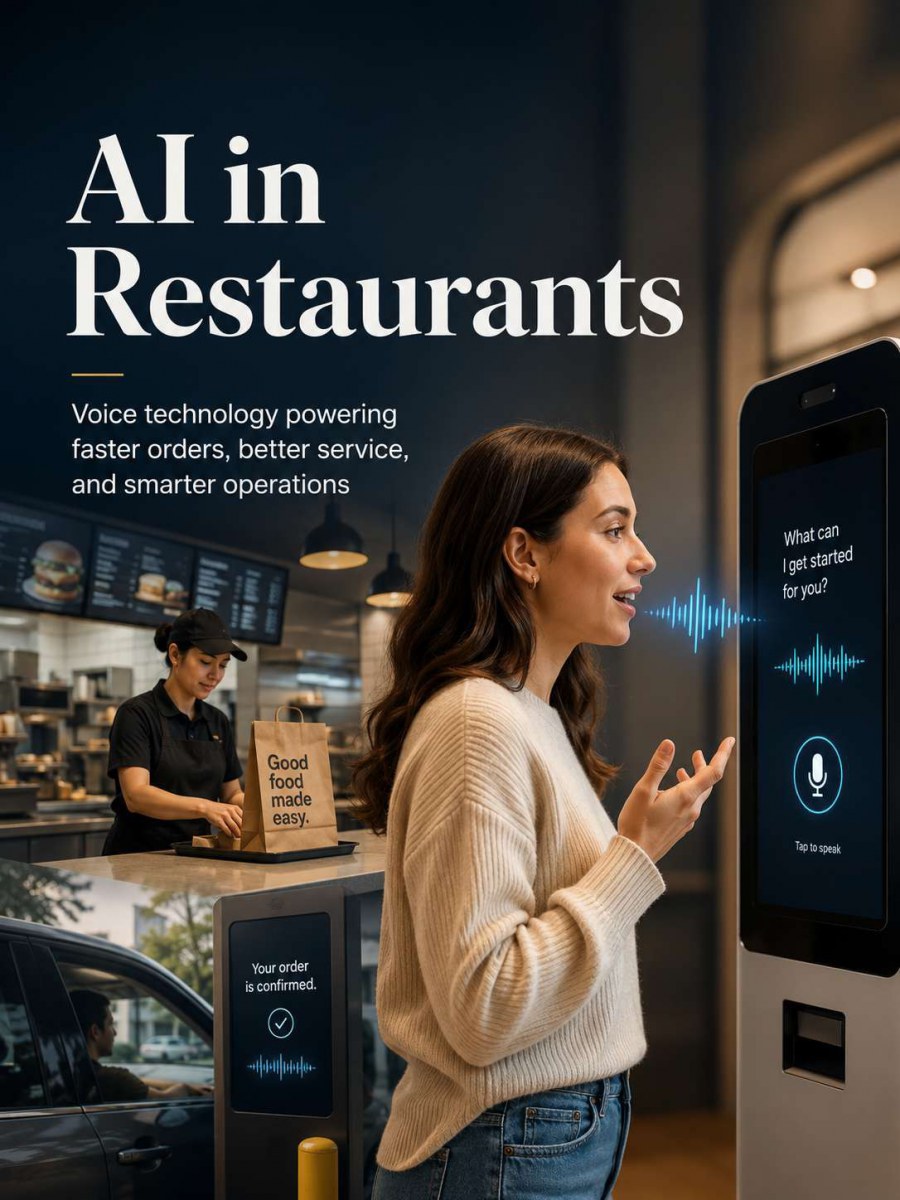
Companies such as VoicePlug are helping restaurants move toward this new operating model by using voice-powered commerce tools that allow customers to order naturally through phone systems, drive-thru lanes, kiosks, and specialized ordering assistants such as Pizza Voice.
The result is a restaurant experience that feels faster, more personalized, and more efficient for both guests and operators.
The New Role of AI in Restaurants
AI in restaurants can be understood as a digital support layer that helps restaurants make better decisions and serve customers more efficiently. It can listen, understand, recommend, predict, automate, and analyze.
Instead of relying only on manual processes, restaurants can use AI to support:
- Phone ordering
- Drive-thru ordering
- Kiosk ordering
- Menu recommendations
- Customer service
- Inventory forecasting
- Staff scheduling
- Marketing personalization
- Food waste reduction
- Revenue optimization
In practical terms, AI helps restaurants answer a simple question:
How can the restaurant serve more customers, with fewer errors, in less time, while improving the guest experience?
AI-Powered Ordering: Faster Service With Fewer Missed Orders
One of the most visible uses of AI in restaurants is automated ordering. Many restaurants lose revenue because staff are too busy to answer every phone call, drive-thru lines move slowly, or customers abandon orders when the process takes too long.
Voice AI helps solve this problem by allowing customers to speak naturally and place orders without waiting for an employee to become available.
Common AI Ordering Channels
For busy restaurants, this matters because every missed call or abandoned order can represent lost revenue. AI ordering tools allow restaurants to stay available during rush hours, late nights, staffing shortages, and peak demand periods.
Personalization: Turning Menus Into Smart Recommendations
Traditional menus show the same options to every customer. AI-powered restaurant systems can go further by using customer data, ordering history, dietary needs, time of day, and local trends to recommend relevant items.
For example, a returning customer may be shown:
- Favorite meals from past orders
- Add-ons that match previous purchases
- Gluten-free or vegetarian options
- Weather-based suggestions
- Popular items during lunch or dinner hours
- Limited-time offers based on buying patterns
This creates a more personalized dining experience and helps restaurants increase average order value.
Example: AI Menu Personalization Flow
Customer Data → AI Analysis → Smart Recommendation → Faster Order → Higher Satisfaction
A customer who regularly orders vegetarian meals may be shown plant-based specials first. A family that often orders large pizzas may receive a bundle recommendation. A customer ordering during cold weather may be shown soup, warm drinks, or comfort-food options.
The goal is not to overwhelm the guest. The goal is to make ordering easier.
AI in the Kitchen: Improving Consistency and Efficiency
AI is also changing restaurant kitchens. While not every restaurant will use robotic chefs, many food-service businesses are beginning to use AI-assisted tools to improve preparation, workflow, and quality control.
AI can help kitchens by:
- Predicting which items will be in demand.
- Alerting staff when ingredients are running low.
- Supporting consistent portioning and preparation.
- Reducing bottlenecks during peak hours.
- Helping managers understand kitchen performance.
- Supporting automation for repetitive prep tasks.
In larger restaurant chains, AI can also analyze sales patterns across multiple locations and help operators make smarter purchasing and staffing decisions.
Inventory Management: Reducing Waste and Protecting Profit Margins
Food waste is one of the biggest problems in the restaurant industry. Overstocking ingredients can lead to spoilage. Understocking can lead to disappointed customers and lost sales.
AI helps restaurants find the balance.
By reviewing historical sales, seasonal trends, weather, promotions, holidays, and real-time demand, AI-powered inventory tools can help restaurants forecast what they need more accurately.
AI Inventory Benefits
For restaurants operating on tight margins, smarter inventory control can directly improve profitability.
Customer Experience: Less Waiting, More Convenience
Modern customers expect convenience. They want to order quickly, customize easily, avoid long waits, and receive accurate food.
AI supports this experience by helping restaurants create smoother customer journeys.
AI Can Improve the Guest Experience Through:
- Faster phone ordering
- Shorter drive-thru lines
- Self-service kiosk support
- 24/7 ordering availability
- Personalized recommendations
- Fewer order errors
- Faster answers to common questions
- Better loyalty offers
- More consistent service during rush hours
This is especially useful for quick-service restaurants, pizza shops, coffee shops, ghost kitchens, franchise operators, and high-volume casual dining brands.
Voice Commerce: Why Speaking Is Becoming the New Ordering Interface
One of the most important developments in restaurant AI is voice commerce. Customers already use voice assistants, smart speakers, and voice search in daily life. Restaurants can use this behavior to make ordering more natural.
Voice ordering is powerful because it reduces friction. Instead of clicking through multiple screens or waiting on hold, the customer simply speaks.
VoicePlug’s approach focuses on helping restaurants create natural voice interactions through tools such as Phone AI, Drive-Thru AI, Kiosk AI, and Pizza Voice. These systems are designed to help customers place orders more easily while giving restaurants a more scalable ordering process.
Simple Visual: Restaurant Voice AI Impact
AI and Restaurant Staff: Support, Not Replacement
A common concern is that AI will replace restaurant employees. In reality, the strongest use case is often staff support.
Restaurants frequently struggle with labor shortages, high turnover, and rush-hour pressure. AI can reduce the burden by handling repetitive tasks so employees can focus on food quality, customer care, cleaning, packaging, and problem-solving.
AI can assist with:
- Answering repetitive questions
- Taking routine orders
- Managing order flow
- Suggesting upsells
- Reducing phone interruptions
- Helping new employees work more efficiently
- Supporting managers with reports and forecasts
This can improve the work environment by reducing stress during peak service times.
Restaurant AI Use Cases by Business Type
Different restaurants do not need the same AI strategy. A pizza shop may benefit most from voice ordering. A large franchise may need drive-thru automation and advanced reporting. A café may prioritize loyalty personalization and demand forecasting.
The Future of AI in Restaurants
AI in restaurants is still developing. The next stage will likely include more advanced tools that combine automation, personalization, predictive analytics, and immersive digital experiences.
Restaurants may soon see wider adoption of:
-
Predictive staffing tools
AI can help managers schedule the right number of employees based on expected demand. -
Smarter drive-thru systems
AI can recognize order patterns, reduce delays, and improve accuracy. -
AI kitchen assistants
Digital tools may guide food preparation, timing, and quality control. -
Personalized loyalty programs
Restaurants can deliver offers based on actual customer behavior. -
Augmented reality menus
Customers may preview dishes visually before ordering. -
Automated customer recovery
AI can identify unhappy customers and trigger follow-up offers or support. -
Sustainability optimization
AI can help reduce waste, manage energy usage, and improve purchasing decisions.
Key Benefits of AI for Restaurants
For Restaurant Owners
- More completed orders
- Lower order abandonment
- Better labor efficiency
- Improved upselling
- Reduced food waste
- Smarter inventory management
- Better customer data
- Stronger loyalty programs
- More consistent service
For Customers
- Faster ordering
- Shorter wait times
- More accurate orders
- Personalized recommendations
- Easier menu navigation
- 24/7 ordering access
- Better overall convenience
For Staff
- Less pressure during rush hours
- Fewer repetitive interruptions
- More time for hospitality
- Better workflow support
- Easier order management
Challenges Restaurants Must Consider
AI brings major opportunities, but restaurants should implement it carefully.
Important considerations include:
- Data privacy
- Customer consent
- System accuracy
- Menu complexity
- Staff training
- Integration with POS systems
- Maintenance and monitoring
- Clear escalation to human support
Restaurants should not treat AI as a magic replacement for management. It works best when it is part of a well-designed operating system that combines technology, staff training, and strong customer service standards.
AI Is Becoming a Competitive Advantage in Food Service
AI is shaping the restaurant industry by making service faster, ordering easier, operations smarter, and customer experiences more personalized. From voice ordering and digital kiosks to inventory forecasting and AI-powered recommendations, restaurants now have tools that can improve both revenue and efficiency.
Voice-focused platforms such as VoicePlug show how restaurant AI can be applied in practical ways through Phone AI, Drive-Thru AI, Kiosk AI, and Pizza Voice solutions. These tools help restaurants serve customers using natural voice interactions while reducing wait times, missed calls, and operational pressure.
The restaurants that adopt AI thoughtfully will be better positioned to compete in a food-service market where customers expect speed, convenience, personalization, and consistency.
AI will not remove the need for hospitality. It will help restaurants deliver it better.
For more information visit https://voiceplug.ai/ai-in-restaurants/