How Hippos And Whales Are Related: The Remarkable Evolutionary Story That Began On Land
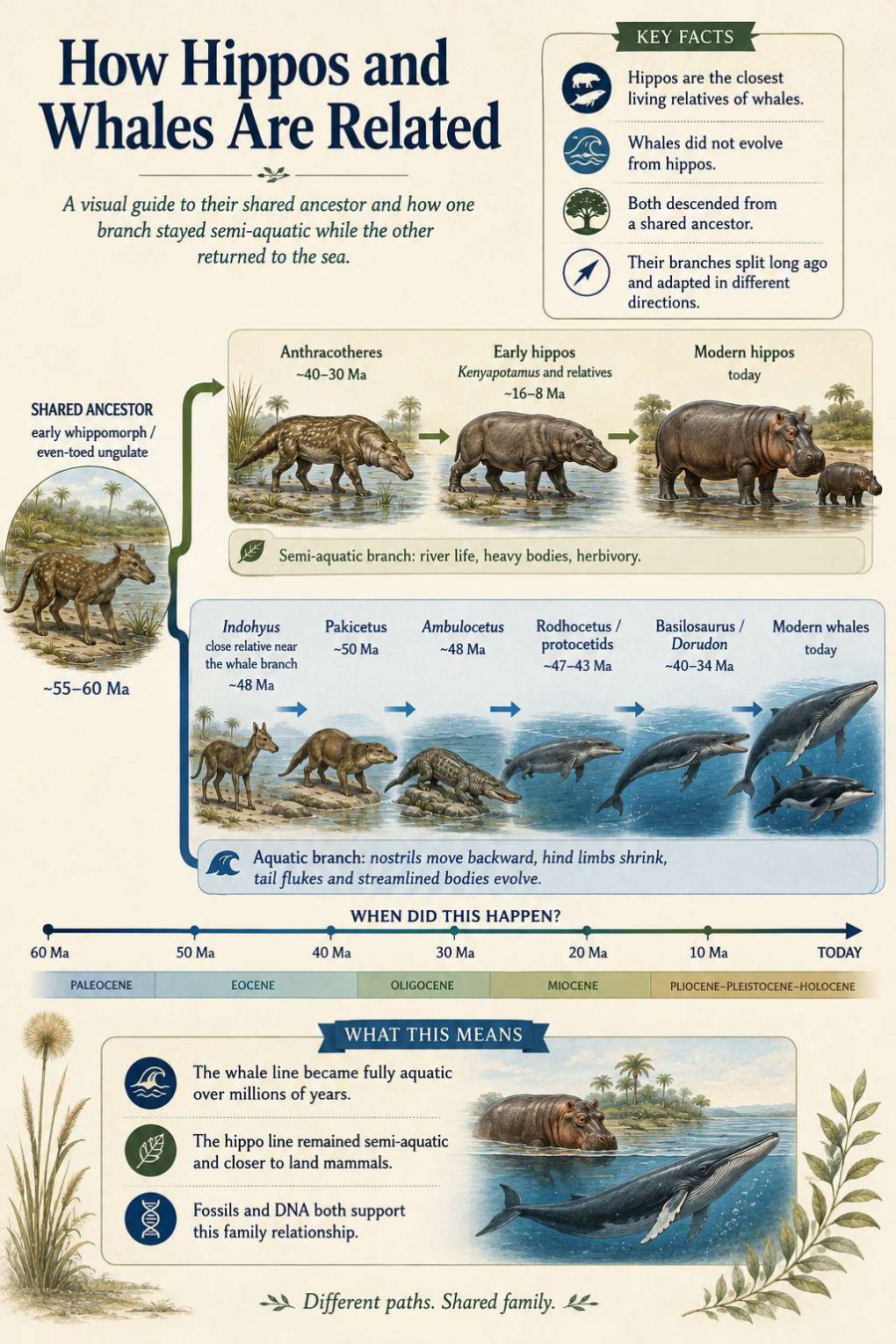
At first glance, a hippopotamus and a whale appear to have almost nothing in common. One is a massive, barrel-shaped mammal that spends much of its life in African rivers and lakes. The other includes some of the most completely aquatic animals on Earth, from dolphins and porpoises to the enormous blue whale. Yet genetics and fossils reveal something extraordinary: Hippos are the closest living relatives of whales and dolphins. They did not evolve from whales, and whales did not evolve from hippos. Instead, both branches descend from an extinct common ancestor that lived roughly 55 million years ago. From that ancestral population, evolution eventually produced two radically different experiments in living around water. One branch remained tied to land and freshwater and ultimately produced the hippopotamuses. The other returned progressively to the water until its descendants became completely aquatic whales, dolphins and porpoises. It is one of the most dramatic transformations in mammalian evolution. The Family Connection Scientists Didn't Expect For many years, scientists tried to determine where whales belonged on the mammalian family tree. Their bodies offered few obvious clues. Modern whales have flippers instead of walking legs, streamlined bodies, tail flukes and almost no visible connection to hoofed terrestrial mammals. Genetic evidence eventually produced a surprising result. Whales belong within the same major evolutionary group as even-toed hoofed mammals, which includes animals such as cattle, deer, giraffes, pigs and hippos. Within that group, living hippos form the closest surviving branch to cetaceans—the group containing whales, dolphins and porpoises. Scientists sometimes refer to the hippo-cetacean grouping as Whippomorpha, although classifications and terminology can vary. The important point is simple: A whale is evolutionarily more closely related to a hippopotamus than it is to most other living hoofed mammals. Their Common Ancestor Walked on Four Legs The last common ancestor of hippos and cetaceans was nothing like a modern blue whale. It was a four-legged mammal belonging to the broader even-toed ungulate lineage. Estimates place the split leading toward hippos and cetaceans at roughly 55 million years ago, although reconstructing the exact appearance and ecology of that ancestral species remains difficult because the fossil record is incomplete. This is also an important correction to a common misconception. There was not necessarily one known fossil species that scientists can point to and say: "That animal became both hippos and whales." Evolutionary trees represent populations branching over enormous periods of time. Many fossils provide snapshots of nearby branches rather than direct parent-to-child sequences. That means animals such as Indohyus, Pakicetus and Ambulocetus are extremely valuable for understanding early whale evolution, but they should not simply be presented as a straight line of direct ancestors leading from hippo to whale. Then the Family Tree Split Imagine an evolutionary fork approximately 55 million years ago. One lineage eventually moved toward what became the hippo family. The other became the first cetaceans. The two branches then followed radically different paths. Branch One: Toward Hippos The fossil history of hippos is actually harder to reconstruct than the evolution of whales. Scientists have long investigated extinct mammals known as anthracotheres, semi-aquatic even-toed ungulates that had features connecting them with the lineage leading toward hippopotamuses. Research has helped close some of the large gaps between early cetartiodactyl ancestors and later hippos, although the precise relationships among several fossil groups remain debated. Over millions of years, the lineage leading to modern hippos retained four weight-bearing limbs and remained capable of moving on land while becoming strongly adapted to freshwater environments. Modern hippos spend large portions of their lives in water, but they are not fully aquatic mammals in the way whales are. They still return to land and retain the basic terrestrial body architecture of their ancestors. Branch Two: Toward Whales The other branch underwent one of the greatest habitat transitions known among vertebrates: a land mammal returned to the sea. Early cetaceans began appearing more than 50 million years ago. Fossils document progressively more aquatic forms as the lineage moved from land to shallow water and eventually into open oceans. Several fossils help illustrate this extraordinary transition. Pakicetus — About 50 Million Years Ago Pakicetus looked much more like a four-legged land mammal than a modern whale. It lived around 50 million years ago in the region that is now Pakistan and is considered among the earliest known cetaceans. Its skeleton was adapted primarily for terrestrial movement, even though anatomical characteristics—particularly involving the skull and hearing apparatus—connect it firmly with whales. If someone had encountered Pakicetus alive, they probably would not have immediately thought: "whale." Yet it occupied an early position on the cetacean side of the family tree. Ambulocetus — The "Walking Whale" A little later came animals such as Ambulocetus. Its name essentially means "walking whale." Ambulocetus retained substantial limbs capable of supporting it outside the water, while its body also shows adaptations for swimming. It represents the kind of intermediate anatomy scientists would expect during a transition from terrestrial locomotion toward increasingly aquatic life. This evolutionary stage probably looked less like a modern whale and more like a large semi-aquatic predator. The important point is not that Ambulocetus suddenly transformed into a whale. Rather, fossils like it reveal that early cetaceans existed at stages between terrestrial and fully marine life. The Legs Began Losing Their Importance As later cetaceans spent increasingly more time in the water, natural selection began reshaping almost every part of their bodies. Forelimbs became specialized for swimming. Hind limbs became progressively reduced. Bodies became more streamlined. The tail became increasingly important for propulsion. The skull changed. Breathing became increasingly adapted to life at the surface of the water. Hearing changed dramatically to function underwater. Eventually, cetaceans no longer needed functional rear legs for locomotion. By roughly 40 million years ago, ancient whale groups included forms that were completely aquatic. Basilosaurids: Whales That Could No Longer Walk Animals belonging to the basilosaurid group represent a much later stage in this transition. These were unmistakably whales. They were fully aquatic and lived approximately 40–34 million years ago. Fossil evidence shows that these animals possessed extremely reduced hind limbs that were no longer capable of supporting their bodies on land. Basilosaurids are close to the evolutionary ancestry of modern cetaceans. At this point, the great return to the water was essentially complete. Their descendants would eventually diversify into the two great living cetacean branches: baleen whales, including blue, humpback and right whales, and toothed whales, including sperm whales, orcas, dolphins and porpoises. Why Do Whales Still Have Evidence of Their Land-Animal Past? Evolution rarely redesigns an organism from nothing. Instead, it modifies structures that already exist. That is why modern whales retain anatomical and genetic evidence of their terrestrial ancestry. Their front flippers contain bones corresponding to the same basic limb structures found in terrestrial mammals. Their ancestors possessed hind limbs. Whales still breathe air with lungs, rather than extracting oxygen from water like fish. They give birth to live young and nurse them with milk. And evolutionary changes associated with cetacean movement, cardiovascular function, vision and other physiological systems can still be detected in their genomes. A whale therefore isn't a fish-shaped animal that somehow became mammalian. It is the descendant of land mammals whose bodies were progressively reshaped for life in water. And Hippos Took a Different Route The hippo branch never completed that return to the sea. Instead, it specialized in a lifestyle positioned between terrestrial and aquatic environments. Hippos spend many daylight hours submerged, use water for thermoregulation and move comfortably through rivers and lakes, yet retain four functional walking limbs. This produces one of evolution's fascinating contrasts. Beginning with closely related ancestral populations, natural selection ultimately produced: one branch that remained amphibious and terrestrial enough to become the hippopotamus, and another branch that became so completely aquatic that its descendants eventually included the largest animals ever known. But Their Aquatic Similarities Are Not Necessarily Inherited From One Aquatic Ancestor There is another intriguing complication. Because both hippos and whales are strongly associated with water, it might seem obvious that their common ancestor was already highly aquatic. But research into their skin genetics suggests that some of the specialized skin characteristics seen in modern hippos and cetaceans evolved independently after their lineages separated. That is a classic example of convergent evolution. Related organisms can independently acquire similar solutions when they encounter similar environmental pressures. The hippo and whale lines both became increasingly adapted to life around water—but they did not necessarily inherit every aquatic adaptation from the same ancestor. DNA Solved a Mystery That Bones Alone Couldn't The whale-hippo relationship is also a wonderful example of how modern evolutionary science works. For much of scientific history, researchers reconstructed relationships primarily by comparing skeletons and fossils. That method is extraordinarily valuable, but highly modified animals can make comparisons difficult. A dolphin scarcely resembles a hoofed mammal externally. Genetic analysis revealed relationships that morphology alone had obscured. Scientists then returned to the fossil record and discovered additional anatomical evidence supporting the molecular results. Today, fossils and genetics reinforce the conclusion: cetaceans belong deep within the evolutionary radiation of even-toed ungulates, and hippos are their closest living relatives. The Family Tree in Simple Form A simplified representation looks something like this: Early even-toed mammal ancestor↓Common hippo-cetacean ancestor — roughly 55 million years ago↙︎ ↘︎Hippo lineage Cetacean lineage↓ ↓Anthracothere-related forms Early cetaceans↓ ↓Early hippopotamids Pakicetus-like forms↓ ↓Modern hippos Amphibious cetaceans ↓ Fully aquatic ancient whales ↓ Baleen + toothed whales ↓ Whales, dolphins & porpoises today That tree is intentionally simplified. Evolution involves many side branches and extinct species rather than a neat single-file procession. Two Animals That Reveal the Power of Evolution Perhaps the most remarkable part of this story is what happened after the split. One lineage ultimately produced an animal weighing several tonnes that still walks on four legs and spends much of its life in rivers. The other eventually produced animals that never need to walk at all. Some became dolphins capable of sophisticated echolocation. Some became deep-diving sperm whales. And one lineage produced the blue whale—the largest known animal in Earth's history. Yet deep within their evolutionary history, those very different animals remain connected. The hippo standing in an African river and the whale swimming through the open ocean are distant cousins separated by roughly 55 million years of evolution. Their story demonstrates something fundamental about evolution: An ancestor does not determine one inevitable
Mapped Content Destinations
This creative references the existing image file. No duplicate image was created. Choose the article, offer, event, contest or creator profile you want the share to promote.
| Source | Mapped content | Category | Destination | Last synchronized | |
|---|---|---|---|---|---|
| ArticleBot #6145 |
How Hippos And Whales Are Related: The Remarkable Evolutionary Story That Began On Land At first glance, a hippopotamus and a whale appear to have almost nothing in common. One is a massive, barrel-shaped mammal that spends much of its life in African rivers and lakes |
Latest News | https://www.pampermenetwork.com/apps/contestmarket/article.php?id=6145 | 2026-08-20 03:10:10 |