Latest News

Latest News

The Pamper Me Network is dedicated to helping content creators to build better relationships with their followers. CLICK HERE TO SIGN UP and begin submitting your content.

Monday, 21 September 2026 01:38

Halloween decorating does not have to look cluttered or overly theatrical to make an impact. The best setups combine warm lighting, layered pumpkins, candlelight, autumn foliage, and a few spooky accents that make a space feel seasonal without losing its style.

This guide brings together indoor and outdoor Halloween decor ideas that work for porches, front doors, living rooms, foyers, dining rooms, mantels, walkways, backyards, and even a cozy coffee bar. If you want a home that feels festive, welcoming, and visually polished, these ideas offer a strong place to start.

Pinterest style Halloween indoor and outdoor decor feature image

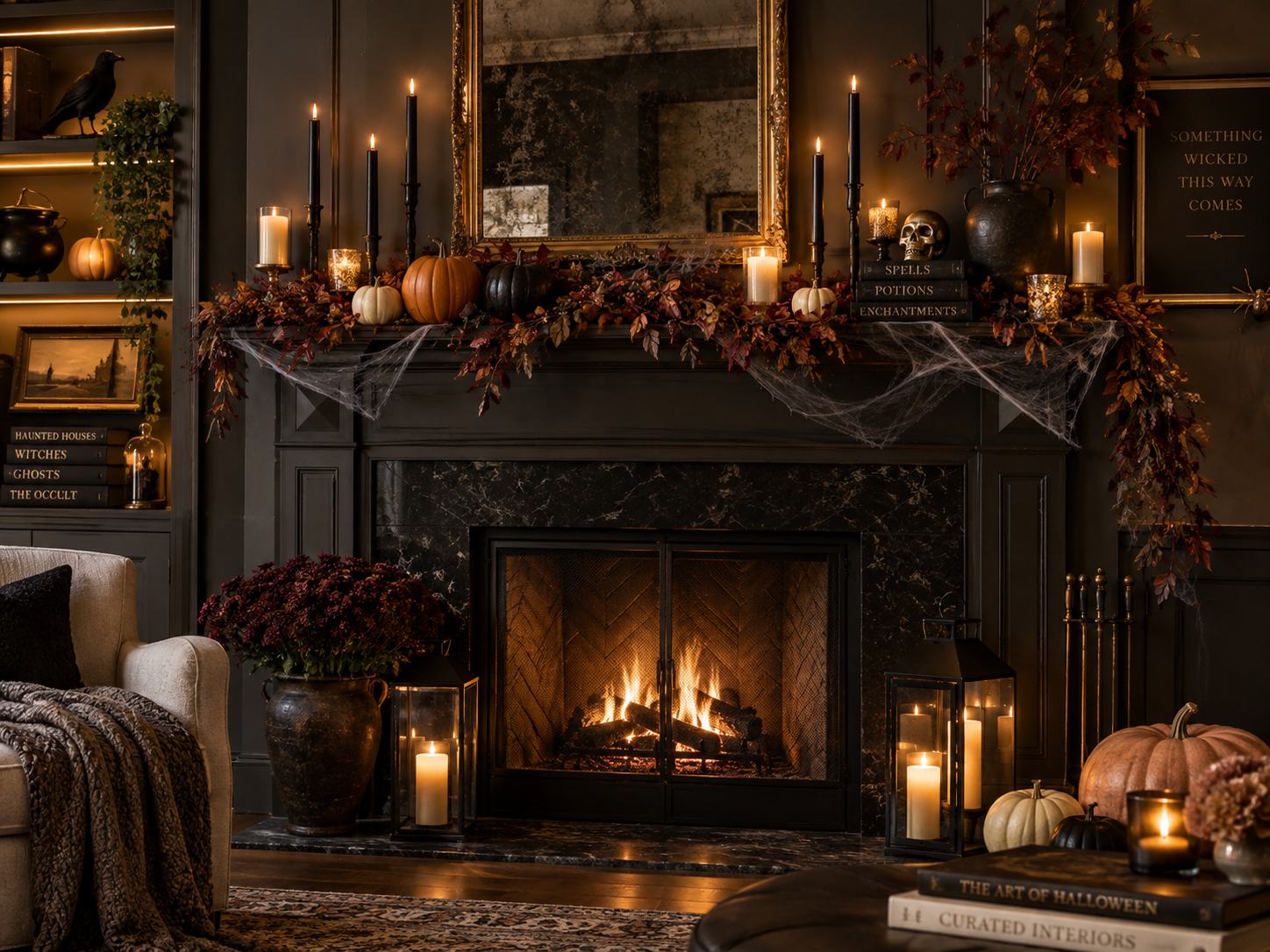
1. Style a Halloween Mantel With Candles and Layered Texture

A decorated mantel is one of the easiest ways to create a strong Halloween focal point indoors. Use black taper candles, pillar candles, pumpkins in mixed tones, autumn garland, and subtle gauzy spiderweb texture to build depth. Dark walls, an aged mirror, and warm candlelight can make the entire setup feel more elevated.

This approach works especially well when you want something moody and elegant rather than overly playful. A few curated accents go a long way.

Halloween mantel decor with candles pumpkins and autumn garland

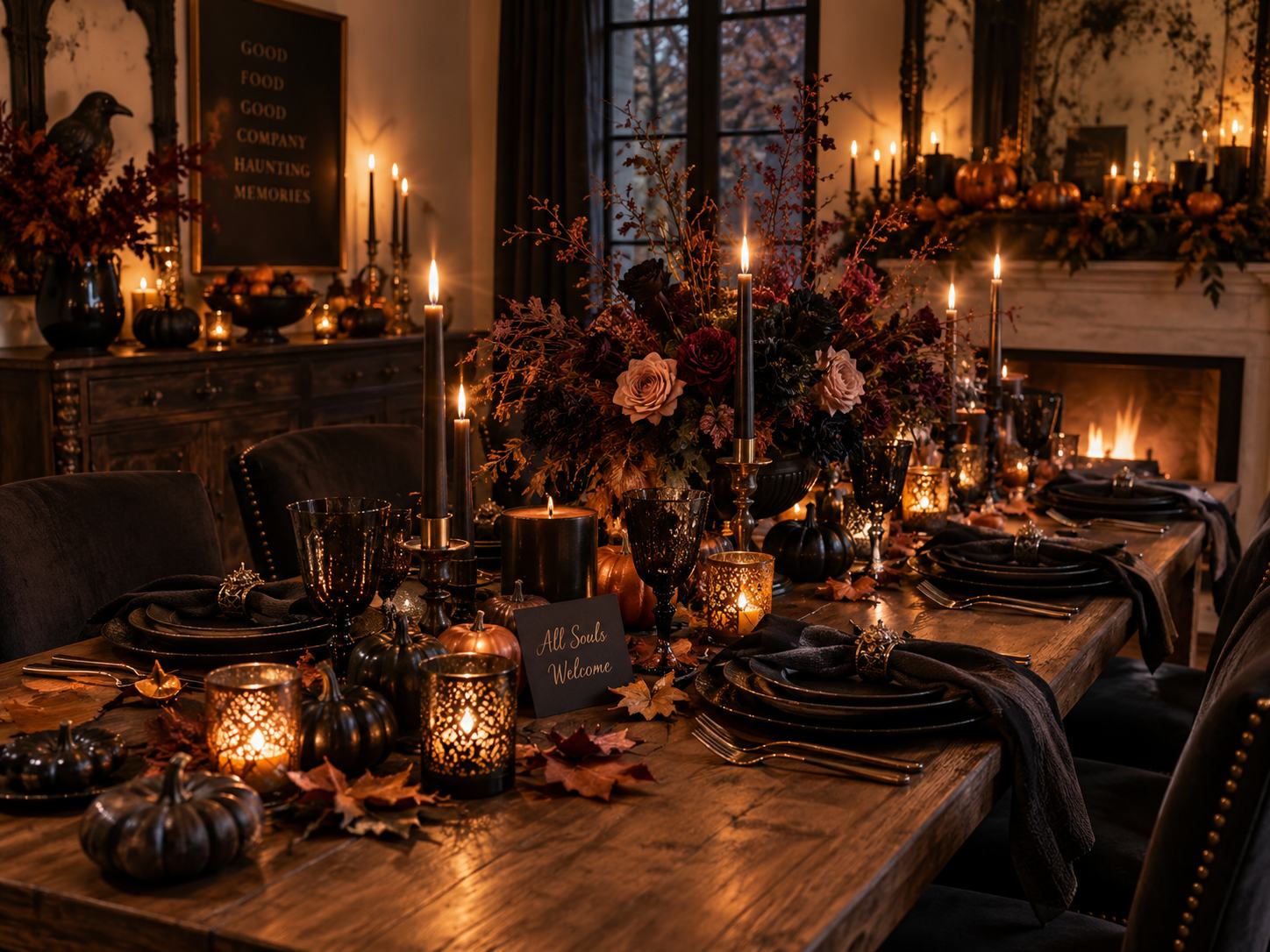
2. Create a Dramatic Halloween Dining Table

A Halloween dining room does not need heavy novelty decor to feel memorable. Start with a dark table setting, black or smoky glassware, candlelight, pumpkins, and a rich floral arrangement in autumn tones. Layering textures such as wood, metal, glass, and leaves helps the table feel seasonal and full.

This look is ideal for Halloween dinners, themed gatherings, or anyone who wants a more refined entertaining setup.

Halloween dining table decor with black plates candles and floral centerpiece

3. Make the Living Room Feel Cozy and Spooky

A cozy Halloween living room balances comfort with seasonal details. Throw blankets, themed pillows, pumpkins, candles, string lights, and a styled coffee table can completely shift the mood of the room. A lit fireplace or warm amber lighting adds even more atmosphere.

This is one of the easiest ways to decorate for Halloween while still keeping the room practical for everyday use.

Cozy Halloween living room decor with pumpkins candles and string lights

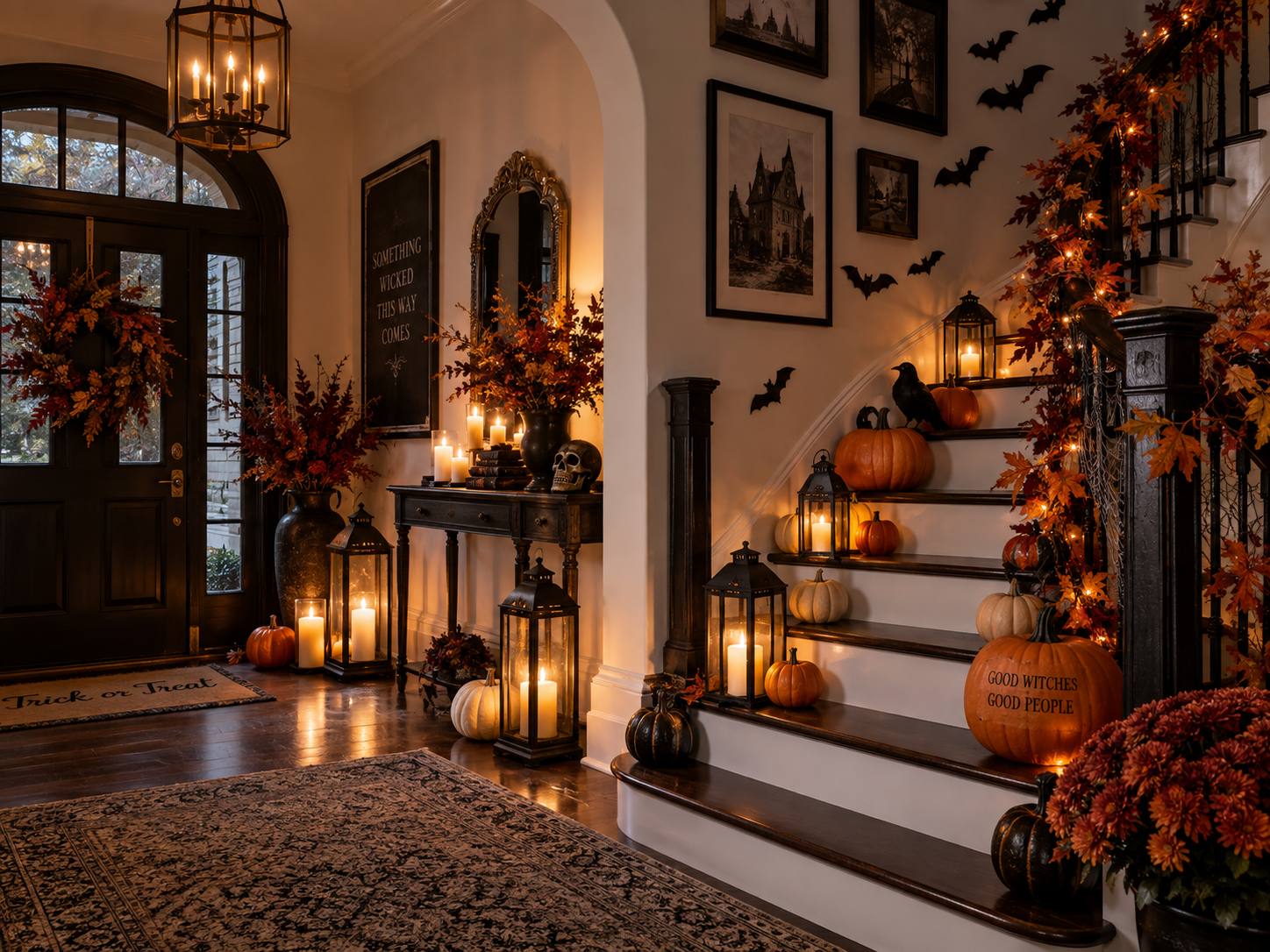
4. Decorate the Foyer and Staircase

The foyer is where guests first experience the tone of your home, so it is worth styling. Pumpkins on the stairs, lanterns with candles, autumn garland on the banister, wall bats, and a console table with candles and foliage can create a polished Halloween entrance indoors.

This kind of setup works particularly well in homes with staircases because the vertical space helps the decor feel more layered and dramatic.

Halloween foyer and staircase decor with lanterns pumpkins and fall garland

5. Build a Warm Halloween Front Porch

A strong front porch setup can make the whole exterior feel festive. Layer large and small pumpkins, lanterns, candles, mums, a bench or chair, and a seasonal wreath to create a welcoming porch that still feels distinctly Halloween.

Using soft warm light instead of harsh lighting keeps the display inviting while still allowing the spooky details to stand out.

Warm Halloween front porch decor with pumpkins lanterns and mums

6. Give the Front Door Strong Seasonal Curb Appeal

The front door is one of the most important decor moments outside. A dark painted door, a dramatic wreath, potted mums, layered pumpkins, candles, and a few signs can create a complete look without needing a large porch.

If you want the exterior to look polished in photos, focus on symmetry, warm lighting, and repeated materials such as black metal lanterns and natural autumn textures.

Halloween front door decor with wreath candles mums and pumpkins

7. Light the Walkway for a Spooky Arrival

A decorated walkway creates anticipation before guests even reach the door. Line the path with lanterns, pumpkins, and fallen leaves, then add a few signs or subtle figures to make the space feel immersive. Warm candlelight and low lighting can turn an ordinary entry into a full Halloween experience.

This works especially well for evening entertaining and trick-or-treat night because it adds both atmosphere and visual direction.

Halloween walkway decor with lanterns leaves and glowing pumpkins

8. Set Up a Halloween Backyard Party Space

If you plan to host outdoors, a backyard setup can become a major feature. Use string lights, candles, pumpkins, lounge seating, a dining table, and a drink or dessert station to create a complete Halloween entertaining zone. Keep the palette cohesive with black, orange, cream, and warm wood tones.

This style of decor turns a regular patio into a memorable seasonal gathering space.

Halloween backyard party decor with string lights dining table and dessert station

9. Add Halloween Decor to the Kitchen or Coffee Bar

A decorated kitchen corner or coffee bar is a simple way to carry the Halloween theme deeper into the home. Use seasonal mugs, pumpkins, candles, small treats, signs, and a few black-and-orange accents to make the area feel styled and fun.

This works well for everyday enjoyment because it gives the home a seasonal touch in a space people use constantly.

Halloween coffee bar decor with seasonal mugs treats and pumpkins

Quick Tips for Better Halloween Decor

  • Use lighting intentionally: candles, lanterns, and string lights do more for atmosphere than overcrowding a space with props.
  • Repeat materials: black metal, warm wood, natural pumpkins, and autumn foliage help indoor and outdoor spaces feel cohesive.
  • Mix spooky with cozy: the strongest Halloween decor usually feels both festive and livable.
  • Keep a color story: black, orange, rust, cream, deep plum, and warm neutrals work especially well together.
  • Decorate in layers: large anchor pieces, medium accents, and small details give the display more depth.

Final Thoughts

Halloween indoor and outdoor decor works best when it feels styled rather than random. A candlelit mantel, an elegant dining table, a cozy living room, a decorated staircase, a porch full of pumpkins, a strong front door, a glowing walkway, a backyard party setup, and a festive coffee bar each offer a different way to make the season feel more immersive.

Pick one area or combine several, and you can turn your home into a Halloween space that feels warm, festive, and polished from the inside out.

Sunday, 09 August 2026 06:12

At first glance, a hippopotamus and a whale appear to have almost nothing in common.

One is a massive, barrel-shaped mammal that spends much of its life in African rivers and lakes. The other includes some of the most completely aquatic animals on Earth, from dolphins and porpoises to the enormous blue whale.

Yet genetics and fossils reveal something extraordinary:

Hippos are the closest living relatives of whales and dolphins.

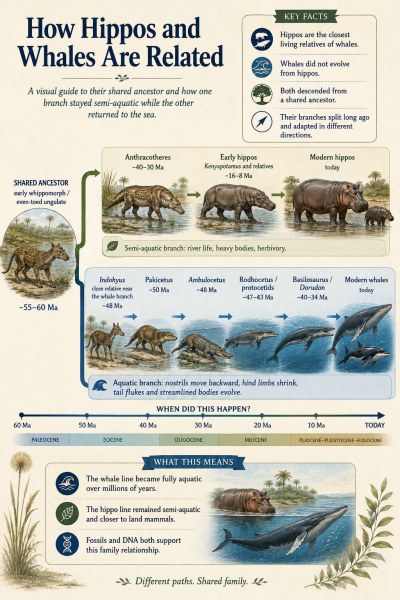
They did not evolve from whales, and whales did not evolve from hippos. Instead, both branches descend from an extinct common ancestor that lived roughly 55 million years ago.

From that ancestral population, evolution eventually produced two radically different experiments in living around water.

One branch remained tied to land and freshwater and ultimately produced the hippopotamuses.

The other returned progressively to the water until its descendants became completely aquatic whales, dolphins and porpoises.

It is one of the most dramatic transformations in mammalian evolution.

The Family Connection Scientists Didn't Expect

For many years, scientists tried to determine where whales belonged on the mammalian family tree.

Their bodies offered few obvious clues. Modern whales have flippers instead of walking legs, streamlined bodies, tail flukes and almost no visible connection to hoofed terrestrial mammals.

Genetic evidence eventually produced a surprising result.

Whales belong within the same major evolutionary group as even-toed hoofed mammals, which includes animals such as cattle, deer, giraffes, pigs and hippos. Within that group, living hippos form the closest surviving branch to cetaceans—the group containing whales, dolphins and porpoises.

Scientists sometimes refer to the hippo-cetacean grouping as Whippomorpha, although classifications and terminology can vary.

The important point is simple:

A whale is evolutionarily more closely related to a hippopotamus than it is to most other living hoofed mammals.

Their Common Ancestor Walked on Four Legs

The last common ancestor of hippos and cetaceans was nothing like a modern blue whale.

It was a four-legged mammal belonging to the broader even-toed ungulate lineage. Estimates place the split leading toward hippos and cetaceans at roughly 55 million years ago, although reconstructing the exact appearance and ecology of that ancestral species remains difficult because the fossil record is incomplete.

This is also an important correction to a common misconception.

There was not necessarily one known fossil species that scientists can point to and say:

"That animal became both hippos and whales."

Evolutionary trees represent populations branching over enormous periods of time. Many fossils provide snapshots of nearby branches rather than direct parent-to-child sequences.

That means animals such as Indohyus, Pakicetus and Ambulocetus are extremely valuable for understanding early whale evolution, but they should not simply be presented as a straight line of direct ancestors leading from hippo to whale.

Then the Family Tree Split

Imagine an evolutionary fork approximately 55 million years ago.

One lineage eventually moved toward what became the hippo family.

The other became the first cetaceans.

The two branches then followed radically different paths.

Branch One: Toward Hippos

The fossil history of hippos is actually harder to reconstruct than the evolution of whales.

Scientists have long investigated extinct mammals known as anthracotheres, semi-aquatic even-toed ungulates that had features connecting them with the lineage leading toward hippopotamuses. Research has helped close some of the large gaps between early cetartiodactyl ancestors and later hippos, although the precise relationships among several fossil groups remain debated.

Over millions of years, the lineage leading to modern hippos retained four weight-bearing limbs and remained capable of moving on land while becoming strongly adapted to freshwater environments.

Modern hippos spend large portions of their lives in water, but they are not fully aquatic mammals in the way whales are.

They still return to land and retain the basic terrestrial body architecture of their ancestors.

Branch Two: Toward Whales

The other branch underwent one of the greatest habitat transitions known among vertebrates:

a land mammal returned to the sea.

Early cetaceans began appearing more than 50 million years ago. Fossils document progressively more aquatic forms as the lineage moved from land to shallow water and eventually into open oceans.

Several fossils help illustrate this extraordinary transition.

Pakicetus — About 50 Million Years Ago

Pakicetus looked much more like a four-legged land mammal than a modern whale.

It lived around 50 million years ago in the region that is now Pakistan and is considered among the earliest known cetaceans. Its skeleton was adapted primarily for terrestrial movement, even though anatomical characteristics—particularly involving the skull and hearing apparatus—connect it firmly with whales.

If someone had encountered Pakicetus alive, they probably would not have immediately thought:

"whale."

Yet it occupied an early position on the cetacean side of the family tree.

Ambulocetus — The "Walking Whale"

A little later came animals such as Ambulocetus.

Its name essentially means "walking whale."

Ambulocetus retained substantial limbs capable of supporting it outside the water, while its body also shows adaptations for swimming. It represents the kind of intermediate anatomy scientists would expect during a transition from terrestrial locomotion toward increasingly aquatic life.

This evolutionary stage probably looked less like a modern whale and more like a large semi-aquatic predator.

The important point is not that Ambulocetus suddenly transformed into a whale.

Rather, fossils like it reveal that early cetaceans existed at stages between terrestrial and fully marine life.

The Legs Began Losing Their Importance

As later cetaceans spent increasingly more time in the water, natural selection began reshaping almost every part of their bodies.

Forelimbs became specialized for swimming.

Hind limbs became progressively reduced.

Bodies became more streamlined.

The tail became increasingly important for propulsion.

The skull changed.

Breathing became increasingly adapted to life at the surface of the water.

Hearing changed dramatically to function underwater.

Eventually, cetaceans no longer needed functional rear legs for locomotion.

By roughly 40 million years ago, ancient whale groups included forms that were completely aquatic.

Basilosaurids: Whales That Could No Longer Walk

Animals belonging to the basilosaurid group represent a much later stage in this transition.

These were unmistakably whales.

They were fully aquatic and lived approximately 40–34 million years ago. Fossil evidence shows that these animals possessed extremely reduced hind limbs that were no longer capable of supporting their bodies on land. Basilosaurids are close to the evolutionary ancestry of modern cetaceans.

At this point, the great return to the water was essentially complete.

Their descendants would eventually diversify into the two great living cetacean branches:

baleen whales, including blue, humpback and right whales,

and

toothed whales, including sperm whales, orcas, dolphins and porpoises.

Why Do Whales Still Have Evidence of Their Land-Animal Past?

Evolution rarely redesigns an organism from nothing.

Instead, it modifies structures that already exist.

That is why modern whales retain anatomical and genetic evidence of their terrestrial ancestry.

Their front flippers contain bones corresponding to the same basic limb structures found in terrestrial mammals.

Their ancestors possessed hind limbs.

Whales still breathe air with lungs, rather than extracting oxygen from water like fish.

They give birth to live young and nurse them with milk.

And evolutionary changes associated with cetacean movement, cardiovascular function, vision and other physiological systems can still be detected in their genomes.

A whale therefore isn't a fish-shaped animal that somehow became mammalian.

It is the descendant of land mammals whose bodies were progressively reshaped for life in water.

And Hippos Took a Different Route

The hippo branch never completed that return to the sea.

Instead, it specialized in a lifestyle positioned between terrestrial and aquatic environments.

Hippos spend many daylight hours submerged, use water for thermoregulation and move comfortably through rivers and lakes, yet retain four functional walking limbs.

This produces one of evolution's fascinating contrasts.

Beginning with closely related ancestral populations, natural selection ultimately produced:

one branch that remained amphibious and terrestrial enough to become the hippopotamus,

and

another branch that became so completely aquatic that its descendants eventually included the largest animals ever known.

But Their Aquatic Similarities Are Not Necessarily Inherited From One Aquatic Ancestor

There is another intriguing complication.

Because both hippos and whales are strongly associated with water, it might seem obvious that their common ancestor was already highly aquatic.

But research into their skin genetics suggests that some of the specialized skin characteristics seen in modern hippos and cetaceans evolved independently after their lineages separated.

That is a classic example of convergent evolution.

Related organisms can independently acquire similar solutions when they encounter similar environmental pressures.

The hippo and whale lines both became increasingly adapted to life around water—but they did not necessarily inherit every aquatic adaptation from the same ancestor.

DNA Solved a Mystery That Bones Alone Couldn't

The whale-hippo relationship is also a wonderful example of how modern evolutionary science works.

For much of scientific history, researchers reconstructed relationships primarily by comparing skeletons and fossils.

That method is extraordinarily valuable, but highly modified animals can make comparisons difficult.

A dolphin scarcely resembles a hoofed mammal externally.

Genetic analysis revealed relationships that morphology alone had obscured. Scientists then returned to the fossil record and discovered additional anatomical evidence supporting the molecular results.

Today, fossils and genetics reinforce the conclusion:

cetaceans belong deep within the evolutionary radiation of even-toed ungulates, and hippos are their closest living relatives.

The Family Tree in Simple Form

A simplified representation looks something like this:

Early even-toed mammal ancestor
↓
Common hippo-cetacean ancestor — roughly 55 million years ago
↙︎            ↘︎
Hippo lineage      Cetacean lineage
↓             ↓
Anthracothere-related forms  Early cetaceans
↓             ↓
Early hippopotamids     Pakicetus-like forms
↓             ↓
Modern hippos       Amphibious cetaceans
             ↓
           Fully aquatic ancient whales
             ↓
          Baleen + toothed whales
             ↓
        Whales, dolphins & porpoises today

That tree is intentionally simplified. Evolution involves many side branches and extinct species rather than a neat single-file procession.

Two Animals That Reveal the Power of Evolution

Perhaps the most remarkable part of this story is what happened after the split.

One lineage ultimately produced an animal weighing several tonnes that still walks on four legs and spends much of its life in rivers.

The other eventually produced animals that never need to walk at all.

Some became dolphins capable of sophisticated echolocation.

Some became deep-diving sperm whales.

And one lineage produced the blue whale—the largest known animal in Earth's history.

Yet deep within their evolutionary history, those very different animals remain connected.

The hippo standing in an African river and the whale swimming through the open ocean are distant cousins separated by roughly 55 million years of evolution.

Their story demonstrates something fundamental about evolution:

An ancestor does not determine one inevitable destination.

Populations separate.

Environments differ.

Natural selection follows different pressures.

Bodies change.

Millions of years pass.

And eventually two branches of the same ancient family can become so different that their relationship is almost impossible to recognize—until fossils and DNA reveal the connection.

Wednesday, 15 July 2026 07:37

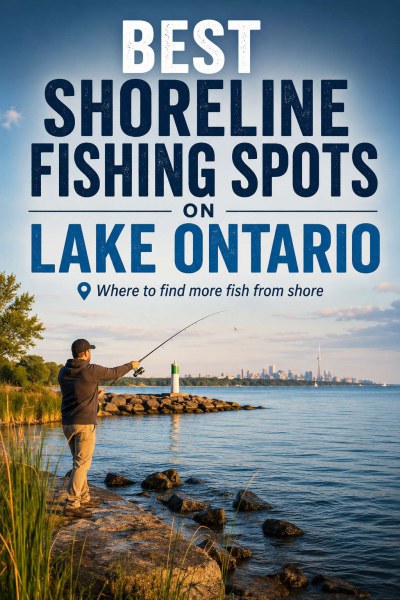
Lake Ontario is full of fish, but if you walk along a random stretch of shoreline, it can feel like there is nothing there.

That does not mean the lake is empty. It usually means the fish are holding in the places that give them what they need: cooler water, food, structure, current, shelter, or access to tributaries. Shoreline fishing on Lake Ontario is less about picking any open spot and more about finding the right type of shoreline.

The good news is that there are still plenty of productive places to fish from shore, especially around river mouths, piers, harbours, marinas, rocky points, wetlands, and restored waterfront habitats.


Why There Are Not Always Lots of Fish Right Along the Shore

1. Lake Ontario is deep, and many fish move with temperature

Lake Ontario is a large, deep lake. Fish do not stay in one place all year. They move based on temperature, oxygen, food, and spawning patterns.

In warm weather, many trout and salmon move deeper or farther offshore because they prefer cooler water. In spring and fall, they are more likely to move closer to shore or into tributaries.

Destination Ontario notes that trout around Toronto are most active in cooler water, with productive periods in spring, fall, and other cold-weather months. It also notes that many major Lake Ontario river mouths are open to trout fishing year-round, but anglers should check the specific zone rules.


2. Fish follow food, not sidewalks

Fish do not spread evenly along the shoreline. They follow baitfish, insects, crayfish, gobies, plankton, and other food.

That is why some shoreline areas look dead, while a nearby river mouth, harbour wall, weed bed, or rocky point may hold fish.

Good shoreline fishing areas usually have at least one of these:

  • Current
  • Rocks
  • Weeds
  • Drop-offs
  • Shade
  • Baitfish
  • River inflow
  • Marina structure
  • Wetland habitat
  • Piers or breakwalls

3. Much of the shoreline has been changed

Urban shorelines are often hardened with concrete, seawalls, marinas, roads, and development. That can reduce natural fish habitat.

Fish prefer structure and habitat. Natural shoreline areas with wetlands, rocks, plants, sheltered bays, and current usually attract more fish than flat concrete walls with no cover.

That is why restored areas, marshes, river mouths, and parks often produce better fishing than random open waterfront.


4. Clear water can make fish more cautious

Invasive mussels have made many parts of the Great Lakes clearer by filtering plankton from the water. Clearer water can make fish more cautious near shore because they are more exposed to predators, shadows, people, and boat traffic.

So even when fish are present, they may feed during lower-light periods such as:

  • Early morning
  • Evening
  • Cloudy days
  • After rain
  • During seasonal migrations

Best Shoreline Locations to Fish on Lake Ontario

Here are some of the better types of places and specific shoreline locations to consider.

Quick Location Table

Location Best For Why It Works
Humber River Mouth / Humber Bay Salmon, trout, bass, pike, panfish, carp River mouth, current, resident and migratory fish
Humber Bay Park West Mixed species Near Mimico Creek and Humber River influence
Toronto Islands Bass, pike, panfish, carp Sheltered water, weeds, structure
Tommy Thompson Park Bass, pike, carp, panfish Restored habitat, rocky shoreline, protected water
Ashbridges Bay Pike, bass, panfish, carp Harbour structure, bay habitat
Bluffers Park Bass, panfish, carp, trout/salmon at times Deeper nearby water and shoreline access
Port Credit / Credit River Mouth Salmon and trout Major migratory river mouth
Port Dalhousie / St. Catharines Salmon, trout, bass, walleye, panfish Piers, marina, Lake Ontario access
Ganaraska River / Port Hope Salmon and trout Major salmon and trout run
Kingston Waterfront / Bay of Quinte Area Bass, pike, walleye, perch Eastern Lake Ontario structure and warmer bays

1. Humber River Mouth and Humber Bay

This is one of the best urban shore fishing areas in Toronto.

The mouth of the Humber River, around Humber Bay Park East and the pedestrian bridge, is listed by Destination Ontario as one of Toronto’s most productive urban salmon and trout fishing spots, especially during the fall run. The same source also lists species such as chinook salmon, coho salmon, rainbow trout, brown trout, northern pike, bass, perch, panfish, bullhead, and carp.

Why it is good

  • Major river mouth
  • Seasonal salmon and trout movement
  • Good access
  • Mix of resident and migratory fish
  • Nearby parkland and shoreline structure

Best times

  • Spring for trout
  • Late summer and fall for salmon
  • Early morning or evening for bass, pike, and carp

2. Humber Bay Park West

Humber Bay Park West is another strong shoreline option. Destination Ontario notes that the nutrient-rich inflow of Mimico Creek, combined with the park’s location near the mouth of the Humber River, attracts both migratory and resident fish year-round.

Why it is good

  • Big waterfront park
  • River and creek influence
  • Shoreline walking access
  • Mixed fish species
  • Good city skyline views

Good targets

  • Salmon
  • Trout
  • Pike
  • Bass
  • Perch
  • Carp
  • Panfish

3. Toronto Islands

The Toronto Islands are one of the better shoreline fishing areas because the water is more sheltered and has more structure than much of the open lakefront.

The City of Toronto lists the Toronto Islands among its official “Where to Fish” locations.

Why it is good

  • Sheltered channels
  • Weeds and structure
  • Shoreline variety
  • Good for casual anglers
  • Less exposed than open lakefront

Good targets

  • Largemouth bass
  • Northern pike
  • Carp
  • Perch
  • Panfish

4. Tommy Thompson Park

Tommy Thompson Park is another strong Toronto shoreline location because it has a mix of rocky shoreline, protected water, habitat restoration, and access to deeper water nearby.

The City of Toronto lists Tommy Thompson Park as one of its public fishing locations.

Why it is good

  • Rocky structure
  • Protected bays
  • Restored natural habitat
  • Good walking access
  • Less “flat concrete” shoreline

Good targets

  • Bass
  • Pike
  • Carp
  • Panfish
  • Migratory fish at certain times

5. Ashbridges Bay Park

Ashbridges Bay is a popular shoreline fishing location because bays and harbour-style areas often hold warmer water, weeds, baitfish, and structure.

The City of Toronto includes Ashbridges Bay Park on its list of places to fish.

Why it is good

  • Bay habitat
  • Harbour structure
  • Accessible shoreline
  • Good for warm-water species

Good targets

  • Pike
  • Bass
  • Carp
  • Perch
  • Panfish

6. Bluffers Park

Bluffers Park in Scarborough is another public shoreline location listed by the City of Toronto.

It can be a better option than featureless shoreline because it has park access, harbour structure, and deeper Lake Ontario water nearby.

Why it is good

  • Shore access
  • Harbour and marina structure
  • Nearby deeper water
  • Scenic location

Good targets

  • Bass
  • Carp
  • Panfish
  • Pike
  • Trout or salmon during certain seasonal windows

7. Rouge River Marsh

Rouge River Marsh is one of the more diverse fishing areas in Toronto’s east end, but access is important to confirm before going.

Destination Ontario describes Rouge River Marsh as one of the most diverse fishing spots in the GTA, with both resident fish and migratory species travelling up from Lake Ontario. It also notes that Rouge Beach and the marsh are temporarily closed because of construction, with access expected to resume in 2027.

Why it is good

  • River mouth habitat
  • Marsh habitat
  • Resident and migratory fish
  • Natural shoreline environment

Check before going

Because access conditions can change, confirm whether the area is open before planning a trip.


8. Port Credit / Credit River Mouth

Port Credit is one of the best-known shoreline fishing areas west of Toronto.

Destination Ontario describes the lower Credit River in Mississauga as especially productive for migratory salmon and trout, and notes that the Credit River is known for more than 45 fish species.

Why it is good

  • Major tributary
  • Salmon and trout runs
  • Harbour access
  • Walkable waterfront area
  • Strong seasonal movement

Best times

  • Spring for trout
  • Late summer and fall for salmon
  • Cooler mornings and evenings

9. Port Dalhousie and St. Catharines Shoreline

On the Niagara side of Lake Ontario, Port Dalhousie and Port Weller are well-known access points.

FishingBooker’s St. Catharines guide notes that Port Dalhousie allows anglers to fish Lake Ontario from the pier, marina, boat, or kayak, and also lists 12 Mile Creek, Four Mile Creek, and the Niagara River as important fishing options in the area.

Why it is good

  • Pier access
  • Marina structure
  • Lake Ontario access
  • Nearby tributaries
  • Seasonal trout and salmon movement

Good targets

  • Trout
  • Salmon
  • Bass
  • Walleye
  • Panfish

10. Ganaraska River / Port Hope

For salmon and trout, Port Hope is one of the classic Lake Ontario shoreline and tributary areas.

Destination Ontario notes that the Ganaraska River flows into Lake Ontario at Port Hope and is home to one of Southern Ontario’s most extensive salmon runs, along with excellent trout fishing.

Why it is good

  • Major salmon run
  • Strong trout opportunities
  • Shore-accessible areas
  • Famous migratory fish destination

Best times

  • Fall for salmon
  • Spring and fall for trout

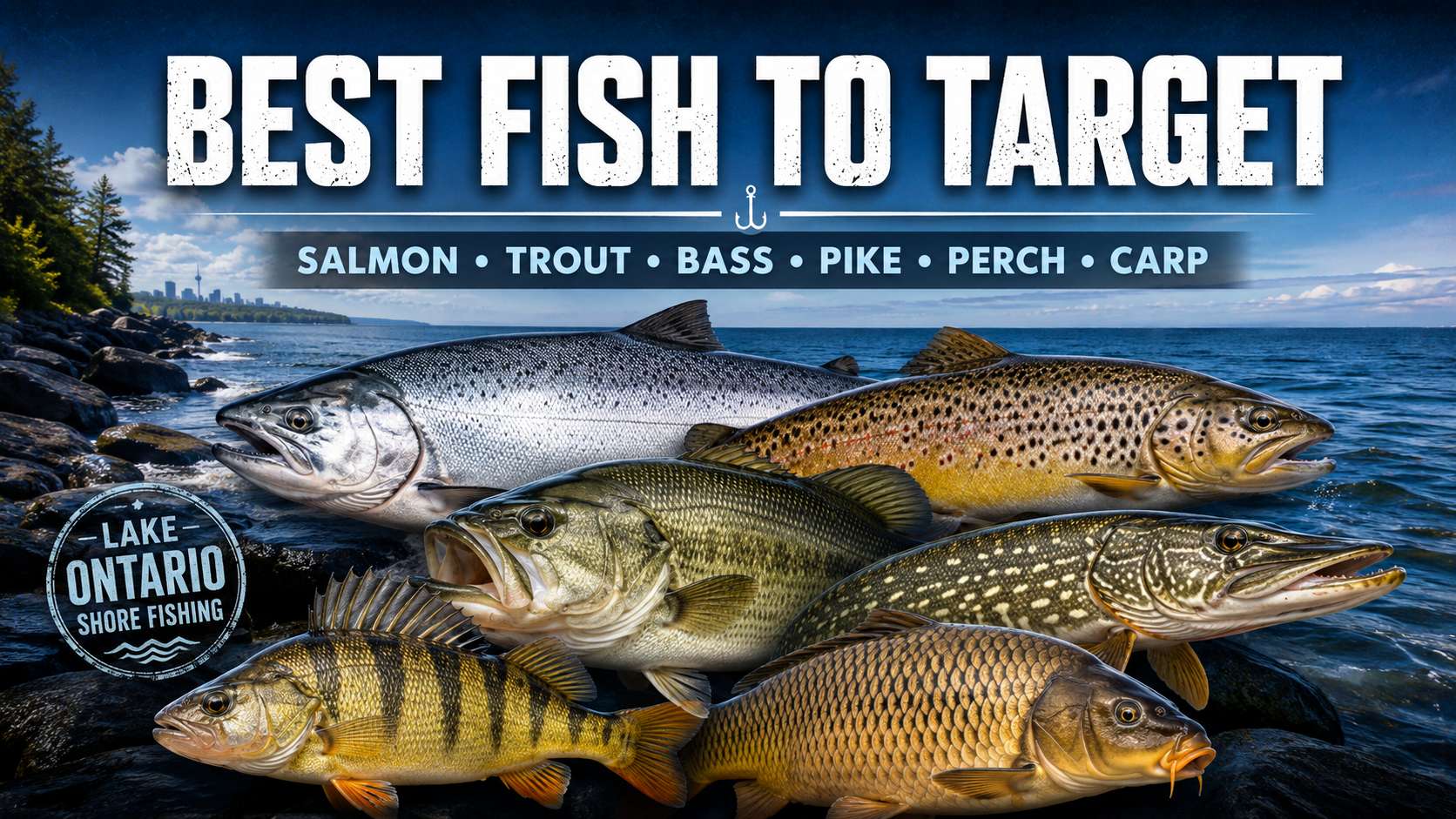
What to Fish For From Shore

Species Best Shoreline Areas Best Timing
Salmon River mouths, piers, tributary mouths Late August through fall
Rainbow trout / steelhead Tributary mouths and lower river sections Spring and fall
Brown trout River mouths, harbours, cold-water areas Spring, fall, cool weather
Bass Rocks, weeds, bays, harbours Late June through fall
Pike Weedy bays, marinas, sheltered water Spring and fall, also early/late day
Carp Warm bays, harbours, river mouths Spring through fall
Perch and panfish Piers, marinas, sheltered bays Spring through fall
Walleye Eastern Lake Ontario, Bay of Quinte, low light Spring, fall, evening

Best Conditions for Shoreline Fishing

If you are walking the shoreline and not seeing fish, try changing the conditions rather than giving up.

Better fishing windows usually include:

  1. Early morning
    Fish are often closer to shore before the sun gets high.
  2. Evening
    Low light makes fish more comfortable feeding near shore.
  3. After rain
    Rain can increase tributary flow and trigger trout or salmon movement.
  4. Cloudy days
    Fish may stay shallower longer when the light is reduced.
  5. Wind blowing into shore
    Wind can push baitfish and food toward the shoreline.
  6. Seasonal runs
    Salmon and trout move near shore and into rivers at specific times.

Safety, Rules, and Eating Fish

Before fishing, check the current Ontario rules for the exact waterbody and zone. Lake Ontario is part of Fisheries Management Zone 20, which includes Lake Ontario, Hamilton Harbour, the Niagara River downstream of the falls, and related waters. Ontario’s Zone 20 regulations list species seasons and limits, including open seasons for Pacific salmon and rainbow trout, plus limits for pike, walleye, yellow perch, and other species.

The City of Toronto also reminds anglers to follow posted signs because they indicate where fishing is and is not allowed.

Before eating fish, check Ontario’s Guide to Eating Ontario Fish, which provides advice by fish species, size, and location. The guide gives different advice for the general population and sensitive populations, including children and people who are pregnant or may become pregnant.


Summary

There are fish along the Lake Ontario shoreline, but they are not evenly spread out. The best shore fishing usually happens where the shoreline has something fish need: current, food, rocks, weeds, shade, piers, harbours, marinas, wetlands, or tributary access.

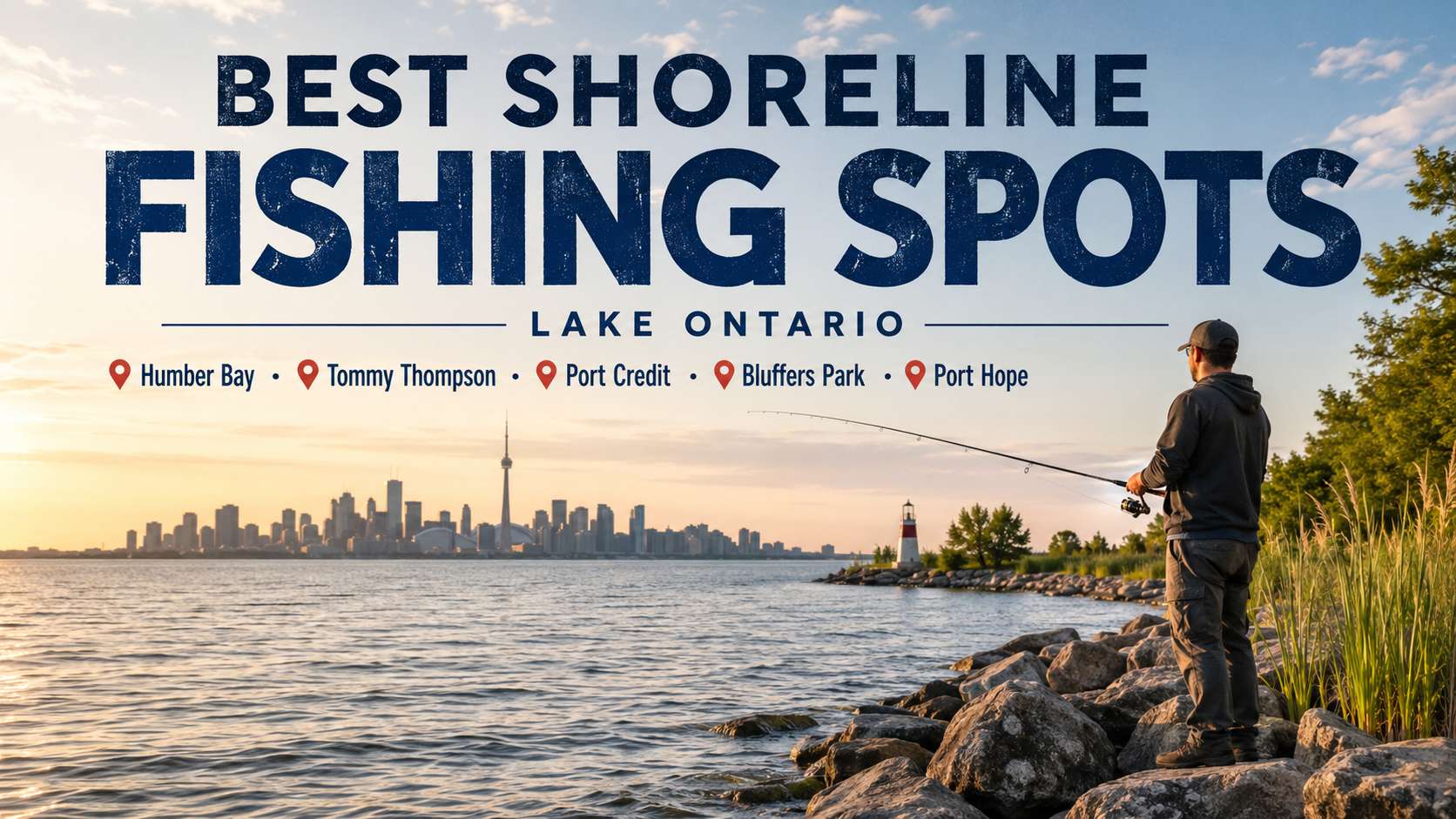
Instead of fishing a random open stretch of waterfront, focus on high-percentage areas like Humber River Mouth, Humber Bay Park, Toronto Islands, Tommy Thompson Park, Ashbridges Bay, Bluffers Park, Port Credit, Port Dalhousie, and the Ganaraska River at Port Hope.

Lake Ontario rewards anglers who think like fish: find the food, find the structure, watch the season, and fish the low-light windows.

Click here for terms of use

© 2026 Pamper Me Network. All Rights Reserved.