AI has turned event marketing into an information problem. The organizations that understand that shift will be easier to find, easier to recommend and easier to trust.
A promotional flyer can be beautifully designed, immediately understandable and almost invisible to the systems now shaping online discovery.
This article was optimized by the PublicistBot.
Want 10 articles per month promoting your business & making you money on autopilot? Activate the PublicistBot for $299.99/year. Add 720 short-form videos for $250 per month more.
Learn More About the Offer in This Article
Send your interest to the appropriate article or offer owner. PMN records the article that generated the enquiry, updates the funnel, logs the activity, sends notifications and adds the lead to PMN Messages.
The exact article is saved with the lead.
The featured offer or redemption link is preserved.
Owners receive messages and email notifications.
The applicant is connected to the campaign source.
A person can glance at an image and recognize the date, venue, speaker, subject and registration offer. Search engines and AI discovery tools do not always interpret that information with the same confidence. Important details may be locked inside an image, separated from the registration page or published without enough supporting context to explain who the event is for.
That creates a strange new reality for event marketers: a campaign can look complete while remaining incomplete as data.
AI did not make event promotion less visual. It made the information surrounding the visual more important.
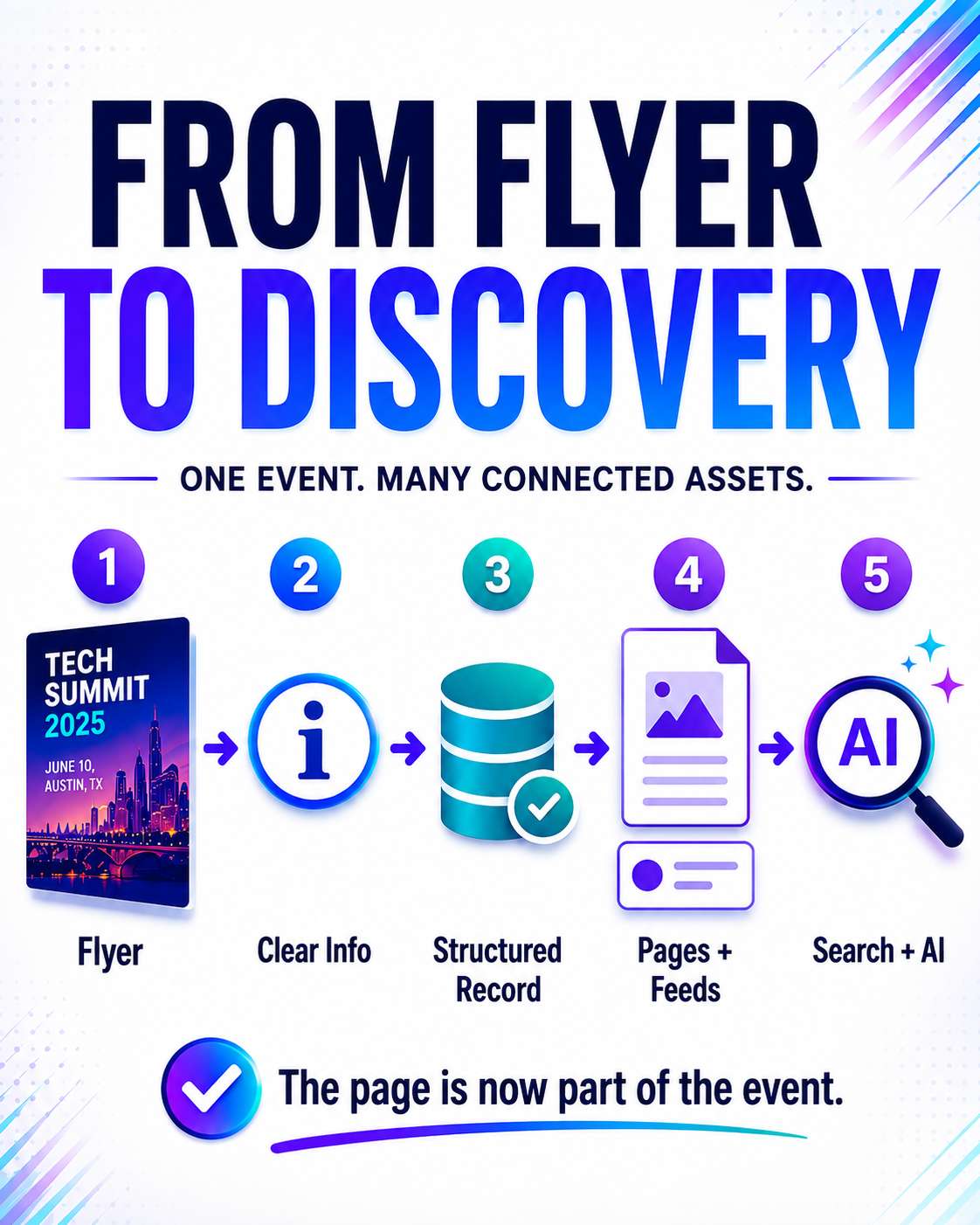
AI changed what it means to publish an event
For years, event promotion followed a familiar pattern. Create a flyer, publish a social post, send an email and direct people to a registration page.
That approach was built primarily for human attention. Modern discovery is increasingly mediated by systems that classify, summarize and recommend information before a person ever sees the original campaign.
Someone may now ask an AI assistant:
“What free marketing webinars are happening next month?”
Another person may search for:
“Online workshops for small-business owners in Toronto.”
A recommendation system may need to determine whether an event is relevant to entrepreneurs, creators, students or corporate marketers.
These systems require more than an attractive headline. They need explicit information about the event’s topic, audience, format, date, speakers, location, registration requirements and related offer.
When that information is missing, inconsistent or trapped inside a flyer, the event becomes harder to classify and easier to overlook.
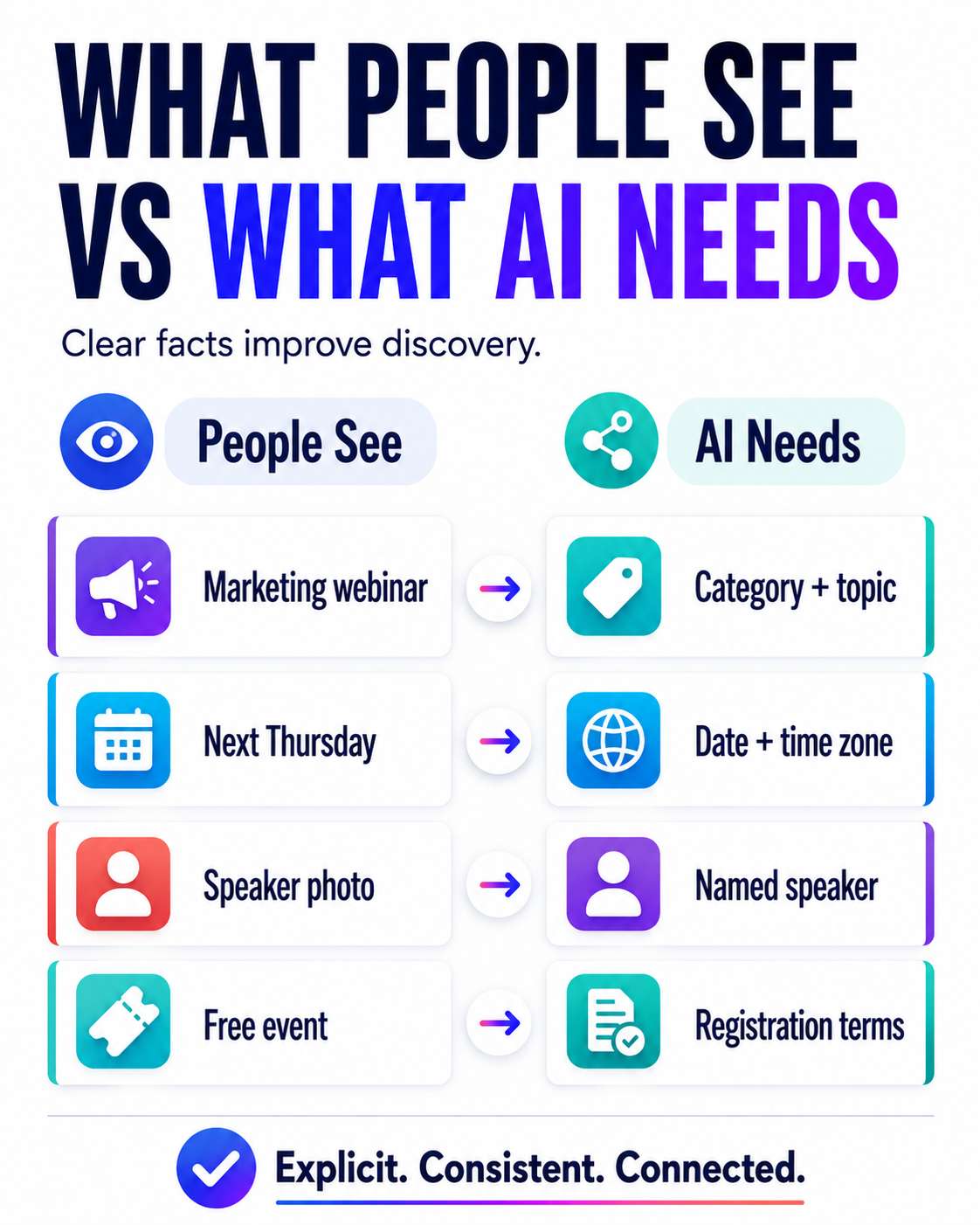
What people understand—and what machines need
| What a person may understand from a flyer | What a discovery system needs |
|---|---|
| “This is a marketing webinar” | A clear event category and topic |
| “It happens next Thursday” | A specific date, time and time zone |
| “That person is the speaker” | A named speaker with relevant context |
| “It is probably for business owners” | An explicitly defined audience |
| “The event is free” | Clear pricing and registration terms |
| “I can click the link in the post” | A stable registration destination |
| “There may be a related service” | A clearly described offer or next action |
The issue is not that machines are incapable of understanding images. Modern systems can extract text, recognize objects and interpret increasingly complex visual material.
The issue is reliability.
Event information may appear differently across a flyer, caption, registration page and social post. Dates may be written without a year. Time zones may be omitted. Speaker names may appear only in an image. The audience may be implied rather than stated.
AI systems work best when important facts are explicit, consistent and connected.
The event page is becoming infrastructure
The most useful event page is no longer simply an online poster. It is a structured source of truth.
It tells people what is happening while also giving search engines, AI tools, feeds, affiliates and apps enough information to reuse the opportunity accurately.
This is the problem the Events Discovery Network is designed to address.
EDN takes the information behind an event, contest or offer and organizes it into a campaign structure that can include a landing page, directory record, article, offer, infographic, video, structured data, RSS or JSON feed and tracked widget.
The distinction matters.
A flyer is one asset.
A discovery-ready campaign is a collection of connected assets that reinforce one another.
Flyer or announcement
          ↓
Clear event information
          ↓
Structured campaign record
          ↓
Pages, articles, feeds and widgets
          ↓
Search, AI, social, affiliates and apps
The goal is not to replace creative design with rows of technical data. It is to connect the two.
New Way To Market & Monetize Music
Whether it is music, events, articles or contests, PMN is the only creator marketplace dedicated to rewarding artists for building their fan network. See how we transform a simple MP3 file from static content into a dynamic shareable, trackable interactive video experience. Press play to sample the new way to enhance the content experience while simplifying the sales outreach, content discovery & monetization process. Ask how you can earn $1.00 from every fan that signs up FREE to support YOU.
For artists, managers, labels, producers and music marketers who want more from every release.
(30-second preview)
IMAGINE THIS POWERING YOUR NEXT RELEASE.
The visual attracts attention. The structured information gives that attention somewhere meaningful to go.
AI creates more competition—but also more leverage
AI has lowered the cost of producing promotional content. Organizers can now generate captions, articles, videos, graphics and follow-up messages faster than before.
That advantage is widely available, which means the volume of content is increasing.
More content does not automatically create more discovery. In many cases, it creates more noise.
The organizers most likely to benefit will not be those who produce the largest number of disconnected posts. They will be those who build coherent campaign systems.
One event can support:
- A central landing page
- A detailed editorial article
- Speaker and topic summaries
- Short-form social content
- An event-specific offer
- Referral-aware sharing links
- A guest-list campaign
- An event-related contest
- Follow-up content after the event
AI can help produce these assets, but the assets still need a common structure. Without that structure, automation may simply create multiple versions of the same incomplete announcement.
Free events need a longer economic life
The discovery problem becomes even more important for free events.
A free webinar or workshop may generate no ticket revenue, but it can still create commercial value by building an audience, introducing an offer, developing partnerships and identifying potential customers.
The event itself is only one part of the asset.
The guest list may be more valuable than the event date. The recording may remain useful after the live session. The speaker’s expertise can support future articles. A related contest can increase sharing. A post-event offer can convert interest into revenue.
PMN’s model adds another layer by allowing qualifying organizers, guests, contestants and registered voters to receive tracked Social Rewards for eligible actions. Event planners may also qualify for an annual revenue share when eligible EventBot, PublicistBot or AI Marketer licences are activated through their campaign ecosystem.
That changes the role of an attendee.
A guest is no longer only someone who registers. A guest may become a referral partner, content participant, future customer or promoter of the next event.
The same principle applies to contestants and voters. When sharing is attributable, participation can become part of the distribution system.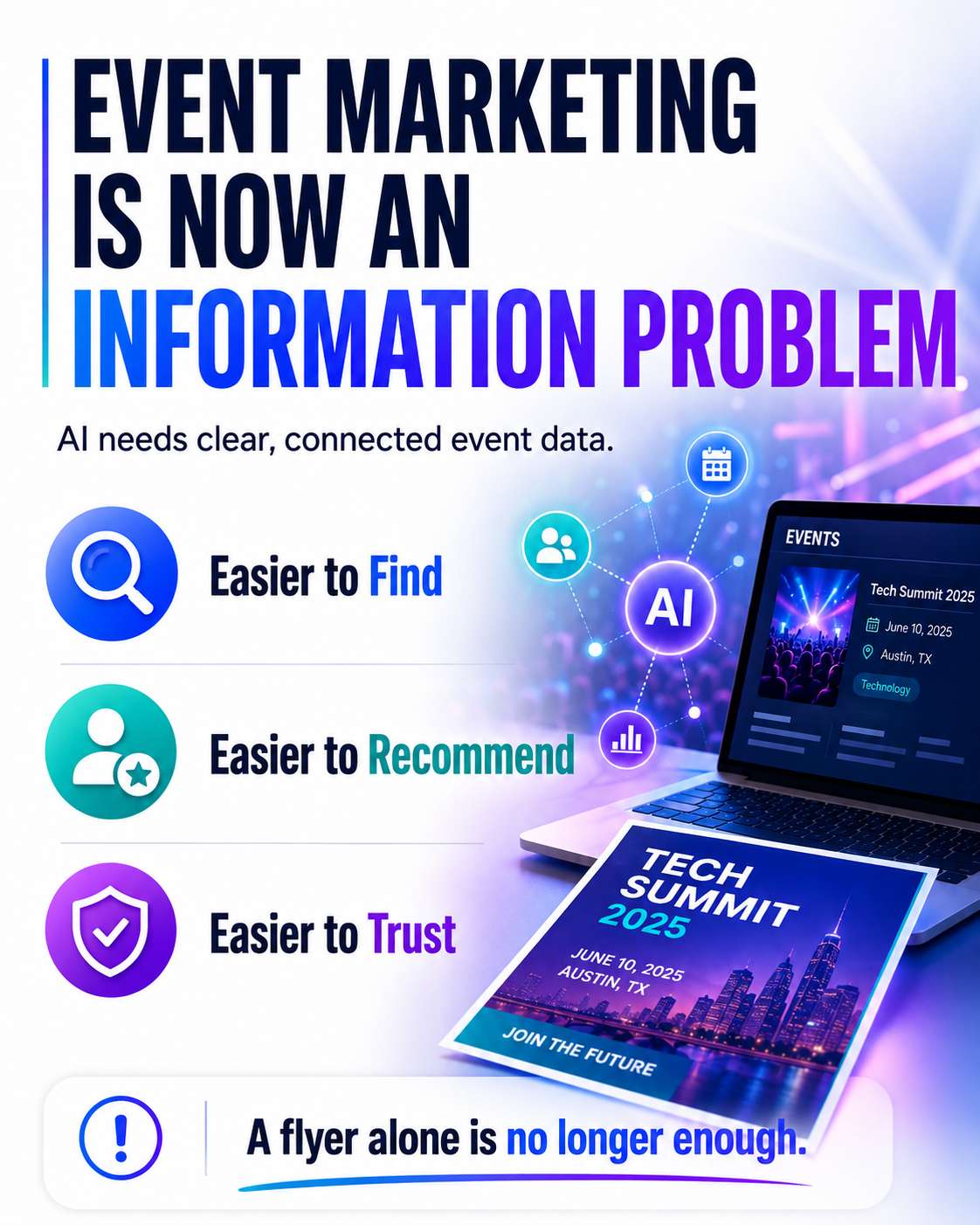
Discovery is cumulative
One event page may generate limited attention. A library of related events, articles, offers and contests creates more entry points.
That is why recurring organizers have an advantage.
A consultant who lists one webinar has one discovery asset. A consultant who publishes a webinar series, related articles, speaker profiles, downloadable resources and follow-up offers creates a larger body of connected information.
Turn one article into an ongoing visibility engine.
PublicistBot can keep your business visible with monthly articles, search-friendly distribution, affiliate-aware sharing, and optional AI Marketer video content.
Learn How to Share This Article and Earn $1.00 per Free Enquiry
Ask PMN how referral-aware article sharing works, how eligible free enquiries are attributed, and how Social Rewards are tracked in your account.
The exact article is saved with the lead.
The featured offer or redemption link is preserved.
Owners receive messages and email notifications.
The applicant is connected to the campaign source.
Each asset helps explain the others.
The Events Discovery Network is built around that cumulative model. More approved events, contests and offers give PMN additional material that may be expanded through editorial coverage, related pages, affiliate distribution and other promotional support.
This does not mean quantity should replace quality. Ten weak listings are not automatically more useful than one strong campaign.
The advantage comes from consistency:
- Each event has complete information.
- Each asset points to a clear destination.
- Each offer has an understandable next step.
- Each referral can be attributed.
- Each new campaign adds to the organizer’s existing discovery footprint.
Visibility still does not guarantee attendance
Structured information improves the possibility of discovery. It does not guarantee that an event will succeed.
An event can be technically well organized and still struggle because the topic is weak, the audience is poorly defined or the value proposition is unclear.
AI discovery systems cannot rescue an event people do not want.
They can, however, reduce preventable failures.
They can help ensure that a relevant person—or a system acting on that person’s behalf—can understand:
- What the event is
- Why it matters
- Who should attend
- When it happens
- How to register
- What happens afterward
That clarity is becoming a basic requirement of modern promotion.
The new job of the event marketer
The event marketer’s job is no longer finished when the flyer is published.
The modern task is to create an information environment around the event.
That environment must work for two audiences at once.
It must be persuasive enough for people and explicit enough for machines.
It must support immediate registration while also creating material that remains useful after the event ends.
It must encourage sharing while preserving attribution.
It must make the event visually appealing without allowing the most important information to remain trapped inside the visual.
The flyer still matters. It creates the first impression.
But the flyer is no longer the event.
The event is now the page, the data, the context, the article, the feed, the offer, the referral path and the measurable activity surrounding it.
The organizations that understand this shift will not simply create better promotions.
They will create events that are easier for the internet—and the AI systems increasingly organizing it—to understand.
Want more optimized articles like this?
PMN can create and promote up to 120 PublicistBot articles per year for $299.99/year, with an optional AI Marketer video add-on that adds up to 720 videos for $250 per month more.
Learn How to Earn $90.00 When a User Activates PublicistBot AI Agents
Ask PMN about the PublicistBot referral process, eligibility, attribution, commission tracking and the steps required for a qualifying activation.
The exact article is saved with the lead.
The featured offer or redemption link is preserved.
Owners receive messages and email notifications.
The applicant is connected to the campaign source.