
Why Artificial Intelligence Has Become One of the Defining Technologies of the Modern Era
AI has moved beyond chatbots and novelty demonstrations. It is becoming a general-purpose layer for software development, research, business operations, communication, content creation and decision support.
This article was optimized by the PublicistBot.
Want 10 articles per month promoting your business & making you money on autopilot? Activate the PublicistBot for $299.99/year. Add 720 short-form videos for $250 per month more.
Learn More About the Offer in This Article
Send your interest to the appropriate article or offer owner. PMN records the article that generated the enquiry, updates the funnel, logs the activity, sends notifications and adds the lead to PMN Messages.
The exact article is saved with the lead.
The featured offer or redemption link is preserved.
Owners receive messages and email notifications.
The applicant is connected to the campaign source.
The more useful question is no longer whether AI is important. It is where AI creates real leverage, where human judgment remains essential, and how individuals and organizations can use the technology responsibly.

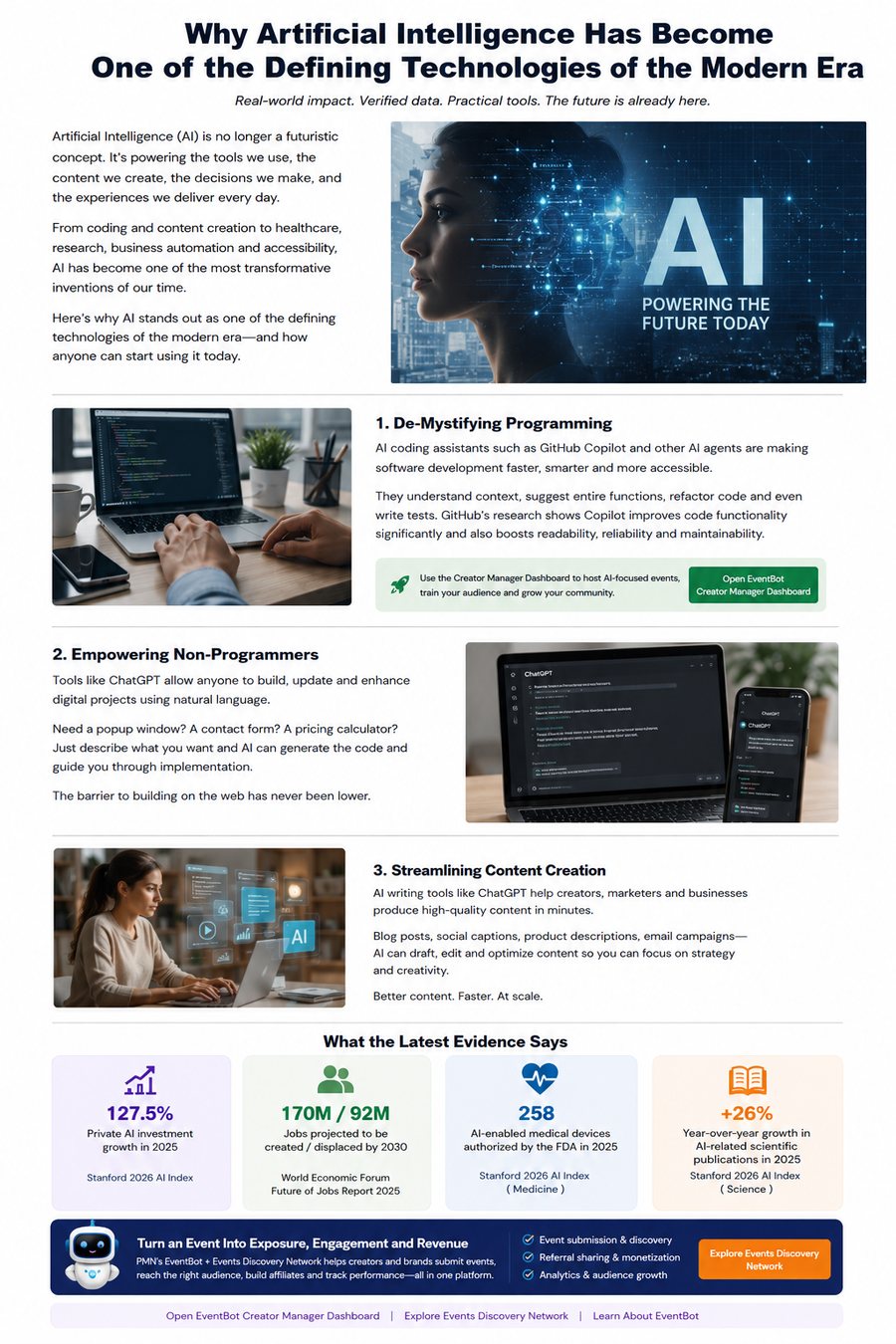
Artificial intelligence is often compared with foundational technologies such as electricity, the internet and the personal computer because it can be applied across many industries rather than solving only one narrow problem. Stanford's 2026 AI Index describes a field whose capabilities, investment and adoption continue to expand rapidly, while also emphasizing that measurement, governance and social systems are struggling to keep pace.
1. Natural Language Is Becoming a New Interface for Computing
For decades, using powerful software meant learning menus, syntax, commands and specialized workflows. Generative AI changes that relationship by allowing people to describe goals in ordinary language and receive drafts, analyses, plans, code, images or structured outputs in return.
This does not eliminate expertise. It changes where expertise is applied. The valuable skill increasingly becomes the ability to define the problem clearly, provide useful context, evaluate the output and make the final decision.
2. Software Development Has Moved From Autocomplete to AI Agents

Older descriptions of AI programming assistants focused mainly on code completion. That is now dated. Modern coding systems can help explain unfamiliar code, generate tests, review changes, refactor applications, work across repositories and execute multi-step development tasks.
GitHub's controlled research found that developers using Copilot were more likely to produce code that passed all unit tests in the study, with smaller but statistically significant improvements in readability, reliability, maintainability and conciseness. OpenAI's current Codex tools similarly position AI as an agent for end-to-end engineering work rather than a simple autocomplete feature.
3. AI Is Expanding What Non-Programmers Can Build
A small-business owner, marketer, educator or creator can now use conversational instructions to prototype a landing page, analyze a spreadsheet, draft a campaign, create a workflow or describe a software feature. Modern AI systems can also work with files and connected applications, which moves the experience beyond one-off answers and toward completed work.
That democratization matters because it gives more people access to capabilities that once required a larger technical team. The strongest results still come from users who understand the business problem and can verify what the AI produces.
4. Content Creation Is Becoming a Workflow, Not Just a Writing Task

The first wave of generative AI made headlines for producing text. The more important change is that AI can now support an entire content workflow: research, outlining, drafting, editing, repurposing, image creation, distribution planning, search optimization and performance analysis.
For creators and marketers, this means the advantage is shifting away from simply producing more content. The real opportunity is building a repeatable system that turns one idea into multiple useful assets and connects those assets to measurable business outcomes.
Turn an Event Into a Searchable, Shareable Growth Asset
Pamper Me Network's Events Discovery Network and EventBot workflow helps structure webinars, courses, podcasts and other events for human audiences, search engines, AI discovery systems, affiliates, feeds and apps. It also supports referral-aware sharing, event discovery, guest-list operations and campaign measurement.
Creators can use the current EventBot Creator Manager workflow to submit, manage, promote and measure event campaigns from one place.

5. AI Is Accelerating Analysis, Research and Scientific Discovery

AI's impact extends well beyond marketing and office productivity. The 2026 Stanford AI Index reports continued growth in AI-related scientific publications across natural sciences, with AI representing a growing share of research output in multiple fields.
Researchers are using machine learning and generative systems to analyze complex datasets, model proteins and materials, automate parts of experimentation, search scientific literature and generate hypotheses. These systems can accelerate discovery, but scientific validation still depends on rigorous methods, reproducibility and expert review.
For more information please click here or select the claim offer button below.
Claim OfferMake Money Building Your Fan Network
Share music, videos, articles, events and contests. Build your network, grow your audience and earn rewards when people connect through you. PMN turns ordinary content into shareable, interactive and trackable experiences designed to help you reach more people and monetize your network. Earn $1.00 for every fan who signs up FREE to support you.
For artists, creators, fans and everyday social media users.
(30-second preview)
IMAGINE THIS POWERING YOUR NEXT RELEASE.
6. Healthcare Is Moving From Experimentation Toward Regulated Deployment
AI is increasingly embedded in medical imaging, decision-support systems and other regulated health technologies. The FDA maintains a public list of AI-enabled medical devices that have met applicable premarket requirements, while regulators are also developing approaches for generative-AI-enabled devices and real-world performance monitoring.
The key point is not that AI replaces doctors. It is that AI can become another instrument available to clinicians—one that can help identify patterns, summarize information and support decisions when it is appropriately validated and used within its intended scope.
7. Automation Is Shifting From Repetitive Tasks to Multi-Step Work
Traditional automation worked best when every step could be defined in advance. AI agents are broadening that model by interpreting instructions, choosing tools, handling exceptions and coordinating multiple steps toward an objective.
That creates opportunities in customer service, sales operations, reporting, research, marketing, scheduling and administration. But autonomous systems also introduce new failure modes. Organizations need permissions, review points, audit trails and clear limits on what an AI system is allowed to do.
8. AI Is Improving Communication and Accessibility

Translation, transcription, speech recognition, summarization and multimodal interfaces can reduce communication barriers. For people with disabilities, AI-assisted captioning, speech tools, image understanding and adaptive interfaces can make information and software more accessible.
These benefits are strongest when accessibility is designed intentionally rather than added as an afterthought.
9. AI Will Change Jobs—But the Story Is More Complicated Than “AI Replaces People”
The World Economic Forum's Future of Jobs Report 2025 projects substantial job creation and displacement by 2030: 170 million roles created and 92 million displaced across the broader set of economic and technological trends it analyzes, for a net increase of 78 million jobs. It also reports that nearly 40% of skills required on the job are expected to change.
AI and big data rank among the fastest-growing skill areas, but human capabilities such as analytical thinking, creativity, resilience, leadership and collaboration remain important. The more realistic future is therefore a mix of automation, augmentation, role redesign and continuous reskilling.
Turn one article into an ongoing visibility engine.
PublicistBot can keep your business visible with monthly articles, search-friendly distribution, affiliate-aware sharing, and optional AI Marketer video content.
Learn How to Share This Article and Earn $1.00 per Free Enquiry
Ask PMN how referral-aware article sharing works, how eligible free enquiries are attributed, and how Social Rewards are tracked in your account.
The exact article is saved with the lead.
The featured offer or redemption link is preserved.
Owners receive messages and email notifications.
The applicant is connected to the campaign source.
10. The Cost of AI Matters Too
A modern article about AI should not discuss benefits without discussing infrastructure. The International Energy Agency reported that global data-centre electricity demand rose sharply in 2025, with AI-focused data centres growing even faster. The IEA expects data-centre electricity use to continue rising substantially through 2030.
That means responsible AI strategy includes not only accuracy and ethics, but also efficiency: using the right model for the task, avoiding unnecessary computation and designing systems that create enough value to justify their energy and infrastructure costs.
What the Latest Evidence Says
What Makes AI Historically Significant?
AI is significant because it is becoming a reusable capability layer rather than a single product. The same underlying technologies can assist with coding, design, research, forecasting, communication, customer engagement, medicine, education and scientific discovery.
Its importance also comes from the speed of iteration. Models, applications and workflows are improving quickly enough that descriptions written only a year or two ago can already feel obsolete.
Getting Started: Move From Experimenting With AI to Building a System
For creators, consultants, businesses and event organizers, a practical way to learn AI is to apply it to a real workflow. Start with one measurable objective: publish an event, build a guest list, create a content series, automate follow-up or improve discovery.
PMN's EventBot and Events Discovery Network provide a current example of this approach by connecting event submission, structured discovery, referral-aware sharing, distribution and monetization workflows rather than treating AI as a standalone chatbot.
The Creator Manager dashboard requires a PMN login. If a user is not signed in, PMN routes them through the login process and returns them to the dashboard.
Updated Sources
- Stanford Institute for Human-Centered AI — 2026 AI Index Report
- Stanford AI Index 2026 — Economy
- Stanford AI Index 2026 — Science
- Stanford AI Index 2026 — Medicine
- World Economic Forum — Future of Jobs Report 2025
- GitHub — Research on Copilot and code quality
- OpenAI — Codex
- U.S. FDA — Artificial Intelligence-Enabled Medical Devices
- International Energy Agency — Key Questions on Energy and AI
- Pamper Me Network — Events Discovery Network
- Pamper Me Network — EventBot AI Webinar Guest List Builder
Want more optimized articles like this?
PMN can create and promote up to 120 PublicistBot articles per year for $299.99/year, with an optional AI Marketer video add-on that adds up to 720 videos for $250 per month more.
Learn How to Earn $90.00 When a User Activates PublicistBot AI Agents
Ask PMN about the PublicistBot referral process, eligibility, attribution, commission tracking and the steps required for a qualifying activation.
The exact article is saved with the lead.
The featured offer or redemption link is preserved.
Owners receive messages and email notifications.
The applicant is connected to the campaign source.
For more information please click here or select the claim offer button below.
Claim Offer