
In 2025, artificial intelligence is no longer a novelty for small businesses—it’s a necessity. According to recent data, 68% of U.S. small businesses now use AI tools regularly, a notable jump from just 48% in mid-2024.
This article was optimized by the PublicistBot.
Want 10 articles per month promoting your business & making you money on autopilot? Activate the PublicistBot for $299.99/year. Add 720 short-form videos for $250 per month more.
Learn More About the Offer in This Article
Send your interest to the appropriate article or offer owner. PMN records the article that generated the enquiry, updates the funnel, logs the activity, sends notifications and adds the lead to PMN Messages.
The exact article is saved with the lead.
The featured offer or redemption link is preserved.
Owners receive messages and email notifications.
The applicant is connected to the campaign source.
This widespread adoption reflects a significant shift in how small businesses approach productivity, automation, and competitiveness in an increasingly digital-first economy.
Daily Usage on the Rise
Even more striking: 28% of small businesses now use AI tools daily. Whether it's streamlining repetitive tasks or generating content on demand, entrepreneurs are integrating AI into their workflows to save time and reduce costs.
Productivity Gains Fuel Adoption
The appeal of AI is clear. 74% of small business AI users say these tools have improved their productivity—a massive improvement from 46% just a year ago. This productivity boost is driving deeper investment and experimentation, even among non-technical founders.
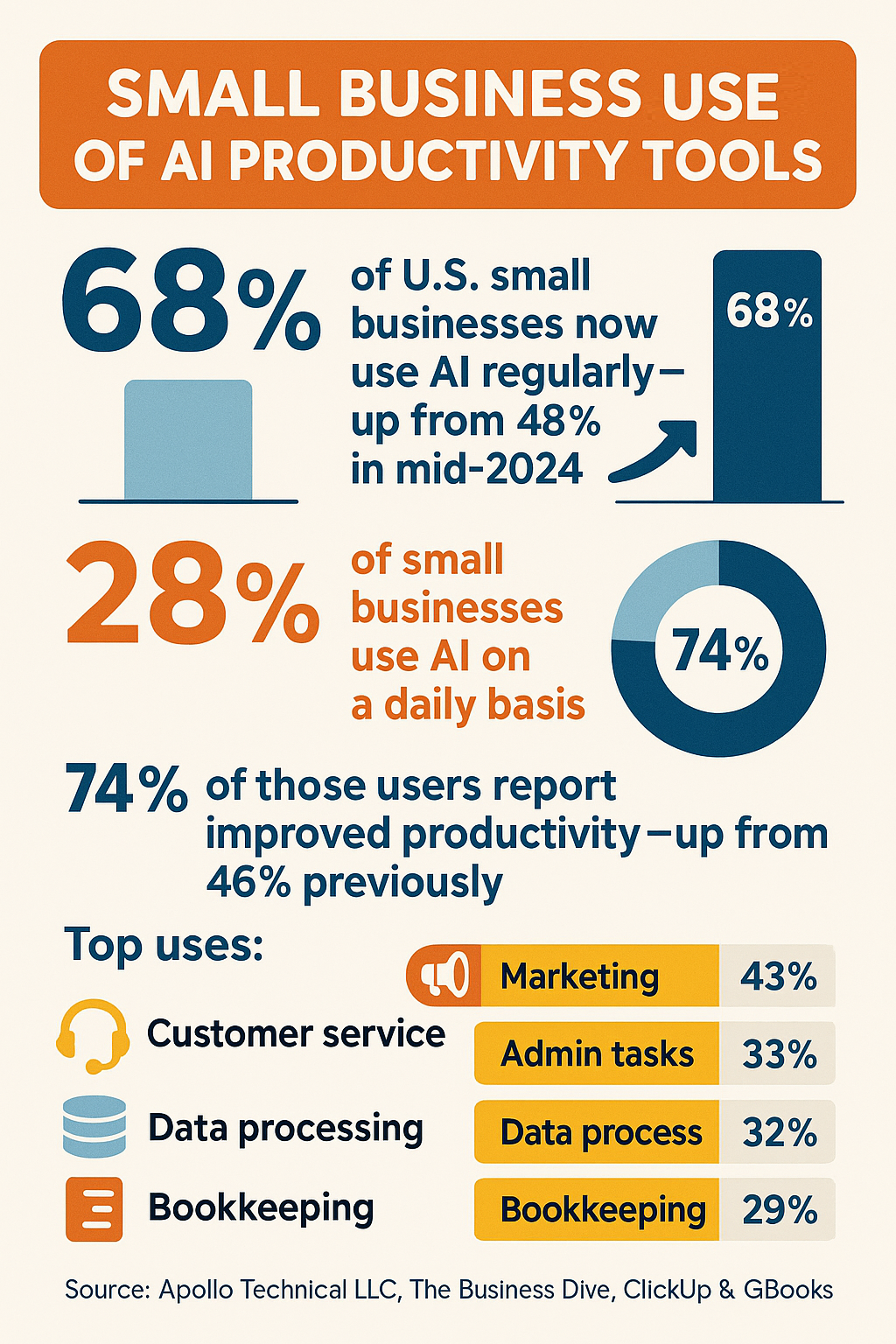
Top Areas Where Small Businesses Use AI
Here’s how small businesses are putting AI to work:
-
Marketing (43%)
Automating social media posts, writing emails, generating ad copy, and personalizing campaigns. -
Customer Service (36%)
Using AI-powered chatbots and help desk tools to respond to inquiries faster and around the clock. -
Administrative Tasks (33%)
Scheduling meetings, writing internal documentation, and organizing workflows using virtual assistants. -
Data Processing (32%)
Turning spreadsheets, sales reports, and CRM data into visual insights with the help of AI dashboards and summaries. -
Bookkeeping (29%)
Automating expense tracking, invoice generation, and tax prep using AI-powered accounting tools.
Why This Matters
The rapid rise in AI adoption among small businesses isn’t just a passing trend—it reflects a strategic response to mounting pressures like limited staffing, time constraints, and the need for greater efficiency. Here’s why this shift matters more than ever:
1. AI Helps Small Teams Compete Like Big Ones
AI tools offer small businesses the kind of power and scalability that was once only accessible to large enterprises.
Key Benefits:
-
✅ Automates repetitive, time-consuming tasks
-
✅ Enhances decision-making with real-time data insights
-
✅ Reduces human error
-
✅ Increases speed without compromising quality
-
✅ Offers 24/7 customer engagement (via chatbots, auto-responders)
PMN INTERACTIVE CREATIVEMusic Monetization ExperienceATTENTION FANS, CREATORS & DIGITAL MARKETERSMake Money Building Your Fan Network
Share music, videos, articles, events and contests. Build your network, grow your audience and earn rewards when people connect through you. PMN turns ordinary content into shareable, interactive and trackable experiences designed to help you reach more people and monetize your network. Earn $1.00 for every fan who signs up FREE to support you.
For artists, creators, fans and everyday social media users.
AURORA REACTORREADY · PRESS PLAY
FEATURED TRACK(30-second preview)
30-SECOND PREVIEW COMPLETEIMAGINE THIS POWERING YOUR NEXT RELEASE.
Like what you have seen & heard?Request a video player or widget like this.(Free with the PublicistBot)Tell a friend and earn $1.00 for each free fan registrationOver 500 Million Impressions Generated for performers, creators, models, athletes and brands using music powered by PMN approved artistsONE MUSIC FILE → AN INTERACTIVE MUSIC MARKETING & MONETIZATION SYSTEM Finally, a creator monetization & music distribution system that rewards artists for building their fan network.
2. AI Adoption Is on the Rise—With Big Results
| Metric | 2024 | Mid-2025 | Change |
|---|---|---|---|
| Small businesses using AI regularly | 48% | 68% | ↑ +20% |
| Daily AI users | 18% (est.) | 28% | ↑ +10% |
| Users reporting productivity gains | 46% | 74% | ↑ +28% |
3. Top Use Cases of AI in Small Business
| Function | % of Businesses Using AI |
|---|---|
| Marketing | 43% |
| Customer Service | 36% |
| Admin Tasks | 33% |
| Data Processing | 32% |
| Bookkeeping | 29% |
Examples of Real-World Use:
-
Marketing: AI tools generate ad copy, analyze campaign performance, and schedule social media posts automatically.
-
Customer Service: AI chatbots respond instantly to FAQs and escalate complex issues to humans.
-
Admin & Data: Tools like AI schedulers, invoicing apps, and smart CRMs save hours of manual work.
Turn one article into an ongoing visibility engine.
PublicistBot can keep your business visible with monthly articles, search-friendly distribution, affiliate-aware sharing, and optional AI Marketer video content.
Learn How to Share This Article and Earn $1.00 per Free Enquiry
Ask PMN how referral-aware article sharing works, how eligible free enquiries are attributed, and how Social Rewards are tracked in your account.
The exact article is saved with the lead.
The featured offer or redemption link is preserved.
Owners receive messages and email notifications.
The applicant is connected to the campaign source.
4. No Tech Background? No Problem.
Today’s AI tools are built with simplicity in mind.
Plug-and-play platforms offer:
-
Drag-and-drop interfaces
-
Pre-built templates
-
Natural language prompts
-
Easy integrations with tools like QuickBooks, Canva, Slack, Google Workspace
Even business owners with no coding experience can start benefiting from AI in minutes.
Key Takeaway
AI is leveling the playing field for small businesses, making high-efficiency workflows and smart automation accessible and affordable. As adoption grows, we can expect even more innovation in tools that simplify tasks, deepen customer relationships, and unlock new growth opportunities.
Sources:
Apollo Technical LLC | The Business Dive | ClickUp | QuickBooks
Want more optimized articles like this?
PMN can create and promote up to 120 PublicistBot articles per year for $299.99/year, with an optional AI Marketer video add-on that adds up to 720 videos for $250 per month more.
Learn How to Earn $90.00 When a User Activates PublicistBot AI Agents
Ask PMN about the PublicistBot referral process, eligibility, attribution, commission tracking and the steps required for a qualifying activation.
The exact article is saved with the lead.
The featured offer or redemption link is preserved.
Owners receive messages and email notifications.
The applicant is connected to the campaign source.