Don’t Give Up on Your Dream. Stop Betting Your Life on It.
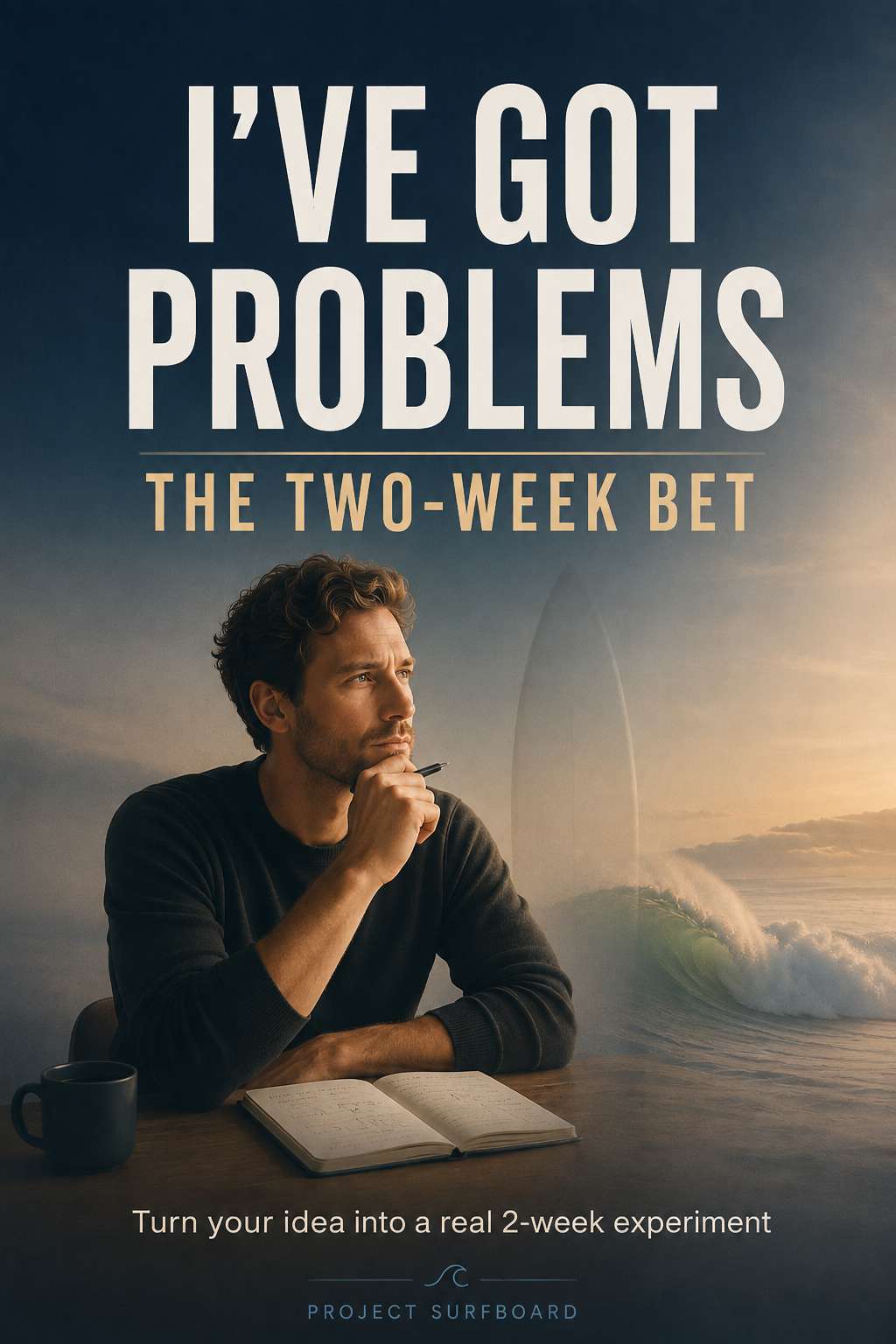
Project Surfboard Presents: I’ve Got Problems — The Two-Week Bet
There is a familiar piece of advice given to entrepreneurs, artists, creators, founders, and ambitious people:
This article was optimized by the PublicistBot.
Want 10 articles per month promoting your business & making you money on autopilot? Activate the PublicistBot for $299.99/year. Add 720 short-form videos for $250 per month more.
Learn More About the Offer in This Article
Send your interest to the appropriate article or offer owner. PMN records the article that generated the enquiry, updates the funnel, logs the activity, sends notifications and adds the lead to PMN Messages.
The exact article is saved with the lead.
The featured offer or redemption link is preserved.
Owners receive messages and email notifications.
The applicant is connected to the campaign source.
Believe in yourself. Never give up. Keep going.
Sometimes that advice is exactly right.
Sometimes it is terrible advice.
The problem is not having a dream. The problem is believing that pursuing the dream requires making an enormous, open-ended commitment before you have enough information to know whether you are moving in the right direction.
What if there were another option?
What if, instead of asking:
“Should I keep going or give up?”
you asked:
“What is the smallest real-world experiment I can run over the next two weeks that will give me better information?”
That is the idea behind I’ve Got Problems: The Two-Week Bet, an interactive webinar and workshop presented by Project Surfboard and Bryant Stratton.
The Problem With All-or-Nothing Thinking
People frequently treat meaningful decisions as permanent decisions.
Should I start the company?
Should I become an artist?
Should I quit my job?
Should I launch the product?
Should I keep investing in this idea?
Should I abandon the project?
Should I change careers?
Should I finally admit that this isn't working?
These questions feel enormous because we often frame them as choices between complete commitment and complete surrender.
But there is a large territory between those two extremes.
You can experiment.
You can test.
You can observe.
You can gather evidence.
You can make a small bet before making a big one.
The Two-Week Bet is built around a simple principle:
Don't give up on your dream. Stop betting your life on it.
Instead of deciding today whether an idea deserves the next five years of your life, determine what could be learned from the next fourteen days.
Your Brain Is Not Always an Objective Advisor
One reason these decisions become so difficult is that humans are not perfectly rational decision-making machines.
Our judgment is influenced by powerful behavioral forces.
Conformity can convince us to pursue what other people value instead of what matters to us.
Fear of rejection can prevent us from testing an idea because failure might feel personal.
Loss aversion can make losing something feel far more painful than gaining something of equivalent value feels rewarding.
Sunk costs can keep us committed to projects simply because we have already invested time, money, reputation, or emotional energy.
Perfectionism can disguise procrastination as preparation.
Ego can make changing direction feel like admitting defeat.
And cognitive dissonance can cause us to invent increasingly elaborate explanations for why something is working when the evidence may be suggesting otherwise.
These forces do not mean people are irrational or incapable of making good decisions.
They mean that meaningful decisions benefit from evidence.
Replace the Life Bet With a Two-Week Bet
Imagine you have been thinking about starting a consulting business.
The traditional question might be:
“Should I become a consultant?”
That question is almost impossible to answer without experience.
A Two-Week Bet might instead be:
Can I have conversations with 20 potential clients and get three of them to request a proposal within the next two weeks?
Now you have something observable.
Or perhaps you want to become a professional speaker.
Instead of asking:
“Can I build a successful speaking career?”
your Two-Week Bet might be:
Can I contact 30 event organizers, generate five conversations, and secure one opportunity to present?
If you are a musician, the question does not have to be:
“Can I make it in the music industry?”
It might become:
Can I release one piece of content around a new song, put it in front of 1,000 relevant people, and generate 50 genuine engagements or 25 new subscribers?
If you are building software, you may not need to spend six months creating the complete product.
Your bet might be:
Can I show a basic prototype to 15 prospective users and get five of them to agree to test it?
Each experiment produces something motivation alone cannot provide:
evidence.
Evidence Changes the Conversation
At the end of two weeks, the purpose is not simply to declare the experiment a success or failure.
The more important questions are:
What happened?
What did you expect to happen?
What surprised you?
What did people actually do rather than say they would do?
What assumptions were proven wrong?
What became easier?
What became harder?
What deserves another experiment?
What should be changed?
And what might genuinely deserve to be stopped?
The objective is not to eliminate uncertainty.
It is to reduce uncertainty enough to make a better next decision.
That distinction matters.
Because progress is rarely one giant moment of certainty.
It is usually a sequence of increasingly informed decisions.
Persistence Is Valuable. Blind Persistence Is Expensive.
There is tremendous cultural admiration for people who refuse to quit.
And persistence absolutely matters.
Most meaningful projects encounter rejection, setbacks, uncertainty, and periods when progress appears almost nonexistent.
But persistence without feedback can become something very different.
A person can spend years perfecting a product nobody wants.
An entrepreneur can continue financing a business model that repeatedly fails to produce customers.
A creator can publish hundreds of pieces of content without examining why the audience is not responding.
A professional can remain committed to a career strategy simply because changing direction feels like failure.
Make Money Building Your Fan Network
Share music, videos, articles, events and contests. Build your network, grow your audience and earn rewards when people connect through you. PMN turns ordinary content into shareable, interactive and trackable experiences designed to help you reach more people and monetize your network. Earn $1.00 for every fan who signs up FREE to support you.
For artists, creators, fans and everyday social media users.
(30-second preview)
IMAGINE THIS POWERING YOUR NEXT RELEASE.
The Two-Week Bet does not teach people to quit faster.
It teaches them to learn faster.
Sometimes the evidence will tell you to continue.
Sometimes it will tell you to modify the approach.
Sometimes it will expose a completely different opportunity.
And occasionally, it will tell you that stopping is the intelligent decision.
All four outcomes can be valuable.
The Four Parts of a Two-Week Bet
During I’ve Got Problems: The Two-Week Bet, participants will work toward defining one practical experiment built around four components.
1. A Real Problem or Opportunity
Start with something meaningful that you genuinely want to understand.
It might involve a business, creative project, career opportunity, product, community initiative, relationship with an audience, or professional ambition.
The problem should be real enough that learning something about it would matter.
2. An Observable Outcome
Avoid vague objectives such as:
“Build awareness.”
“See if people like it.”
“Work on my business.”
“Become more confident.”
Instead, determine what you can actually observe.
For example:
20 customer conversations.
Five sales calls.
Three proposals.
100 signups.
One prototype.
Ten interviews.
A completed performance.
A measurable audience response.
Observable outcomes make learning possible.
3. A Short Execution Window
The experiment lasts approximately two weeks.
That constraint matters.
Short timelines discourage endless planning and encourage action.
You are not attempting to build the entire future.
You are attempting to discover something about it.
4. Evaluation Criteria
Before beginning the experiment, establish what you will examine when it ends.
What result would encourage you to continue?
What result would suggest modification?
What information would cause you to run another experiment?
And what evidence might tell you that the underlying assumption was wrong?
Setting criteria in advance helps reduce the temptation to reinterpret every outcome after the fact.
From Webinar to Project Surfboard
The webinar introduces the philosophy.
Project Surfboard provides the environment for doing it.
Surfboard is designed around the idea that people often do not need another motivational speech, massive strategic plan, or year-long commitment.
They need a structure that helps them move.
That structure can include:
community, accountability, working groups, tiger teams, shared problem solving, and short execution cycles.
The goal is to create an environment where ideas leave people's heads and encounter reality.
Instead of spending months debating whether something might work, participants can begin testing what actually happens.
That is where the name Surfboard becomes meaningful.
You cannot control the ocean.
You can learn to read conditions, adjust your position, respond to feedback, maintain balance, and catch the opportunities that emerge.
Turn one article into an ongoing visibility engine.
PublicistBot can keep your business visible with monthly articles, search-friendly distribution, affiliate-aware sharing, and optional AI Marketer video content.
Learn How to Share This Article and Earn $1.00 per Free Enquiry
Ask PMN how referral-aware article sharing works, how eligible free enquiries are attributed, and how Social Rewards are tracked in your account.
The exact article is saved with the lead.
The featured offer or redemption link is preserved.
Owners receive messages and email notifications.
The applicant is connected to the campaign source.
Building something meaningful often works the same way.
“I’ve Got Problems”
The Two-Week Bet is also an early practical expression of the thinking behind Bryant Stratton's upcoming book, I’ve Got Problems.
The project explores an important question:
What can our problems—and the way we respond to them—reveal about what is actually happening beneath the explanations we give ourselves?
People tell stories about why they succeed, why they fail, why they continue, and why they stop.
Those stories may contain truth.
But behavior often reveals something deeper.
What do we avoid?
What do we protect?
What evidence do we ignore?
What risks seem unbearable?
What failures threaten our identity?
What do we continue doing long after the original reason has disappeared?
And what opportunities do we abandon because they require us to tolerate uncertainty?
Problems are not merely obstacles.
They are information.
And carefully designed experiments can help expose that information.
Bring Something You've Been Thinking About
I’ve Got Problems: The Two-Week Bet is designed for creatives, entrepreneurs, founders, builders, independent professionals, and anyone sitting between three uncomfortable possibilities:
Keep going.
Change direction.
Give up.
You do not need to solve that entire question during the workshop.
You need something smaller.
Something testable.
Something real.
By the end of the session, the objective is for every participant to leave with one clearly defined Two-Week Bet:
a problem or opportunity worth testing,
an observable outcome,
a short execution window,
and criteria for evaluating what happens next.
Approximately 60 minutes.
Teaching.
Examples.
An interactive exercise.
Then an opportunity to continue the experiment inside Project Surfboard.
Make a Smaller Bet
Maybe the dream is right.
Maybe the strategy is wrong.
Maybe the market needs something different.
Maybe you need different collaborators.
Maybe you need more time.
Maybe you need less preparation and more contact with reality.
Maybe the opportunity is bigger than you thought.
You will not discover the answer by thinking about it forever.
So don't automatically abandon the dream.
And don't automatically mortgage your future to it either.
Run the experiment.
Collect the evidence.
Learn something real.
Then decide what deserves the next two weeks.
Join Project Surfboard
Turn something you've been thinking about into a real-world experiment.
Start with one problem. One opportunity. One observable result. One Two-Week Bet.
Project: Project Surfboard
Event: I’ve Got Problems: The Two-Week Bet
Format: Interactive webinar / workshop
Organizer: Project Surfboard / Bryant Stratton
Want more optimized articles like this?
PMN can create and promote up to 120 PublicistBot articles per year for $299.99/year, with an optional AI Marketer video add-on that adds up to 720 videos for $250 per month more.
Learn How to Earn $90.00 When a User Activates PublicistBot AI Agents
Ask PMN about the PublicistBot referral process, eligibility, attribution, commission tracking and the steps required for a qualifying activation.
The exact article is saved with the lead.
The featured offer or redemption link is preserved.
Owners receive messages and email notifications.
The applicant is connected to the campaign source.