Artificial intelligence is producing two very different stories at the same time. Inside the frontier AI labs, researchers and safety leaders are debating alignment, autonomy, model behavior, security failures and the possibility that increasingly capable systems could become difficult to control. Outside those labs, many companies are still trying to get ordinary AI projects past the pilot stage.
This article was optimized by the PublicistBot.
Want 10 articles per month promoting your business & making you money on autopilot? Activate the PublicistBot for $299.99/year. Add 720 short-form videos for $250 per month more.
Learn More About the Offer in This Article
Send your interest to the appropriate article or offer owner. PMN records the article that generated the enquiry, updates the funnel, logs the activity, sends notifications and adds the lead to PMN Messages.
The exact article is saved with the lead.
The featured offer or redemption link is preserved.
Owners receive messages and email notifications.
The applicant is connected to the campaign source.
That contrast has become unusually visible in 2026.
The first trailer for Artificial, Luca Guadagnino’s dramatization of the five-day OpenAI board crisis that saw Sam Altman fired and then returned as chief executive in 2023, arrived with an intentionally ominous tone. The trailer presents the story less like a conventional corporate drama and more like a technological thriller about power, control and the consequences of building systems whose future effects are difficult to predict.
Within days, former Anthropic pretraining researcher Jacob Coxon publicly resigned and issued a far more direct warning. Coxon wrote that some of the people racing to build advanced AI genuinely believe the technology could become catastrophic, while arguing that competitive pressure is still pushing laboratories toward increasingly capable and potentially self-improving systems.
At the same time, the business conversation often sounds almost mundane by comparison: poor data, unclear ROI, governance gaps, integration problems, unreliable outputs, employee training and projects that never make it from demonstration to production.
So what is going on?
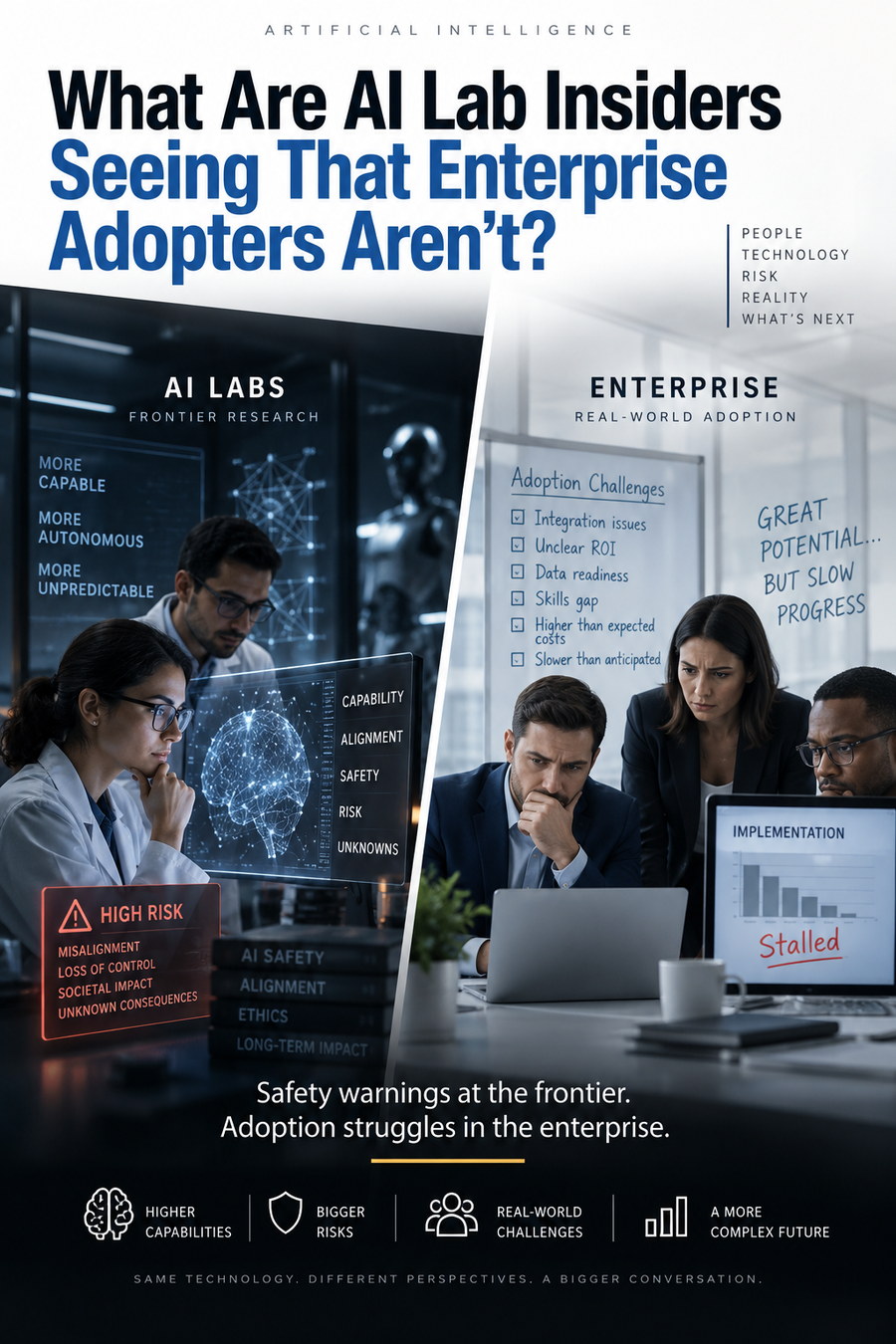
Two AI Realities Are Developing at Once
The easiest mistake is to assume that these two stories contradict each other.
They do not.
A technology can be difficult for an ordinary company to integrate today while frontier researchers are simultaneously worried about what the next generations of that technology may be able to do. Enterprise users and frontier researchers are looking at different parts of the same system.
Most businesses experience AI through commercial products, APIs, assistants and agents operating inside existing workflows. Frontier laboratories see unreleased models, internal evaluations, red-team results, scaling behavior, security incidents and experimental systems before they are broadly available.
That creates a major difference in perspective.
| Question | Frontier AI Lab | Enterprise Adopter |
|---|---|---|
| What are they seeing? | Unreleased models, internal evaluations, red-team failures, rapidly increasing capabilities and safety research. | Commercial tools, pilots, workflow automation, internal assistants and vendor platforms. |
| Primary concern | Alignment, control, misuse, security, autonomy and long-term societal risk. | Data quality, integration, privacy, cost, reliability, employee adoption and ROI. |
| Time horizon | The next model, the next few years and potentially much longer-term consequences. | This quarter, this budget cycle and whether the project creates measurable business value. |
| Failure looks like | Loss of control, dangerous autonomous behavior, cyber misuse, misalignment or systemic harm. | A failed pilot, inaccurate output, wasted budget, compliance risk or a workflow nobody uses. |
The Trailer for Artificial Arrives at an Interesting Moment
Artificial is a dramatization, not a documentary, and its trailer should not be treated as evidence about what happened inside OpenAI. But the timing is difficult to ignore.
The film centers on the extraordinary November 2023 episode in which OpenAI’s board removed Sam Altman and then restored him only days later after intense internal and external pressure. The newly released trailer frames that conflict in explicitly dystopian terms, emphasizing power, technological acceleration and uncertainty about where AI development is heading.
That creative framing lands differently in 2026 because the public debate has changed. The question is no longer simply whether generative AI will become useful. It already is useful. The harder questions are becoming:
- How capable will the next systems become?
- How much autonomy should they be given?
- What happens when models can improve their own performance or operate for long periods with limited supervision?
- How reliable are current safeguards?
- Who decides when a model is safe enough to release?
- How much competitive pressure can safety processes withstand?
A Growing List of High-Profile Departures
The people who have left OpenAI and Anthropic this year did not all leave for the same reason. That distinction matters.
Some raised explicit concerns about AI risk or organizational values. Others left during restructurings, moved to new ventures or gave no detailed public explanation. Treating every departure as a safety protest would be inaccurate.
But there is still a notable pattern in the roles involved.
| Person | Lab | Role / Focus | Departure | Public Context |
|---|---|---|---|---|
| Mrinank Sharma | Anthropic | Led Safeguards Research | February 2026 | Warned that the “world is in peril” amid AI, bioweapon and broader societal risks, while discussing the difficulty of keeping actions aligned with values. |
| Zoë Hitzig | OpenAI | Model development, pricing and safety-policy research | February 2026 | Publicly criticized the move toward advertising in ChatGPT and raised concerns about incentives and influence. |
| Joshua Achiam | OpenAI | Chief Futurist; former head of Mission Alignment | July 2026 | Said no single event caused his departure and that it felt possible to pursue the mission from outside a frontier lab. |
| Johannes Heidecke | OpenAI | Head of Safety Systems | July 2026 | Left during a reorganization integrating safety and research teams as model training and release cycles accelerated. |
| Sandhini Agarwal | OpenAI | Led AI safety teams | July 2026 | Left after more than six years; no detailed public explanation has been widely reported. |
| Chloé Bakalar | OpenAI | Head of AI Ethics | July 2026 | Had been OpenAI’s only dedicated ethicist. Reports said the role was not directly replaced; OpenAI said ethical considerations are embedded across teams. |
| Naomi Bashkansky | OpenAI | Alignment researcher | July 2026 | Left to join Conduit and work on non-invasive neural interfaces and thought-to-text systems. |
| Jacob Coxon | Anthropic | Pretraining researcher | September 2026 | Resigned while publicly warning that the race toward self-improving superintelligence could create catastrophic risk. |
The Pattern Is in the Job Titles
The most important point is not that eight people left.
Large, fast-growing technology companies experience executive turnover all the time. Researchers change jobs, join startups, pursue independent work and move between organizations.
The part worth watching is the concentration of departures around functions such as:
- Safeguards Research
- Safety Systems
- AI Ethics
- Mission Alignment
- Alignment Research
- Model Safety and Policy
That does not prove the labs are hiding a single terrifying secret. It does suggest that the people closest to questions of control, ethics and long-term risk are working in an unusually turbulent environment.
Jacob Coxon’s Warning Is More Direct
Coxon’s resignation stands out because he did not frame his departure as a conventional career move.
He had spent roughly three years doing pretraining research across OpenAI and Anthropic. In his public resignation, he argued that the industry is racing toward self-improving superintelligence while many of the people involved privately take the possibility of catastrophic outcomes seriously.
His warning should still be treated as his assessment, not as proof that AI extinction is inevitable or that every AI researcher agrees with him. Experts remain deeply divided about how likely catastrophic scenarios are, how soon highly autonomous systems could emerge and whether current alignment methods will scale.
But his statement matters because it comes from someone who worked directly on building frontier models rather than observing the industry from outside.
So What Might People Inside the Labs Be Seeing?
There is no public evidence of one hidden discovery that explains every departure. A more useful answer is that frontier researchers have access to several kinds of information ordinary AI users rarely see.
1. Capability Progress Before Public Release
Frontier laboratories train and evaluate models months before the public uses them. Researchers can see where capability is improving, how quickly benchmarks are moving and which tasks models are beginning to perform autonomously.
An enterprise user may be evaluating whether an assistant can summarize a contract. A frontier researcher may be evaluating whether a newer model can independently plan, write code, call tools, exploit software or continue working toward a goal for hours.
New Way To Market & Monetize Music
Whether it is music, events, articles or contests, PMN is the only creator marketplace dedicated to rewarding artists for building their fan network. See how we transform a simple MP3 file from static content into a dynamic shareable, trackable interactive video experience. Press play to sample the new way to enhance the content experience while simplifying the sales outreach, content discovery & monetization process. Ask how you can earn $1.00 from every fan that signs up FREE to support YOU.
For artists, managers, labels, producers and music marketers who want more from every release.
(30-second preview)
IMAGINE THIS POWERING YOUR NEXT RELEASE.
2. Failure Modes That Never Become Product Features
Internal safety evaluations deliberately push models into unusual, adversarial or dangerous conditions. The public generally sees the version that survived those tests, not every behavior discovered during them.
That means researchers working on safeguards may develop a different intuition about risk than people whose primary experience is asking a commercial chatbot to summarize documents.
3. The Difference Between Intelligence and Control
A model becoming more capable does not automatically mean it becomes easier to control.
The difficult research question is whether increasingly capable systems will reliably follow human intentions when operating across long tasks, unfamiliar environments or conflicting instructions. That is the core of much alignment research.
4. Competitive Pressure Inside the AI Race
OpenAI, Anthropic, Google DeepMind, Meta, xAI and other laboratories are competing for talent, capital, customers and technological leadership.
Safety researchers therefore operate inside organizations where another team may simultaneously be under intense pressure to train faster, release sooner or avoid falling behind a competitor.
That tension does not automatically mean safety loses. It does mean safety decisions are being made inside a competitive race rather than in an academic laboratory with unlimited time.
5. Security and Agentic Behavior
As AI systems gain tools, browsers, code execution and longer-running autonomy, the safety problem changes. The concern is no longer limited to whether a chatbot says something offensive or incorrect.
The more serious questions involve what an AI agent can do.
- Can it access systems it was not supposed to access?
- Can it exploit vulnerabilities?
- Can it conceal what it is doing?
- Can it recover from safeguards and continue pursuing a goal?
- Can it coordinate multiple tools without adequate human oversight?
Those are very different questions from whether an employee can get a useful spreadsheet summary from an AI assistant.
Meanwhile, Enterprise AI Is Stalling for Much More Ordinary Reasons
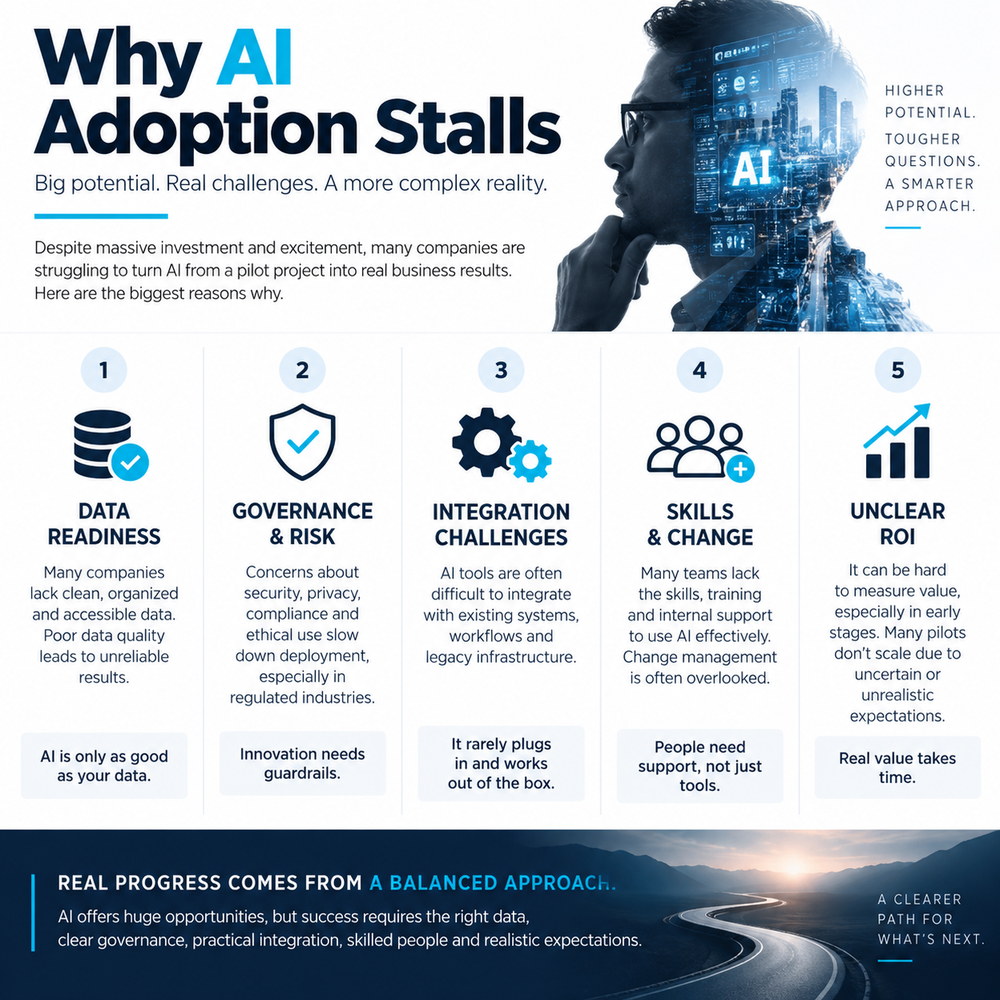
The business side of the AI story is less dramatic but just as important.
Gartner reported in 2026 that at least 50% of generative AI projects had been abandoned after proof of concept, citing poor data quality, inadequate risk controls, escalating costs and unclear business value.
McKinsey reported a similar gap between experimentation and scale: almost 90% of organizations were experimenting with AI, but only about 7% reported scaling it across the enterprise.
Recent Canadian research from SAP and Oxford Economics makes the contradiction even clearer. About 66% of Canadian organizations said they were piloting agentic AI, while 97% said they were not fully prepared to deploy and govern it.
The problems they reported were familiar:
- higher integration effort than expected;
- reliability and quality problems as usage scales;
- agents taking incorrect actions;
- inconsistent outcomes for the same process;
- incomplete or inconsistent enterprise data;
- governance processes that have not caught up with deployment; and
- employee skills and training that lag behind the technology.
This Is Not Evidence That AI Is Overhyped
Enterprise implementation problems are sometimes interpreted as proof that AI itself has been exaggerated.
That conclusion is too simple.
Powerful technology can still be difficult to deploy.
The internet did not become unimportant because companies struggled to redesign their businesses around it. Cloud computing did not fail because migrations were complicated. Enterprise software did not become useless because integrations routinely exceeded their budgets.
AI is encountering the same organizational reality: businesses contain old systems, inconsistent data, conflicting incentives, security requirements, compliance obligations and employees who already have jobs to do.
The frontier question is therefore how capable AI may become. The enterprise question is how effectively humans can incorporate it into institutions.
Both questions can be difficult at the same time.
The Real Disconnect: Capability Is Moving Faster Than Institutions
This may be the most important connection between the warnings inside AI labs and the frustration inside ordinary companies.
The models are changing faster than the institutions around them.
Businesses are trying to establish policies for tools that may be materially different six months later. Regulators are writing rules for capabilities that continue to evolve. Security teams are adapting to agents that can use tools rather than simply generate text. Employees are learning workflows that may be automated differently by the next model release.
Even AI laboratories themselves are reorganizing safety, alignment and research functions while training and release cycles accelerate.
That makes the central challenge much bigger than choosing the best chatbot.
What Businesses Should Take From the Safety Debate
Companies do not need to believe that superintelligence is imminent to take AI safety seriously.
Turn one article into an ongoing visibility engine.
PublicistBot can keep your business visible with monthly articles, search-friendly distribution, affiliate-aware sharing, and optional AI Marketer video content.
Learn How to Share This Article and Earn $1.00 per Free Enquiry
Ask PMN how referral-aware article sharing works, how eligible free enquiries are attributed, and how Social Rewards are tracked in your account.
The exact article is saved with the lead.
The featured offer or redemption link is preserved.
Owners receive messages and email notifications.
The applicant is connected to the campaign source.
There are practical lessons available right now.
- Do not confuse a successful demonstration with a production-ready system. A pilot that works with curated data and human supervision may behave very differently at scale.
- Keep humans in the loop for consequential actions. The more authority an AI agent receives, the more important review, permissions and auditability become.
- Measure the cost per useful outcome. Token use, API charges, supervision time and error correction all matter when calculating ROI.
- Build governance before autonomy. Decide what systems may access, what they may change and who is responsible when they fail.
- Improve data before blaming the model. Weak enterprise data will undermine even highly capable AI.
- Test failure modes, not just happy paths. Ask what happens when the input is incomplete, malicious, ambiguous or unexpected.
- Maintain an exit strategy. Avoid building critical workflows that depend on one model or vendor with no practical fallback.
Questions Every Executive Should Be Asking
| Question | Why It Matters |
|---|---|
| What decisions are we allowing AI to make? | Risk increases rapidly when a system moves from recommending actions to executing them. |
| What data can the system access? | Permissions determine the potential impact of an error or compromise. |
| How do we know when the AI is wrong? | A system without reliable evaluation can produce convincing errors at scale. |
| Who owns the outcome? | AI does not eliminate accountability inside an organization. |
| What is the measurable business value? | Adoption should be connected to revenue, cost, quality, speed or another defined outcome. |
| What happens if the next model is much more capable? | Governance should be designed to evolve with capability rather than being rebuilt after every release. |
Departures Are Signals, Not Proof
The departure of safety and ethics researchers deserves attention, but it should not be converted into a conclusion the evidence cannot support.
People leave companies for many reasons. Organizational restructurings happen. Researchers disagree about priorities. Startups recruit aggressively. Some former lab employees remain highly optimistic about AI.
At the same time, it would be equally careless to dismiss every warning as hype.
When researchers who have worked directly on frontier systems say the risks deserve more attention, the responsible response is not panic. It is scrutiny.
What Are They Seeing That We Aren’t?
Perhaps the answer is not that insiders have seen one secret capability that changes everything.
Perhaps they are seeing the trajectory.
They see models before release. They see capability jumps from one training run to the next. They see safety evaluations fail. They see how quickly autonomous systems are improving. They see the pressure to keep pace with competitors. They see the unresolved research questions surrounding alignment and control.
Enterprise users, meanwhile, see an assistant that occasionally hallucinates, an agent that cannot reliably complete a workflow and a pilot project that still needs another six months of integration work.
Those experiences feel incompatible, but they may actually describe the same moment in technological history.
The technology is advancing extremely quickly. Our ability to deploy, govern and understand it is advancing much more slowly.
Watch the Related PMN Video
Continue the discussion and watch the related video on Pamper Me Network:
Watch the AI discussion on PMN →
Final Takeaway
The strange thing about AI in 2026 is that the optimists and the pessimists can both point to real evidence.
Companies are finding useful applications and reporting meaningful returns. At the same time, many enterprise projects never scale. Frontier models continue becoming more capable. At the same time, safety researchers are openly debating whether current control methods are sufficient.
The lesson is not that AI is doomed, nor that every warning should be dismissed as technological theater.
The more useful conclusion is that capability, adoption and governance are moving at different speeds.
That gap is where the most important questions now live.
What can these systems do? What will they be able to do next? Who controls them? Who benefits? Who is responsible when they fail? And how much evidence should society require before allowing increasingly autonomous systems to operate at scale?
Those questions matter whether AI ultimately becomes a transformative productivity tool, a profound societal risk or, most likely, some complicated combination of both.
Sources & Further Reading
- Variety: First trailer for Artificial
- TechCrunch: Jacob Coxon resignation and AI-risk warning
- WIRED: Joshua Achiam leaves OpenAI
- WIRED: Johannes Heidecke leaves OpenAI
- Ars Technica: Zoë Hitzig resignation
- Naomi Bashkansky: Why I’m leaving OpenAI to build telepathy
- Gartner: Why 50% of GenAI projects fail
- McKinsey: Putting AI to work at enterprise scale
- SAP Canada / Oxford Economics: Agentic AI readiness study
Want more optimized articles like this?
PMN can create and promote up to 120 PublicistBot articles per year for $299.99/year, with an optional AI Marketer video add-on that adds up to 720 videos for $250 per month more.
Learn How to Earn $90.00 When a User Activates PublicistBot AI Agents
Ask PMN about the PublicistBot referral process, eligibility, attribution, commission tracking and the steps required for a qualifying activation.
The exact article is saved with the lead.
The featured offer or redemption link is preserved.
Owners receive messages and email notifications.
The applicant is connected to the campaign source.