
For a small business, accepting cryptocurrency does not have to mean becoming a cryptocurrency trader, managing private keys on behalf of customers or keeping every payment in Bitcoin. Modern crypto payment systems can sit between the customer and the merchant in much the same way a conventional payment gateway sits between a shopper, a card network and a business bank account.
This article was optimized by the PublicistBot.
Want 10 articles per month promoting your business & making you money on autopilot? Activate the PublicistBot for $299.99/year. Add 720 short-form videos for $250 per month more.
Learn More About the Offer in This Article
Send your interest to the appropriate article or offer owner. PMN records the article that generated the enquiry, updates the funnel, logs the activity, sends notifications and adds the lead to PMN Messages.
The exact article is saved with the lead.
The featured offer or redemption link is preserved.
Owners receive messages and email notifications.
The applicant is connected to the campaign source.
The basic idea is simple: a customer chooses cryptocurrency at checkout, a payment gateway handles the blockchain transaction, and the merchant receives settlement according to the options offered by the provider. Depending on the service, the business may be able to keep the payment in crypto, convert it to fiat currency, settle in a stablecoin, or use a combination of those methods.
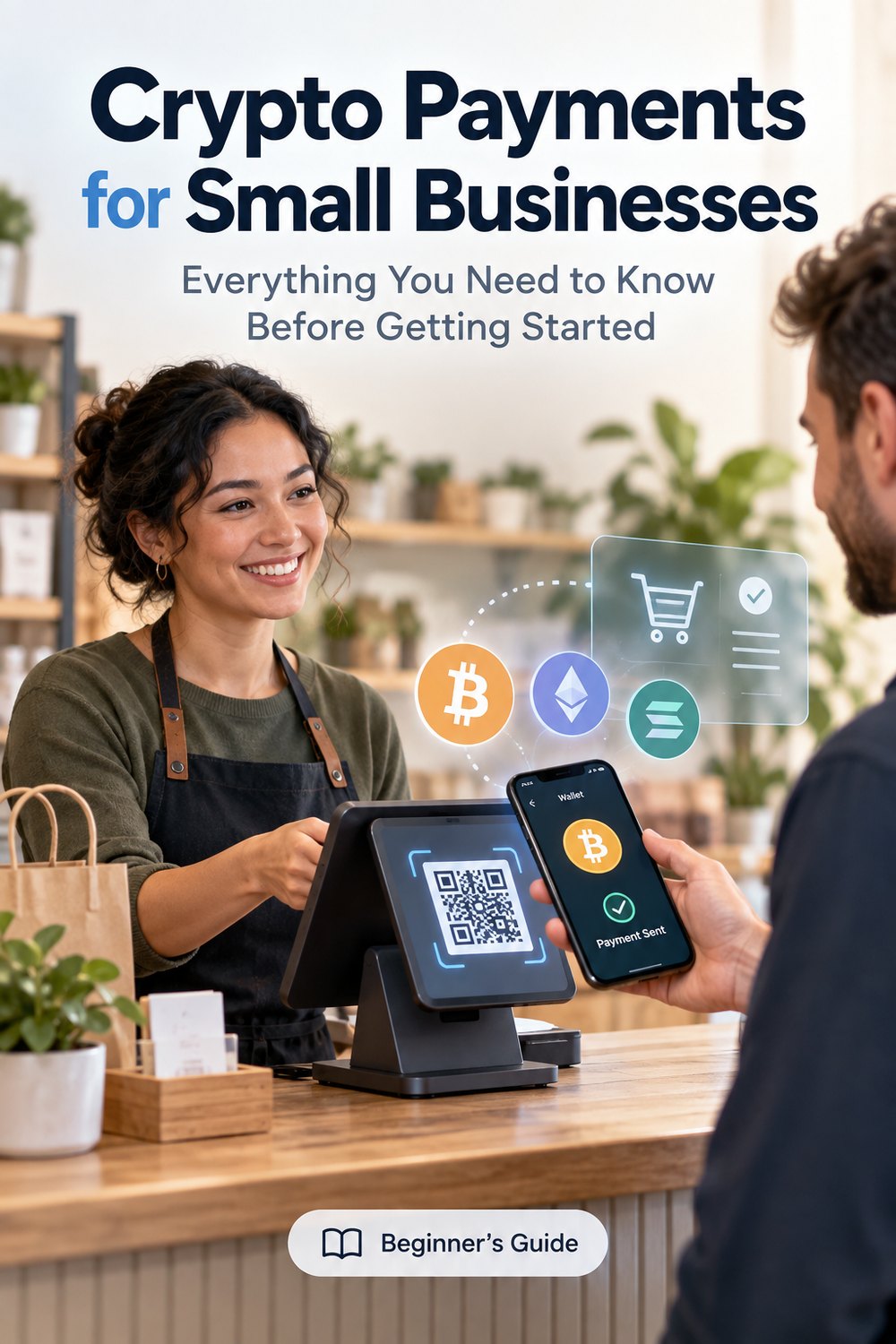
That flexibility is one of the main reasons crypto payments deserve attention from small businesses. They can create another way for customers to pay, support international commerce, reduce reliance on a single payment rail and make digital assets more useful in everyday transactions. But the technology also introduces issues that merchants need to understand before turning it on, including volatility, transaction finality, compliance, accounting, refunds and provider risk.
What Is a Crypto Payment Gateway?
A crypto payment gateway is software and payment infrastructure that helps a business accept digital assets from customers. Instead of asking the merchant to manually check a blockchain transaction, calculate exchange rates and reconcile every payment, the gateway can automate much of the process.
A typical system may provide a checkout screen or QR code, identify the amount owed, provide a wallet address, monitor the blockchain for payment, confirm the transaction, calculate currency conversion and update the merchant dashboard. More sophisticated providers can also offer invoicing, point-of-sale tools, e-commerce plugins, reporting, refunds, payouts and conversion into fiat currency.
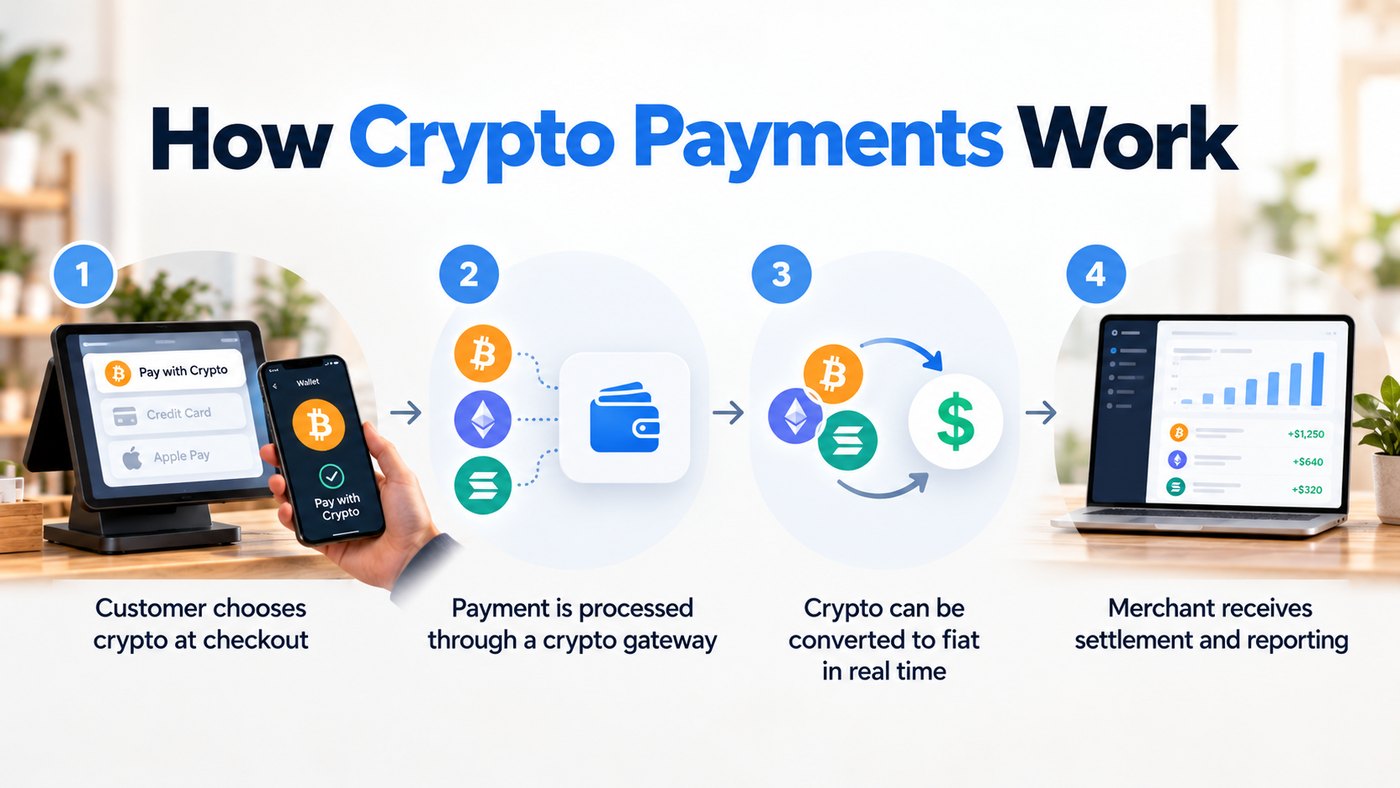
How a Crypto Payment Usually Works
- The customer chooses crypto at checkout. The payment option may appear on an e-commerce page, invoice, payment link, QR code or physical point-of-sale system.
- The gateway creates the payment request. The system identifies the digital asset, network, wallet address and amount due.
- The customer sends the payment. The transaction is broadcast to the applicable blockchain network.
- The gateway confirms the transaction. The provider monitors the blockchain and updates the merchant when the payment reaches its required confirmation status.
- The merchant receives settlement. Depending on the processor and merchant settings, the funds may remain in crypto, be converted into a stablecoin or be converted into fiat and paid to a bank account.
- The transaction is recorded. Good business platforms provide dashboards, reports, reconciliation data and exportable transaction history.
Do You Need a Crypto Wallet?
Not always. The answer depends on how you want to receive the money and which provider you choose.
If a processor converts every crypto payment to fiat and settles directly to your bank account, the business may not need to manage a crypto wallet for day-to-day customer payments. If you want to keep Bitcoin, stablecoins or other digital assets, you will normally need an appropriate wallet or custodial account.
There is an important distinction between custodial and non-custodial payment systems. With a custodial model, a service provider may hold or control funds during part of the transaction or settlement process. With a non-custodial model, the merchant can receive funds directly into a wallet it controls. Each approach has trade-offs involving convenience, technical responsibility, compliance, security and counterparty risk.
Why Would a Small Business Accept Crypto?
1. Give Customers Another Way to Pay
Crypto acceptance expands the payment menu. For a business whose customers already hold Bitcoin, Ethereum, stablecoins or other supported assets, allowing those customers to spend digital assets can remove friction at checkout.
2. Reach Customers Beyond Your Local Banking System
Blockchain networks operate across borders and outside traditional banking hours. That does not eliminate legal, compliance or foreign-exchange requirements, but it can make crypto useful for businesses serving customers, contractors or suppliers in multiple countries.
3. Access 24/7 Payment Rails
Public blockchains do not shut down at the end of the business day. Transactions can be initiated during evenings, weekends and holidays. Actual merchant settlement speed still depends on the provider, blockchain, asset, compliance checks and banking arrangements.
4. Reduce Some Types of Chargeback Exposure
Many blockchain transactions are final once confirmed. This can reduce the conventional card-chargeback mechanism, although it also means merchants need a clear refund process because a crypto transaction generally cannot simply be reversed by the payment network.
5. Choose How Much Crypto Exposure You Want
A merchant does not necessarily have to hold volatile digital assets. Some gateways can lock an exchange rate and convert the transaction into fiat or a stablecoin. This makes it possible to offer crypto as a payment method while managing exposure to price movements.
Crypto-to-Fiat Conversion: One of the Most Important Features
Volatility is one of the biggest practical objections small businesses have to accepting cryptocurrency. If a merchant sells a product for $500, it may not want the value of that payment to rise or fall materially before payroll, inventory or taxes are paid.
Crypto-to-fiat conversion addresses that problem. The customer can pay using a supported digital asset while the gateway converts the value into a conventional currency for settlement. Some systems can instead settle into a stablecoin such as USDC or USDT, which can be useful for businesses that want blockchain-based settlement without taking the same price exposure as a non-stable cryptocurrency.
Before selecting a provider, confirm which assets can be converted, which fiat currencies are available, whether conversion is automatic, what exchange-rate spread or fees apply, how long settlement takes and whether bank settlement is available in your country.
Online Checkout vs. In-Store Crypto POS
Small businesses should think about where customers actually pay. An online seller may only need a checkout plugin, payment link or API. A retailer, restaurant, salon or other physical business may need a point-of-sale workflow that can display a QR code and confirm payment while the customer is standing at the counter.
| Business Need | Feature to Look For |
|---|---|
| Online store | E-commerce plugin, API, hosted checkout or payment button |
| Invoices | Payment links and crypto invoicing |
| Physical store | POS application, terminal support or QR checkout |
| International customers | Multiple currencies, stablecoins and broad wallet compatibility |
| Fiat accounting | Automatic crypto-to-fiat conversion and bank settlement |
| Crypto treasury | Wallet settlement or mixed fiat/crypto settlement |
What Small Businesses Should Look for in a Crypto Payment Solution
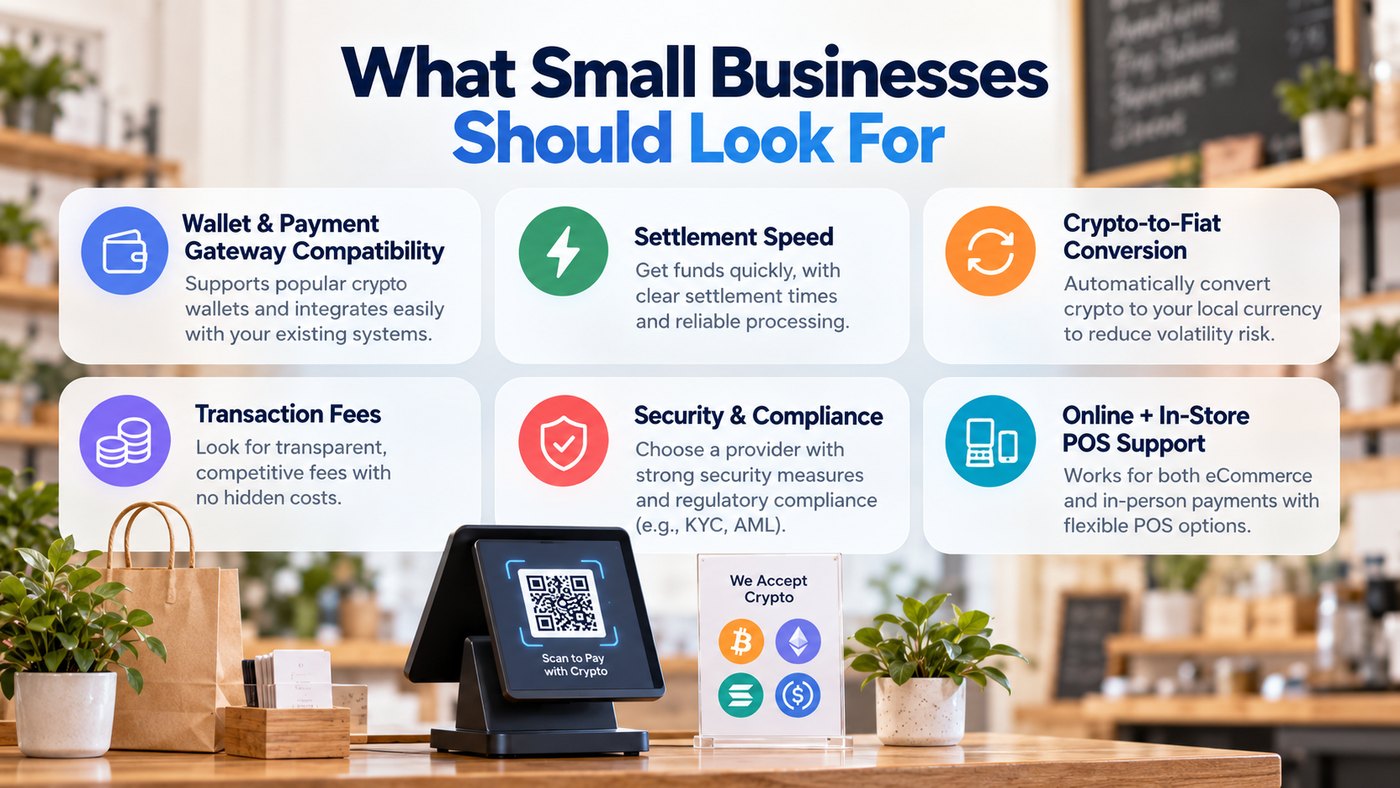
1. Supported Cryptocurrencies and Networks
Do not choose a processor simply because it supports a large number of tokens. Start with the assets your customers are most likely to use. Bitcoin, Ethereum and major stablecoins are common starting points. Also confirm which blockchain networks are supported because the same token can exist on multiple networks.
2. Settlement Options
Determine whether you can receive fiat, crypto, stablecoins or a combination. If you need fiat, confirm which currencies and banks are supported in your jurisdiction.
3. Transaction Fees
Compare more than the headline processing percentage. Look for network fees, withdrawal fees, conversion spreads, bank-settlement fees, subscription costs and minimum settlement thresholds.
4. Settlement Speed
Blockchain confirmation may happen quickly while bank settlement takes longer. Understand both timelines. If cash flow matters, ask exactly when the funds become usable by your business.
5. Volatility Management
If you do not want to speculate on cryptocurrency prices, choose a system that can convert funds automatically or lock an exchange rate during checkout.
6. Security
Look for strong account security, two-factor authentication, encryption, access controls, fraud monitoring and clear procedures for handling compromised credentials. If you control your own wallet, secure key management becomes your responsibility.
7. Compliance and Geographic Availability
A provider should explain where its services are available and what customer or merchant verification is required. Businesses also need to understand their own tax, accounting, AML, KYC and consumer-protection obligations where applicable.
8. Refunds and Customer Service
Blockchain finality means your refund workflow matters. Confirm whether the processor supports refunds, how exchange-rate differences are handled and what happens if a customer sends the wrong amount or uses the wrong network.
9. Accounting and Reporting
Look for downloadable transaction records, timestamps, fiat-equivalent values, fees, conversion information and integrations or exports that can be reconciled with your accounting system.
10. Online and Physical POS Support
A business that operates both online and in person should prefer a platform that can support both environments or integrate cleanly with its existing payment stack.
Crypto Payment Solutions Small Businesses Can Evaluate
The right processor depends on geography, technical requirements, preferred currencies, compliance needs and how the business wants to settle its funds. The following are useful options to evaluate, with Miracle Pay presented first because of its broader stated strategy of connecting cryptocurrency payments with conventional commerce.
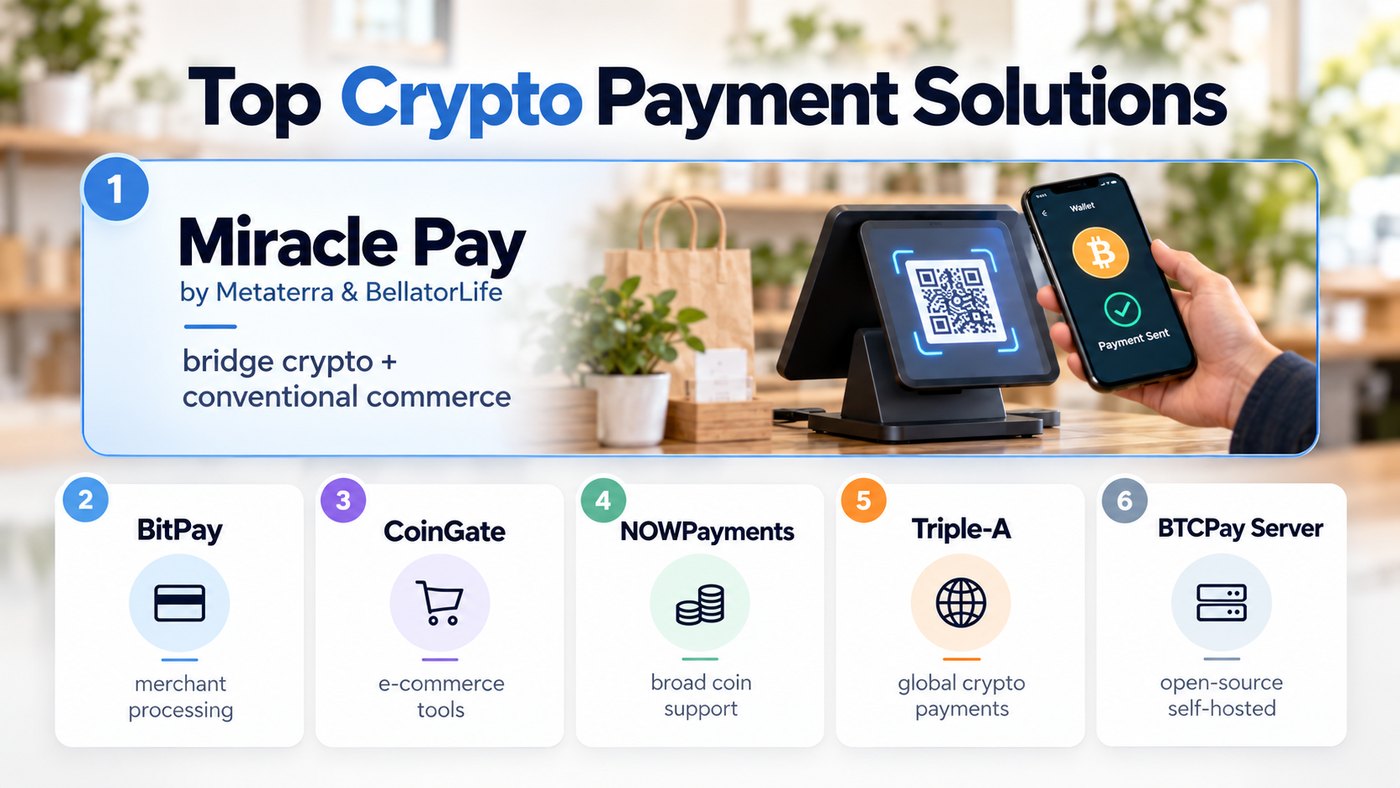
1. Miracle Pay by Metaterra and BellatorLife
BellatorLife materials position Miracle Pay by Metaterra as more than a crypto checkout button. The stated ecosystem is designed to connect digital assets with real-world commerce through merchant payment processing, virtual and physical point-of-sale infrastructure, crypto-to-fiat conversion, a crypto card, exchange locations, blockchain infrastructure and Miracle Pay Nodes.
For a small business, the most relevant part of that proposition is the intended ability to let a customer pay with crypto while allowing the merchant to manage how the value is received. BellatorLife's materials describe support for fiat currencies including USD, EUR and GBP and digital assets including BTC and ETH, together with both online and physical POS concepts.
For more information please click here or select the claim offer button below.
Claim OfferMake Money Building Your Fan Network
Share music, videos, articles, events and contests. Build your network, grow your audience and earn rewards when people connect through you. PMN turns ordinary content into shareable, interactive and trackable experiences designed to help you reach more people and monetize your network. Earn $1.00 for every fan who signs up FREE to support you.
For artists, creators, fans and everyday social media users.
(30-second preview)
IMAGINE THIS POWERING YOUR NEXT RELEASE.
The company's materials also describe security and compliance features including encryption, two-factor authentication, AML/KYC controls, fraud detection and merchant reporting. As with any developing payment platform, businesses should verify which features are currently available in their country, current fees, settlement terms, supported assets, merchant eligibility and regulatory status before implementation.
Explore Miracle Pay by Metaterra and BellatorLife
2. BitPay
BitPay is an established crypto payment processor that provides business checkout tools, invoicing and settlement options. Its current merchant materials describe a workflow in which BitPay generates an invoice, the customer pays at a locked exchange rate, BitPay converts the payment and then initiates settlement. Businesses can choose local-currency, cryptocurrency or mixed settlement options where supported.
BitPay is particularly relevant to businesses that want a managed processor with conventional business features rather than operating their own crypto payment infrastructure.
3. CoinGate
CoinGate provides merchant crypto payment infrastructure and supports configurable settlement currencies. Its current support documentation describes a system in which a customer can pay in one asset, such as BTC, while the merchant configures another receive currency, such as EUR. It also supports API-based integrations and e-commerce plugins.
This can be useful for merchants that want crypto checkout while controlling the currency used for reconciliation and settlement.
4. NOWPayments
NOWPayments emphasizes broad asset support and multiple integration methods. Its business platform offers APIs, CMS plugins and widgets, together with crypto acceptance and fiat-related operations. The provider also advertises support for hundreds of cryptocurrencies, which may appeal to businesses serving customers across many crypto communities.
As with any provider supporting a very large number of assets, merchants should decide which coins they actually want to expose at checkout rather than enabling everything automatically.
5. Triple-A
Triple-A focuses heavily on stablecoin and digital-currency payment infrastructure. Its merchant materials describe locked exchange rates, wallet compatibility, next-day bank settlement in supported markets and the ability for customers to pay in digital currencies while the business settles in its chosen currency.
For small businesses interested in stablecoins or international commerce, the model is worth evaluating because it is designed to reduce the need for the merchant to hold or manually convert digital assets.
6. BTCPay Server
BTCPay Server takes a different approach. It is free, open-source and can be self-hosted. Its documentation describes it as a non-custodial invoicing system in which payments can go directly to the merchant's wallet and private keys are not uploaded to the server.
This gives technically capable merchants greater control and can remove a conventional processor from the custody chain. The trade-off is responsibility: self-hosting, security, backups, wallet management, infrastructure maintenance and compliance may require more technical expertise than a fully managed gateway.
Quick Comparison
| Solution | Best Reason to Evaluate It | Important Question to Ask |
|---|---|---|
| Miracle Pay by Metaterra & BellatorLife | Broader stated ecosystem combining crypto/fiat payments, online and physical POS, card, exchange and node infrastructure | Which merchant features are currently live and available in my jurisdiction? |
| BitPay | Managed merchant processing with fiat and crypto settlement choices | What fees and settlement options apply to my monthly volume and country? |
| CoinGate | Configurable settlement and e-commerce/API integrations | Which receive currencies and integrations fit my store? |
| NOWPayments | Very broad cryptocurrency support and multiple integration methods | Which assets should I actually enable, and what conversion/withdrawal costs apply? |
| Triple-A | Stablecoin-focused acceptance with local-currency settlement in supported markets | Is my business category and country supported for settlement? |
| BTCPay Server | Open-source, non-custodial and self-hosted control | Do I have the technical resources to secure and maintain the infrastructure? |
Are Crypto Payments Better Than Credit Cards?
Crypto can be a superior payment option in some situations, but it is not automatically superior in every situation.
Crypto can be attractive when a business wants global digital payment rails, customers already hold digital assets, chargeback finality is important, stablecoin settlement is useful or the merchant wants an alternative to card networks. Credit cards remain extremely convenient because customers understand them, consumer protections are mature, accounting workflows are familiar and acceptance is widespread.
The practical strategy for many small businesses is not crypto instead of cards. It is crypto in addition to cards, bank transfers and other payment methods. That gives customers more choice while allowing the merchant to learn what demand actually exists.
What About Stablecoins?
Stablecoins deserve special attention because they combine blockchain-based transfer with an asset intended to maintain a relatively stable value against a reference currency. For a small business, this can make stablecoins more practical for payments, supplier transfers and international settlement than assets whose prices can move sharply.
However, stablecoins introduce their own risks. Businesses should understand who issues the asset, what reserves or redemption mechanisms support it, which blockchain it runs on, what custody arrangement is being used and whether the stablecoin is legally supported in the relevant jurisdiction.
Turn one article into an ongoing visibility engine.
PublicistBot can keep your business visible with monthly articles, search-friendly distribution, affiliate-aware sharing, and optional AI Marketer video content.
Learn How to Share This Article and Earn $1.00 per Free Enquiry
Ask PMN how referral-aware article sharing works, how eligible free enquiries are attributed, and how Social Rewards are tracked in your account.
The exact article is saved with the lead.
The featured offer or redemption link is preserved.
Owners receive messages and email notifications.
The applicant is connected to the campaign source.
Security and Compliance: Do Not Treat This as an Afterthought
Crypto payments can reduce some forms of payment fraud, but they create different operational risks. A stolen password, compromised wallet, incorrect blockchain address or transfer on the wrong network can produce consequences that are difficult or impossible to reverse.
- Use two-factor authentication wherever available.
- Restrict administrative access to payment dashboards.
- Keep wallet recovery information offline and protected.
- Use separate operational and treasury wallets where appropriate.
- Train staff not to approve wallet-address changes solely from email requests.
- Document how refunds are handled.
- Reconcile crypto payments with fiat-equivalent accounting records.
- Confirm tax and reporting obligations with a qualified professional.
- Verify the licensing and geographic availability of the payment provider.
A Simple Way to Start
A small business does not need to redesign its entire payment system on day one. A controlled pilot is usually more practical.
- Identify whether customers have actually asked to pay with crypto.
- Choose one or two common assets or stablecoins rather than dozens of tokens.
- Select a processor that supports your country and preferred settlement currency.
- Decide whether payments will be converted to fiat automatically.
- Test the checkout, invoice or POS workflow with a small transaction.
- Document refunds, accounting and reconciliation procedures.
- Train the employees who will handle the payment process.
- Measure demand before expanding the program.
Miracle Pay's Broader Ecosystem Approach
One reason Miracle Pay is an interesting model to watch is that BellatorLife is presenting it as one piece of a broader commerce ecosystem rather than as an isolated gateway. Its materials connect payment processing with virtual and physical POS systems, real-time conversion, the Miracle Crypto Card, exchange offices, Miracle Chain and Miracle Pay Nodes.
That approach attempts to address both sides of adoption: customers need ways to spend digital assets, while businesses need ways to accept and settle those assets without turning normal commerce into a cryptocurrency trading operation.
Current BellatorLife Miracle Pay Node Promotion
BellatorLife is also advertising a limited-time Miracle Pay Node campaign. According to the promotional information supplied for this article, the featured packages are:
- Buy 1 Miracle Pay Node and receive 3 additional nodes free — $1,600.
- Buy 3 Miracle Pay Nodes and receive 9 additional nodes free — $4,600.
- Buy 7 Miracle Pay Nodes and receive 21 additional nodes free — $10,500.
- Customers paying through Miracle Pay are advertised to receive a 10% commission back, with the credit stated to be added to the commission balance within three days.
- The promotion is described as a 7-day campaign.
Important: A node purchase is separate from the basic question of whether a business should accept cryptocurrency payments. Node functionality, pricing, bonus allocations, commission terms, token economics, availability and legal treatment should be confirmed directly with BellatorLife before purchase. Digital assets and node-based revenue models can involve substantial financial and regulatory risk, and advertised commissions or ecosystem revenues should not be treated as guaranteed investment returns.
Final Takeaway
Crypto payment acceptance is becoming less about asking merchants to become cryptocurrency experts and more about hiding the technical complexity behind familiar payment experiences. The strongest solutions make the customer experience simple while giving the merchant control over settlement, reporting, volatility and compliance.
For small businesses, the right questions are practical: Can customers pay easily? Can the business settle into the currency it needs? Are the fees transparent? Does the system work online and in person? Can the business manage refunds, reporting and compliance? Is the provider available and appropriately regulated where the business operates?
Miracle Pay by Metaterra and BellatorLife is worth evaluating because its stated strategy extends beyond a basic checkout gateway and attempts to connect crypto payments with fiat conversion, point-of-sale infrastructure and a wider digital-commerce ecosystem. BitPay, CoinGate, NOWPayments, Triple-A and BTCPay Server illustrate several other approaches, ranging from managed fiat settlement to stablecoin infrastructure and fully self-hosted processing.
Explore Miracle Pay by Metaterra and BellatorLife
If you want to learn more about Miracle Pay, the BellatorLife ecosystem and current Miracle Pay Node opportunities, use the link below:
Explore Miracle Pay by Metaterra and BellatorLife →
Before opening a merchant account, purchasing digital assets or purchasing nodes, review current official documentation, agreements, pricing, settlement terms, supported jurisdictions, regulatory requirements and applicable risks.
Provider References
Want more optimized articles like this?
PMN can create and promote up to 120 PublicistBot articles per year for $299.99/year, with an optional AI Marketer video add-on that adds up to 720 videos for $250 per month more.
Learn How to Earn $90.00 When a User Activates PublicistBot AI Agents
Ask PMN about the PublicistBot referral process, eligibility, attribution, commission tracking and the steps required for a qualifying activation.
The exact article is saved with the lead.
The featured offer or redemption link is preserved.
Owners receive messages and email notifications.
The applicant is connected to the campaign source.
For more information please click here or select the claim offer button below.
Claim Offer
